

A campaign can generate clicks, calls, and polished reports while still failing to produce measurable business results. Effective paid advertising services close that gap by connecting campaign activity to outcomes your business values.
If your ad spend, creative, landing pages, and tracking feel disconnected, comparing proposals gets harder. You need to know what work is included, how success is measured, and whether the campaign is built around a meaningful business outcome.
This guide explains what paid advertising services should cover, from channel strategy and campaign management to creative, conversion paths, and tracking. You’ll learn how these parts work together, what accountable reporting should show, and how to assess whether your measurement can support better decisions.
Barlo Digital manages campaigns across Google Search, Meta, TikTok, Local Services Ads, and Amazon PPC. Related services include creative production, tracking audits and repairs, call and lead tracking, and website design. The right scope depends on your goals and measurement needs. Lead response and appointment setting can also support lead generation, but they are separate services rather than automatic campaign add-ons.
Key Takeaways
- Effective paid advertising services connect campaign planning, creative, tracking, and optimization to a defined business objective.
- Choose channels based on the audience, sales path, and conversion event, not platform popularity alone.
- When reported results are unclear, validate tracking and lead quality before changing campaigns or increasing spend.
- Use a clear scope of work to compare what is managed, measured, and improved over time.
- Start by identifying the business outcome you need and whether your current measurement can verify it.
Paid Advertising Services: What They Solve Beyond Buying Clicks
Buying media is the transaction. Campaign management is the work that determines whether that transaction supports a business objective. Paid advertising services plan, run, measure, and improve campaigns so paid media contributes to a defined business outcome. That is the difference between reporting activity and taking responsibility for what happens after an ad is seen or clicked.
Ad spend goes to the platform. The work behind it includes choosing an objective, shaping the offer, building campaigns, setting up measurement, reviewing results, and making informed adjustments. Online advertising includes many paid formats and placements, but using a platform is not a strategy on its own. Campaign management connects placements to the audience, message, and next step that matter to the business.
Which business problems can paid advertising address?
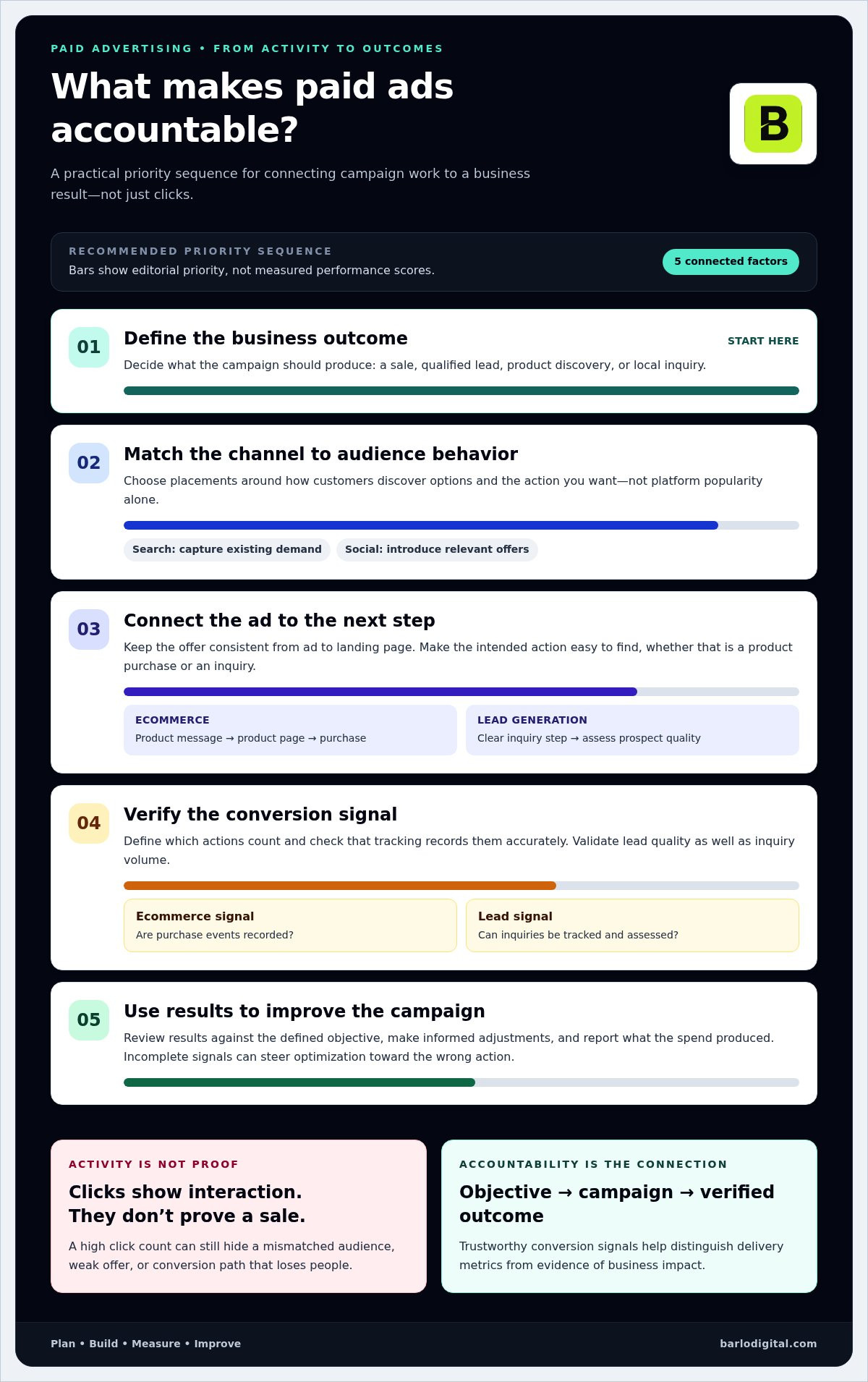
Paid placements can capture existing demand or introduce an offer to relevant audiences who may not be actively searching. A search campaign can reach someone looking for a product or service. A social campaign can present a product to people whose interests or browsing context make the offer relevant. The right approach depends on how customers discover options and what action you want them to take.
That action might be a sale, a qualified lead, product discovery, or a local inquiry. Each objective affects campaign design. An ecommerce campaign needs a clear route from product message to product page and purchase. A lead-generation campaign needs an obvious inquiry step and a way to distinguish a useful prospect from a low-quality submission. A local campaign should make it easy for a potential customer to take the intended next step.
Choose a channel by starting with audience behavior and the conversion objective, then deciding where paid placements can support them. Choosing a channel because it is popular, without defining the action it should produce, creates activity without a clear business case.
Why clicks alone do not prove campaign performance
A click shows that someone interacted with an ad. It doesn’t show whether that person had purchase intent, found the page relevant, completed a form, or bought anything. A high click count can hide a weak offer, a mismatched audience, or a conversion path that loses people before they act.
The landing page should continue the promise made in the ad. If an ad promotes a specific product, sending visitors to a generic page makes them search for it again. If the goal is an inquiry, the page needs a clear next action. Without that connection, ad traffic may arrive without producing a meaningful result.
Performance conclusions also depend on accurate conversion signals. If purchases or qualified inquiries aren’t recorded reliably, campaign reports can’t show what the spend produced. Clicks and impressions describe delivery. Verified conversions help assess business impact. Without trustworthy signals, optimization is guesswork rather than accountability.
What Paid Advertising Services Should Include From Strategy to Measurement
A useful scope explains how the work moves from business objective to campaign decisions, then from campaign data to the next action. Paid advertising services shouldn’t be a vague promise to “manage ads.” They should define what gets planned, built, measured, and reviewed. They should also distinguish the media budget paid to platforms from the management work performed on the campaigns.
The right scope depends on the business model, channel mix, sales cycle, and conversion event. An ecommerce purchase may happen in one session, while a considered service purchase may involve several interactions before a lead becomes a customer. The work should fit that reality rather than force every account into the same checklist.
Planning, campaign setup, and creative execution
Before launch, establish the audience, offer, channel, and intended conversion. Decide what the campaign should produce, such as product sales or qualified inquiries, and map the route from ad to action. The Digital Advertising Alliance (DAA) industry participants page gives context on organizations in the wider advertising ecosystem. For campaign planning, the practical requirement is straightforward: define the audience and objective before selecting tactics.
Setup translates those decisions into campaign structure, targeting, budget allocation, and conversion settings. Creative should follow the same logic. Ad copy and visuals need to make the offer clear and lead to a landing page that supports the promised next step. If an ad promotes a particular product or benefit, the destination should make that offer easy to find.
Barlo Digital produces direct-response creative and user-generated content (UGC) alongside campaign management. These assets can be developed around the campaign’s audience, offer, and destination. They are part of the work to plan and test, not a guarantee of a particular result.
Measurement, optimization, and clear reporting
Measurement starts by defining which actions count as conversions and checking that tracking records them accurately. A campaign change is only as sound as the signal behind it. For ecommerce, check whether purchase events are recorded. For lead generation, check whether inquiries can be tracked and assessed for quality. If the signal is incomplete, reports may create false confidence or steer optimization toward the wrong action.
Good management distinguishes routine adjustments from strategic changes. Refining a campaign based on observed performance is different from changing its audience, offer, or objective. A significant shift should have a stated reason, such as evidence that the current approach is attracting the wrong kind of inquiry. Reporting should connect spend to leads or sales, and to qualified outcomes when reliable data is available.
Before comparing proposals, map the scope against these responsibilities and identify what falls outside it. Media spend and management work are separate parts of the investment, so a report of activity shouldn’t obscure either one. To map campaign responsibilities against your goals and measurement needs, discuss your paid campaign needs with Barlo Digital.
Which Paid Advertising Channels Fit Your Goal and Sales Path?
A channel is a route to an audience, not a business strategy. Choose based on how customers discover options, what the offer asks them to do, and where the conversion can be measured. The platforms used by paid advertising services should fit that path rather than simply fill a media plan.
Search captures expressed intent; paid social introduces offers while people are consuming platform content. That difference affects the message, landing destination, and expectations for how quickly a customer may act.
Search, social, and local campaign roles
Google Search can reach people actively looking for a product or service. Meta and TikTok can put an offer in front of audiences through platform content, where creative needs to earn attention and make the next step clear. Local Services Ads are an option for eligible service businesses seeking local inquiries. A channel’s availability doesn’t make it suitable by itself. The offer, audience, and campaign objective still need to fit.
| Channel | Role and audience context | Suitable objective | Measurement focus |
|---|---|---|---|
| Google Search | Reaches people using relevant search queries | Capture active demand for a product or service | Track conversions tied to relevant queries, such as purchases or qualified inquiries |
| Meta | Reaches audiences through Facebook and Instagram content | Introduce or promote an offer, or support ecommerce sales | Connect ad engagement to tracked site actions and business outcomes |
| TikTok | Places creative within TikTok content and discovery | Build product discovery or direct audiences toward an offer | Measure the intended action beyond views or engagement |
| Local Services Ads | Serves relevant service businesses seeking local customers | Generate service inquiries | Assess inquiry volume and quality against the business’s lead goals |
| Amazon PPC | Promotes products within the Amazon marketplace | Support product visibility and sales on Amazon | Review marketplace purchase activity alongside campaign data |
When ecommerce and marketplace campaigns need different setups
Google and Meta can each play a role in an ecommerce media mix, but neither replaces the need to define where the purchase happens and how it will be recorded. Product feeds organize product information for campaigns; purchase events help connect advertising activity to orders. Tracking should reflect the actual checkout path, or reported results may be incomplete.
Amazon PPC has a different context because the customer shops within the marketplace. Don’t assume its reporting maps neatly to a brand’s own website analytics. Marketplace activity and site activity may need separate interpretation. Compare channels against the same business objective while accounting for where the transaction happens and which purchase signals are available.
Before adding another platform, identify the audience it can reach, the distinct role it will play, and the conversion signal that will show whether it contributes. If those answers are missing, expanding the channel mix adds complexity before it adds clarity.
How to Judge Paid Advertising Services When Results Are Unclear
When campaign numbers conflict, don’t increase spend or replace the strategy on instinct. More budget cannot repair missing or unreliable conversion data. Diagnose the measurement first, then determine whether the issue sits in the campaign, the offer, or the path to purchase.
Use this sequence to distinguish a tracking failure from weak campaign performance:
- Validate the conversion event. Confirm that the intended action, such as a completed purchase, is recorded consistently along the customer journey. Look for missing events, duplicate records, or a checkout step that prevents the conversion from being captured.
- Compare platform data with business records. Review platform-reported conversions alongside relevant order, website, or lead records. Counts may differ because platforms use their own attribution methods. Treat the gap as something to investigate, not automatic proof that either report is fully accurate.
- Inspect conversion quality. For ecommerce, compare reported purchases with actual orders and their status. For lead generation, check whether inquiries are relevant and meet the business’s definition of a qualified lead. A form submission alone doesn’t establish value.
- Review campaign inputs before changing direction. Assess whether the audience, offer, creative, and landing page align. Then make a focused adjustment and document what changed, why it changed, and which measurable signal should respond.
Changing several inputs at once makes the cause of a result harder to identify. If performance shifts, you won’t know which change mattered. Adjust in a way that preserves a clear link between the evidence, the decision, and the outcome you’re monitoring.
What useful oversight and reporting should make visible
Useful reporting connects spend to conversions and, where reliable data exists, qualified leads or sales. It should also state what the numbers can’t establish, such as a tracking gap or a difference between platform attribution and recorded orders. Without those limits, a polished dashboard can make uncertain data look conclusive.
Campaign decisions and follow-through need a clear owner. Someone has to interpret the evidence, approve changes, and check whether the expected signal moved. Paid advertising services are easier to evaluate when reports show not only what happened, but what action follows and who is responsible.
If tracking gaps or conflicting reports are clouding your decisions, request a paid campaign measurement review to identify what needs validation before further optimization.
How Barlo Digital Connects Paid Advertising to the Next Business Action
Campaigns should be judged by the business action they’re built to support, not by platform activity alone. Barlo Digital connects paid campaign management with the measurement and conversion-path work needed to understand what happens after an ad interaction. The scope starts with your objective and the signals available to assess progress. This helps identify the next operational step instead of adding tactics without a clear purpose.
Start with the campaign and measurement reality
Begin by defining the result the campaign should produce and how that result is recorded. For an ecommerce business, the measurement question may be whether product and purchase activity is tracked accurately. Barlo Digital provides ecommerce tracking and measurement audits, along with Measurement Rescue tracking fixes, to address gaps that can undermine campaign decisions.
For businesses that convert through calls or inquiries, the path doesn’t end at a form submission or phone ring. Barlo Digital provides call and lead tracking to connect those responses to campaign activity and give you a clearer view of which inquiries progress. Your business records still matter: conversion data is more useful when compared with actual sales or lead outcomes.
Build the service scope around the conversion path
Barlo Digital manages campaigns across Google Search, Meta, TikTok, Local Services Ads, and Amazon PPC. That doesn’t mean every channel belongs in every engagement. The right mix depends on the audience, offer, sales path, and conversion event. A focused plan should state which role each channel serves and what signal will be used to assess it.
Creative and destination pages are part of that path. Barlo Digital provides direct-response creative, UGC, and website design to support how an offer is presented and where a visitor lands after seeing or clicking an ad. The ad’s promise, landing page, and next action need to align. Otherwise, campaign delivery and customer experience pull in different directions.
Lead-generation businesses may also need to consider what happens after an inquiry arrives. Barlo Digital provides AI lead response and targeted appointment setting for relevant business needs. These services can support campaigns where timely follow-up or booked appointments matter, but they are not automatic components of every paid media engagement. Define their role around the lead process and desired next action.
A practical engagement should leave you with a defined campaign objective, an understanding of measurement readiness, and a clear view of the work in scope. If the tracking foundation needs attention, address that before treating platform-reported performance as the full picture. If measurement is sound, use the available evidence to guide campaign and conversion-path decisions.
Bring your campaign goals, current tracking concerns, and the action you need customers to take. Discuss your paid advertising needs with Barlo Digital to identify the next operational step.
Make the Next Campaign Decision With Clearer Evidence
The next step isn’t necessarily another campaign or a larger budget. Decide what business action matters, who owns that outcome, and whether the evidence is strong enough to guide the decision. That discipline turns paid advertising services from a stream of platform activity into a tool for making better commercial choices.
Barlo Digital is founder-led, with director-level delivery emphasized on its website. The focus is on clarifying the campaign’s purpose and measurement basis, then identifying the work that fits your business rather than applying a fixed set of tactics.
You don’t need every answer before taking action. A defined goal and an honest view of what your current data can show are a practical starting point. Discuss your paid advertising needs and identify a clear next step for your campaigns.
With the right questions in view, you can move forward with greater clarity and control.
Frequently Asked Questions
What do paid advertising services include?
Paid advertising services typically cover campaign planning, account and campaign setup, ad creative, measurement, reporting, and ongoing management. The scope depends on the business and its goals. An online store may need product-level purchase tracking, while a service business may need phone inquiry tracking. Check whether the proposed work names the deliverables, who handles them, and how results will be assessed.
How much do paid advertising services cost?
There’s no single standard price. The total investment generally depends on management scope, channels involved, creative and tracking work required, and the media budget paid to advertising platforms. These are distinct parts of the spend, so a proposal should explain each separately. To compare scopes fairly, note what work is included, what is billed as a separate project, and how campaign changes are handled.
Can paid advertising services guarantee leads or sales?
No responsible campaign manager can guarantee a specific number of leads or sales, because results depend on factors beyond campaign execution, including demand, competition, offer strength, and the customer’s buying decision. A sound engagement can define objectives, tracking, decision processes, and reporting. Evaluate whether those responsibilities are clear rather than relying on promises of a fixed outcome that may not be within anyone’s control.
How long does it take for paid advertising services to show results?
There’s no reliable universal timeline. Early delivery data may show whether ads are reaching the intended audience, but meaningful business outcomes can take longer to assess, especially with a longer sales cycle or infrequent purchases. Agree on what will be reviewed at each stage. For example, separate initial checks for ad delivery and tracking from later evaluation of completed orders or sales-qualified inquiries.
What happens if ad platforms report different conversion numbers?
Different counts don’t automatically mean one platform is broken. Platforms can credit conversions according to different attribution rules, while website analytics and sales records may count activity differently. Compare conversion definitions, attribution settings, and reporting periods before drawing conclusions. Then reconcile platform figures with the closest available business record, such as completed orders. Document any remaining discrepancy so it isn’t mistaken for verified revenue.
Are paid advertising services suitable for small businesses?
They can suit a small business if the campaign objective, available budget, and operational capacity make sense together. A business with limited resources may be better served by focusing on one clear offer and a manageable campaign scope than spreading effort across multiple platforms. Consider whether the business can handle the resulting inquiries or orders and track them well enough to judge the investment.
What should I do if paid ads get clicks but few qualified leads?
First, compare the ad’s promise with the landing page and the questions used to capture an inquiry. A broad message or loose targeting may attract people who aren’t a fit; a confusing form can also screen out good prospects. Review actual lead records, not just platform totals. Then adjust one likely cause at a time and check whether lead relevance changes, rather than optimizing only for more clicks.