

Common Meta ads mistakes that hurt performance often start before an ad goes live: choosing an objective that doesn’t match the business goal, splitting audiences poorly, using unfocused creative, changing campaigns before enough conversion data accumulates, or relying on faulty Pixel tracking. Each mistake can send Meta the wrong signals and make results harder to measure.
It’s easy to blame weak performance on the audience or creative, but a campaign can look active while its setup quietly undermines results. This article explains how objectives, audience segments, creative, conversion volume, and Pixel tracking affect delivery, and what to examine when diagnosing wasted spend. These elements need to work together: the objective tells Meta what to optimize for, audience and creative influence who responds, conversion volume informs delivery, and accurate tracking shows whether the campaign is producing the outcome that matters. The focus is on understanding the problem, not applying quick fixes that hide it.
Key Takeaways
- Match the campaign objective to the business outcome, so Meta optimizes for the action that matters.
- Separate prospecting, engaged audiences, and existing customers to reduce wasted overlap and improve relevance.
- Use varied creative and monitor performance signals to spot when an ad needs a refresh.
- Give campaigns enough conversion data before making changes, rather than reacting to early fluctuations.
- Make Pixel tracking accurate so reported conversions can guide decisions with confidence.
How a professional chooses campaign objectives that match business goals
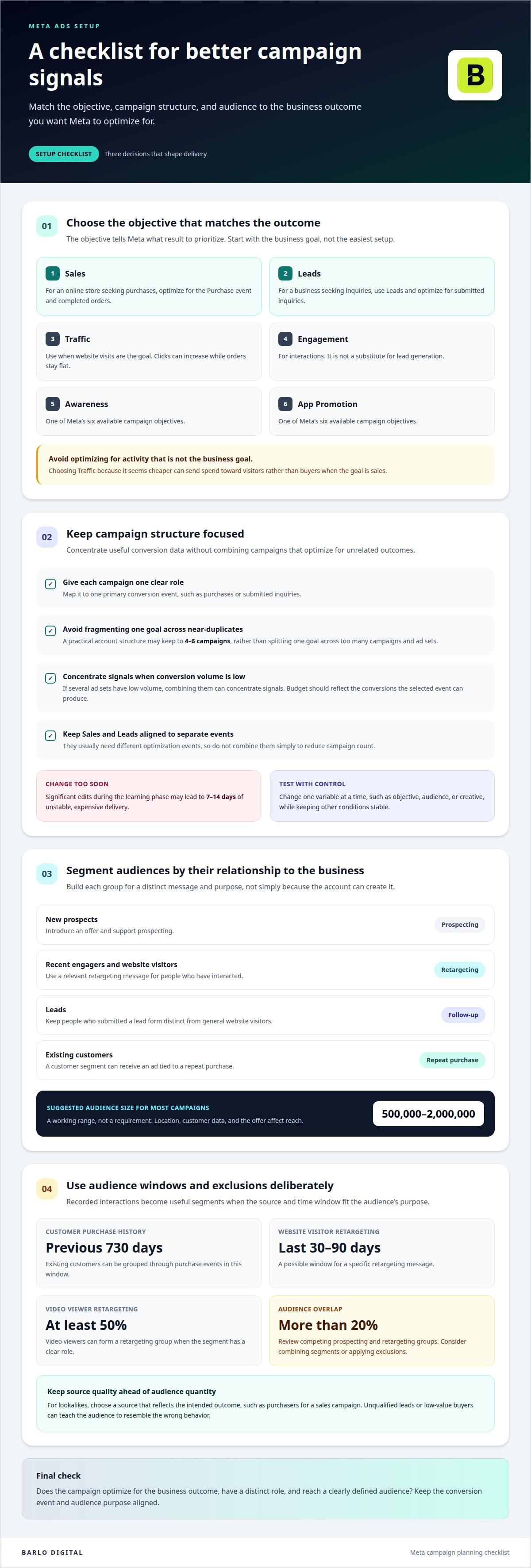
Meta Ads offers six campaign objectives: Awareness, Traffic, Engagement, Leads, App Promotion, and Sales. The objective tells the platform which outcome to prioritize, so start with the business goal, not the easiest setup. For an online store seeking purchases, Sales with the Purchase event aligns delivery with completed orders. A campaign built for website visits instead trains Meta to find people likely to click. Clicks can rise while orders stay flat. For a business seeking inquiries, Leads is the direct match. Engagement is for interactions, not a substitute for lead generation.
That distinction points to one of the common Meta ads mistakes: optimizing for activity that looks useful but does not meet the business goal. Map each campaign to one primary conversion event before setting its budget. For example, an ecommerce campaign can optimize for purchases, while a lead campaign can optimize for submitted inquiries. The event must reflect the result the business values. If the goal is sales, choosing Traffic because it seems cheaper can direct spend toward visitors rather than buyers.
Campaign structure matters next. Splitting a limited budget across too many campaigns and ad sets leaves each unit with less data. A professional reviews overlapping purposes, then consolidates campaigns around distinct goals and conversion events. A practical structure may keep an account to 4-6 campaigns, rather than fragmenting one goal across near-duplicates. Each campaign should have a clear role, such as prospecting for purchases or generating leads. Consolidation does not mean combining unrelated outcomes. Sales and leads usually require different optimization events, so they should not share a campaign simply to reduce the campaign count.
Budget follows the event and the volume it can produce. A professional estimates whether the planned spend can generate enough of the selected conversion for Meta to learn. If an account has several low-volume ad sets, combining them can concentrate signals. Major edits during the learning phase can disrupt delivery; significant changes may lead to 7-14 days of unstable, expensive delivery. That is why professionals avoid repeatedly changing budgets, audiences, and objectives in response to brief fluctuations.
Testing needs control, too. Change one variable at a time, such as the objective, audience, or creative, while keeping other conditions stable. If the objective and audience change together, you can’t tell which adjustment affected performance. Campaign consolidation and disciplined testing help preserve useful data. Compare the selected conversion event with business outcomes, then adjust the structure if the campaign goal and Meta’s optimization signal no longer match.
How a professional defines engaged audiences and customer segments
Target audiences based on their relationship with the business, not a pile of unrelated interests. Separate new prospects, recent engagers, leads, and existing customers because each group needs a different message. For example, a prospecting campaign can introduce an offer, while an existing-customer segment can receive an ad tied to a repeat purchase. The campaign objective still matters: segments should support the outcome being measured, not exist simply because the account can create them.
Custom audiences turn recorded interactions into practical segments. A professional might group website visitors separately from people who submitted a lead form. Existing customers can be grouped through purchase events from the previous 730 days. Those windows serve different purposes: recent leads may need follow-up, while older customers may be relevant for repeat purchases. The professional excludes groups that shouldn’t receive a specific prospecting message, instead of letting audience lists overlap without a clear reason.
Overly narrow targeting can restrict delivery before Meta has enough room to find likely responders. For most campaigns, a suggested audience size is 500,000 to 2,000,000 people. That is a working range, not a requirement for every business: location, available customer data, and the offer all affect reach. A professional avoids stacking narrow interests and demographic filters without evidence that they improve qualified results. Meta uses many targeting inputs as suggestions, so removing useful flexibility can constrain delivery without improving lead or purchase quality.
Lookalike audiences can use customer data to reach people who resemble a source group. Choose a source that reflects the intended outcome, such as purchasers for a sales campaign, rather than combining every interaction into one list. If the source includes unqualified leads or low-value buyers, the resulting audience may mirror the wrong behavior. You can also segment a customer list by purchase history before building a lookalike. Input quality matters more than the number of audience versions or ad images.
Overlap is another source of wasted impressions. A professional reviews whether prospecting and retargeting audiences compete for the same people, then combines segments or applies exclusions when overlap exceeds 20%. Retargeting may use website visitors from the last 30 to 90 days or video viewers who watched at least 50%. These groups should have a specific message and role. When Pixel events and audience membership disagree, measurement problems can distort segmentation; accurate Meta and Shopify tracking helps keep those decisions grounded in recorded behavior.
3. Flexible ad copy and creative combinations
One polished image cannot diagnose every audience response. A professional builds creative variations around distinct concepts, then tests them without changing several elements at once. Meta ads can include up to 10 initial images and videos, five primary text blocks, and five headlines. Those options let delivery combine messages and assets, but more combinations do not automatically mean better advertising. Each asset still needs a clear role, such as showing the product, explaining its value, or addressing an objection.
Format must fit placement. A professional prepares 4:5 creative for Feed, 9:16 for Reels and Stories, and 1:1 for Right Column placements. Cropping one image into every shape can cut off product details, captions, or calls to action. Separate versions preserve the focal point in each placement. For example, a vertical video can keep the subject centered in Reels, while a square image gives Right Column space for a compact product view.
Mobile video needs the message early. Short-form videos should stay under 15 seconds, with the main hook in the first one to two seconds. A professional makes the opening frame understandable without a long setup, then uses on-screen text because 85% of Facebook video is watched without sound. Captions should remain readable on a phone, and the key benefit should appear before viewers scroll away. Videos can demonstrate use, answer a specific objection, or show a product detail that static images cannot communicate as clearly.
Creative fatigue appears when the same ad keeps serving but response weakens. A professional watches frequency alongside click-through rate and cost per acquisition, then introduces new concepts when performance deteriorates. A 30% CTR decline over two weeks, paired with rising acquisition costs, can signal fatigue. Another trigger is a CTR drop of more than 15% from its peak. Creative can be refreshed every 7-14 days or when these signals appear. The decision should come from performance, not an arbitrary calendar alone.
Keep creative tests comparable by changing one variable at a time, such as the opening hook, image, headline, or format. If a new video also changes the offer and headline, the results won’t show which change affected performance. Build ad variations around a clear hypothesis, such as whether a product demonstration performs better than a customer-problem scenario. For entrepreneurs seeking specialized guidance on developing high-performing promotional creative, resources like AI Asset Man emphasize systematic testing to turn digital assets into consistent revenue drivers. Keep the strongest variation and use the evidence to shape the next test. This makes creative production a controlled process, not a stream of unrelated images and videos.
4. Learning-phase conversion volume
The Meta Ads learning phase is when an ad set gathers delivery data to find people likely to complete its selected conversion event. Delivery can remain unstable during this period. Frequent edits to the budget, targeting, or conversion event can disrupt the process and make results harder to interpret. Keep the setup consistent long enough to gather useful evidence instead of reacting to every early fluctuation.
Conversion volume is central. An ad set that generates 50 conversions in a week may reach more stable, predictable delivery. That benchmark is not a promise of performance; it describes a useful signal volume for evaluation. If an account produces only a small number of leads or purchases, splitting the same audience and budget across several ad sets can further thin the data. A professional reviews conversion volume at the ad-set level and consolidates where separate groups do not justify separate learning.
Budget must be assessed against the expected cost of the chosen event. For example, a $20 cost per lead implies at least $140 per week for an ad set in the stated budget example. If planned spend cannot support the event volume, a professional may need to reconsider the structure, budget, or optimization event. Switching to clicks simply to create more activity can misalign delivery with the business result. Clicks measure visits, not completed conversions.
Timing matters too. A professional generally avoids judging a campaign after its first 24 hours. One recommendation is to wait at least three to five days or until 50 optimization events before changing a campaign. A separate testing guideline calls for running a test for at least 7 days or until it reaches 100+ conversions, whichever comes first. These are different decision thresholds, not interchangeable guarantees. The campaign manager should define the evaluation window before launch.
Large changes can reset the evidence. Significant edits during learning may produce 7-14 days of unstable, expensive delivery. A professional therefore avoids changing budget, audience, placements, and conversion event together. If results look weak, the manager first identifies whether the problem is low conversion volume, a tracking issue, or a genuine performance decline. Changing one element preserves a clearer comparison than rewriting the entire setup.
Give the campaign a stable operating window. Hold the planned budget steady as conversion data accumulates, then compare results with the selected event and business outcome. Doubling the budget overnight, changing placements, and replacing the conversion event would create several competing explanations for a shift. Record each change, when it was made, and the resulting conversion volume. This helps prevent early noise from triggering repeated edits that keep the ad set from building consistent delivery evidence.
5. Setting up Meta Pixel conversion tracking
Meta Pixel tracking is useful only when it records the actions that matter. Map the customer journey before installation: a visitor views a landing page, submits a lead form, or completes a purchase. Each event must correspond to a real action. If the Purchase event fires on a page view, Meta may optimize for visits while reporting false sales. Marketing decisions then rely on corrupted data.
Ad rejection is a separate policy issue. Meta can reject ads or restrict delivery when the ad content or its destination violates Meta’s Advertising Standards, including rules on prohibited products or misleading claims. Both the ad and landing page matter, so a compliant image cannot make up for a destination that breaks the rules.
For tracking, first identify where the Pixel should load and which events the site needs. On an ecommerce site, that often means separating product views, add-to-cart actions, and completed purchases. For a lead-generation page, the key event may be a successful form submission rather than a button click. The distinction matters: a click shows intent, while a completed form confirms the next step occurred.
Next, test the full path. A test purchase should produce one Purchase event after checkout, not duplicate events from the confirmation page and a repeated page load. A test lead should register only after a valid submission. Check event names, firing conditions, and event values where used. This catches inflated conversions before they distort reported performance or tell Meta to optimize for the wrong behavior.
Reported results also need context. Meta’s attribution breakdown can separate conversions attributed to a 1-day click, a 7-day click, and a 1-day view. A professional compares those windows with the business’s own order or lead records. A view-through conversion means an impression preceded a conversion within one day; it does not prove the ad caused the sale. The distinction prevents marketing reports from treating every attributed result as equally persuasive.
Finally, the professional checks whether the landing page and event flow remain consistent after site changes. A checkout redesign, new form, or changed confirmation page can interrupt tracking without changing the ad itself. Accurate event data gives Meta a stronger basis to optimize and gives the business a more reliable view of spending. For an integrated review of campaign execution and measurement, explore ecommerce ad management.
Barlo Digital
Barlo Digital helps businesses identify where Meta campaign structure, audience decisions, creative, or tracking are undermining performance. For broader campaign management, our ecommerce ad management covers Meta alongside Google and TikTok. When reported conversions don’t match business records, our ecommerce tracking and measurement audit can investigate the gap. Local businesses can also use our local ad management across Google Search, Local Services Ads, and Meta.
Our director-led team keeps account work at senior level, without an account-manager layer or handoff to junior staff. That matters when campaign decisions depend on connecting ad delivery to accurate conversion data. For a closer review of an ecommerce ad account, an ecommerce ads audit can help identify issues.
Make the next decision from cleaner evidence
Don’t treat every weak campaign as a reason to rebuild the account. Start by deciding which business outcome matters, then assess whether the campaign structure and measurement can show progress toward it. This helps distinguish a fixable setup problem from an offer or landing-page issue, and prevents common Meta ads mistakes from becoming a cycle of reactive changes.
Barlo Digital manages ecommerce advertising across Meta, Google, and TikTok, and offers ecommerce tracking and measurement audits when reported results need closer examination. For local businesses, our services also include local SEO and AI search. The right next step depends on what the evidence shows, not on adding another tactic by default.
If you want a senior-level review of your Meta advertising and the measurement behind it, contact Barlo Digital to improve your Meta ads. Start with the specific performance question your account needs to answer, and move forward from there.
Frequently Asked Questions
What campaign setup errors kill Meta ads performance?
A disconnect between the ad, destination, and sales process can undermine an otherwise sound setup. For example, an ad may promise a product bundle while the landing page shows a different offer, creating friction after the click. Check that the promoted offer, landing-page content, and checkout or inquiry path align. Account access matters, too: the team needs the right permissions to manage the assets connected to the campaigns.
What targeting and audience mistakes waste the most budget?
A common mistake is treating engagement as proof of buying intent. Someone who watches a video or reacts to a post may not be a qualified buyer. Evaluate audience quality against downstream outcomes, such as qualified inquiries or completed orders, rather than judging success by reactions alone. For lead campaigns, feedback from the sales team can reveal whether respondents fit the business’s customer profile.
How much Meta ad budget do D2C brands waste?
There’s no dependable amount that applies to every D2C brand. The waste depends on the account’s own economics, including product margins, fulfillment costs, return rates, and the quality of attributed orders. A professional separates spend that produces unprofitable sales from spend that produces no meaningful result. That distinction gives the business a more useful measure than applying a generic waste estimate to its monthly budget.
What are the biggest Meta ads mistakes beginners make?
Beginners can lose control of an account before assessing campaign performance. Unclear ownership or access to Meta business assets, for example, can delay changes or leave critical assets disconnected. Check that the business retains appropriate ownership and that campaign, page, and tracking permissions are assigned correctly. This administrative foundation helps prevent avoidable interruptions when adjustments are needed.
The impact depends on how much spend is affected, how long the issue persists, and whether campaigns still produce profitable sales. Assess the account by separating spend tied to verified business outcomes from spend with no defensible result. An account-level review is more useful than applying a generic loss estimate to the monthly budget.
What tracking and optimization mistakes cost the most money?
Reported revenue can mislead when purchase values in the ad platform don’t match the business’s order records. For example, canceled or refunded orders may remain in a platform report even though the business evaluates net sales. Define which revenue measure the business uses, then reconcile campaign reporting against it. This keeps budget decisions from relying on sales totals that overstate the revenue the business retains.
Which attribution window should a professional use for Meta ads?
A practical starting recommendation is 7-day click plus 1-day view. The key is to keep the selected window consistent when comparing campaign periods, so a reporting-setting change doesn’t look like a performance shift. A professional also interprets attributed conversions alongside the business’s own order records. The window helps organize reporting, but it doesn’t establish that every attributed purchase would not have happened without the ad.
Which creative and budget errors destroy campaign performance?
Creative can lose relevance when an ad promotes an offer that has changed or no longer matches the product page. Check that the advertised price, bundle, and call to action stay consistent throughout the buyer’s journey. Budget decisions can also go wrong when spending continues without regard to business capacity, such as limited inventory or an inability to handle incoming demand. Ads should support an offer the business can fulfill.

Article by
Carlos Benavides
Carlos Benavides founded Barlo Digital and is its Director of Paid Media and Performance. He has fifteen years in direct-response marketing, more than $50M in lifetime ad spend, and a B.S. in Computer Science, which is why tracking at Barlo Digital is built by hand. Barlo Digital is a director-led paid media and search agency serving US ecommerce brands, home-service companies and practices.


