

A campaign can keep spending even as its ability to generate purchases quietly declines. If you’re asking why your TikTok ads stopped converting, the cause may be less obvious than a weak video. The landing page, campaign objective, conversion volume, budget, or creative can each disrupt the path to purchase.
That drop is frustrating, especially when ads still attract views or clicks. Attention isn’t the same as buyer intent, and spending more won’t fix a mismatch between the ad, the offer, and what happens after someone taps.
This article explains what to inspect across the customer journey. You’ll learn how the landing-page hook affects post-click behavior, why purchase optimization depends on conversion activity, how budget interacts with that activity, and when creative fatigue may be hurting results.
The goal is to find the failure point before treating every dip as a reason to replace the campaign. A clear diagnosis distinguishes an ad that needs a new angle from a funnel or measurement problem that needs a different fix.
Key Takeaways
- Make the landing page carry the ad’s promise through to a clear offer and next step.
- Optimize for purchases, then assess what happens after the click instead of judging attention alone.
- Interpret conversion volume alongside budget before deciding whether campaign delivery has enough purchase data.
- Use declining click-through performance as a signal to test fresh creative angles, not just minor edits.
- Separate a genuine drop in sales from a reporting gap by examining attribution settings and tracking.
1. Making the landing-page hook visible above the fold
A TikTok click is only the start of the conversion path. The first screen should explain the offer, why it matters, and what to do next. Review the page on a phone, where TikTok visitors will see it. If they have to scroll to understand the product, the page is burying its strongest selling point.
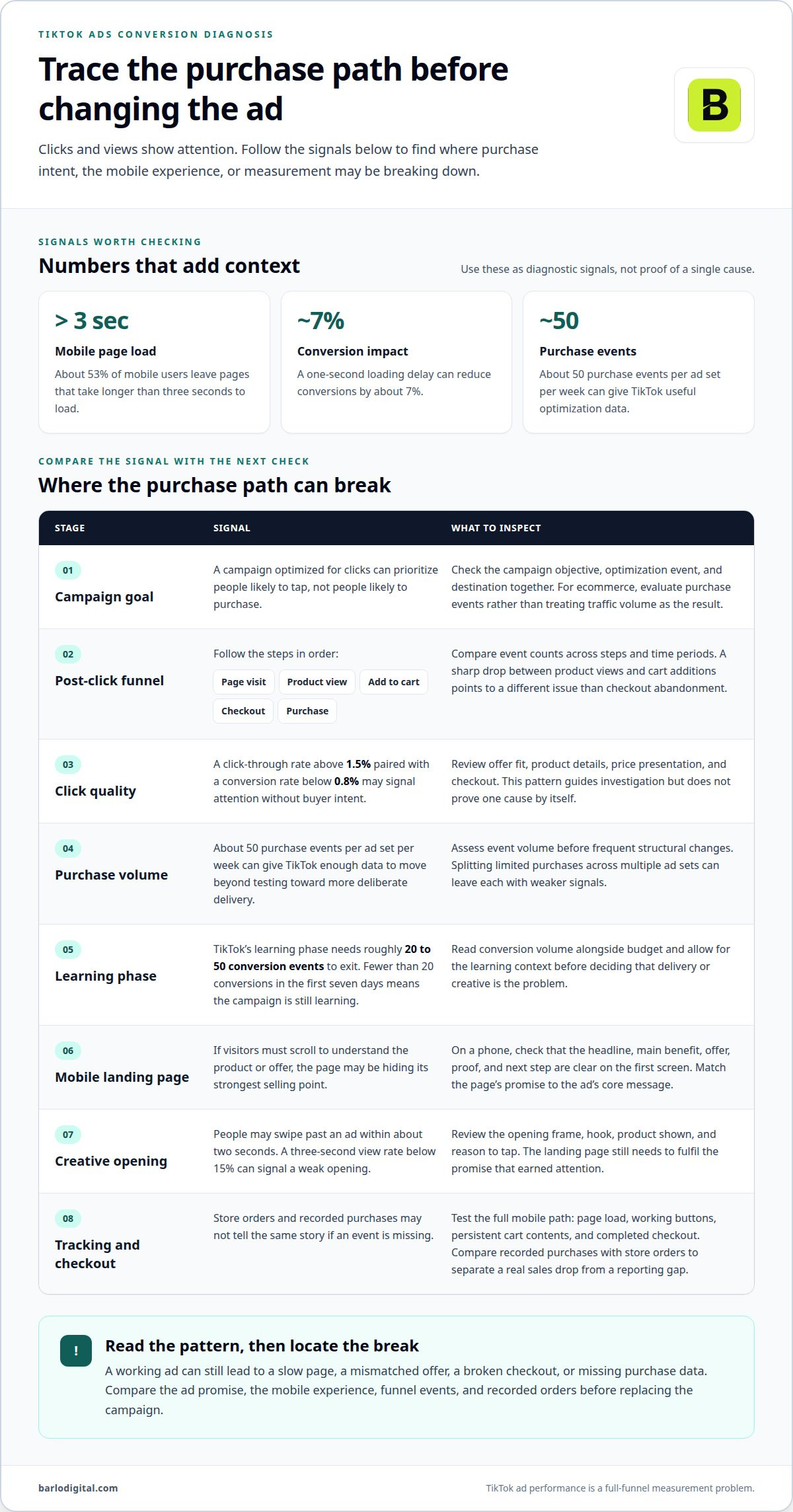
Page speed can waste that click before the offer appears. A mobile page taking more than three seconds to load can lose visitors before rendering. About 53% of mobile users leave pages that take longer than three seconds. A one-second loading delay can reduce conversions by about 7%. A professional tests the mobile page, identifies slow-loading elements, and prioritizes the offer, headline, and call to action.
Next, check message match. The landing page should carry the ad’s core message, angle, and promise into the post-click experience. If an ad says a skincare product simplifies a morning routine, the landing page should explain that benefit right away. A headline about unrelated product features creates a disconnect, and visitors may leave when the page doesn’t match what the ad led them to expect.
Cold traffic needs clarity before detail. Put the main benefit near the top, supported by two to three clear benefit bullets. For example, a reusable water bottle page might lead with easier daily hydration, then explain the practical benefits. Visitors should see the offer and next step without working through a long introduction. Product specifications and brand history can appear lower on the page.
Place proof close to the claim it supports. Customer testimonials, product screenshots, client logos, or a clear explanation of the process can appear near the first screen. Choose proof that fits the offer. For a subscription box, a concise customer quote can explain what arrives and why it matters. Make the next action unmistakable too, such as choosing a product or proceeding to checkout.
The review must include the actual mobile experience, not just a desktop preview. A professional checks whether the headline wraps cleanly, the primary button remains visible, and page elements shift while loading. TikTok users may swipe past an ad within about two seconds if its opening fails to capture attention. A video’s three-second view rate below 15% can signal a weak opening, but the page still needs to fulfil the ad’s promise.
The distinction matters: the ad earns attention, and the landing page must turn it into action. Compare the ad’s opening claim with the landing-page headline and first-screen offer. When all three agree, visitors can understand the offer quickly and act. When they conflict, more clicks may only expose the mismatch—a fundamental dynamic that marketing system frameworks, such as those detailed at growthlocal.com.au, prioritize when configuring landing pages for paid traffic.
2. Optimizing campaigns for purchases instead of clicks
Clicks show that an ad earned attention, not that buyers arrived. Check the campaign objective, optimization event, and destination together. If a campaign optimizes for clicks, TikTok can prioritize people likely to tap, rather than people likely to purchase. The setting should match the business goal. For ecommerce, evaluate purchase events instead of treating traffic volume as the result.
The post-click journey shows where intent disappears. Map each step: landing-page visit, product view, add to cart, checkout start, and completed purchase. Compare event counts across steps and time periods. A sharp drop between product views and cart additions points to a different problem than checkout abandonment. This pattern narrows the investigation and helps avoid misdiagnosing a weak checkout as an ineffective video.
Campaign signals also need context. A click-through rate above 1.5% combined with a conversion rate below 0.8% may indicate attention without buyer intent. That pattern directs attention toward offer fit, product detail, price presentation, or the checkout path. It does not prove one cause by itself. A professional compares the ad promise with the page and then identifies the stage where visitors stop progressing.
Purchase optimization depends on usable event data. About 50 purchase events per ad set per week can give TikTok’s algorithm enough data to move beyond testing toward more deliberate delivery. A professional assesses event volume before making frequent structural changes. Splitting limited purchases across multiple ad sets can leave each with weaker signals. The campaign structure should concentrate the data around the purchase goal where practical.
Views without clicks signal a different break. Review the opening frame, spoken or written hook, product shown, and call to action. If viewers watch but don’t tap, the message may entertain without giving them a reason to visit. Compare engagement by creative and audience, too. One video with views but no visits calls for a different response than several ads with similar results.
For landing-page, checkout, or website issues, test the full mobile purchase path and inspect event records. Check whether the intended page loads, buttons work, cart contents persist, and checkout completes. Then compare recorded purchases with store orders. A missing purchase event can make a working checkout look like a campaign failure. If checkout is genuinely losing customers, fix the broken step rather than changing the bidding objective.
Reliable measurement is the dividing line between a real conversion problem and a reporting gap. When event setup obscures that distinction, ecommerce tracking and measurement can help identify where purchase data fails.
3. Conversion volume and campaign budget
A budget can buy activity without producing enough purchase data. TikTok’s learning phase needs roughly 20 to 50 conversion events to exit. A campaign with fewer than 20 conversions in its first seven days is still learning. That does not automatically mean the offer is failing. It means the performance signal may not yet support a firm conclusion.
Daily spend of $10 to $20 rarely reaches the purchase-event volume described as helpful for learning. A professional compares the budget with the account’s actual purchase rate and costs. If spend produces only occasional orders, the campaign may collect too little feedback. Raising the budget without checking the funnel can simply increase the cost of the same problem.
Budget changes also affect how results should be interpreted. A sharp increase can alter delivery and make comparisons with the previous period less useful. Record each change, then review purchases, cost per purchase, and event volume together. Bid strategy matters too: a bid limit can restrict delivery if it prevents competitive participation. Distinguish a delivery constraint from weak buyer response.
TikTok’s ad review and delivery eligibility can limit which ads run. Check campaign status and review notices, then determine whether a restriction affects one ad, its destination, or the wider campaign. Let the reason shown in the account guide the next step. Don’t assume every conversion drop reflects a policy change.
Audience size and frequency shape the available pool of potential buyers. A narrow audience may see an ad repeatedly, while a broad audience may include people with little purchase intent. A professional compares reach, frequency, and purchase behavior across audience groups. If frequency rises while purchases stall, the audience or creative may need adjustment. If reach remains limited, targeting or delivery settings may be restricting access.
A/B testing helps isolate causes instead of changing several settings at once. Keep the purchase objective steady while testing one variable, such as audience, bid approach, or creative. Compare purchase outcomes, not just clicks. Changing the budget, audience, and ad together makes it hard to tell which change affected delivery.
A test also needs enough conversion activity to support a useful comparison. If one version gets only a few purchases, its apparent advantage may not hold. Check event volume and the time period before drawing conclusions. Use the result to guide the next controlled test, not as a reason to overhaul every campaign setting immediately.
When you’re asking why TikTok ads stopped converting, budget alone rarely explains the whole pattern. Examine spend, learning status, delivery eligibility, audience reach, and purchase events together. This shows whether the campaign lacks data, access to buyers, or a reason for buyers to complete an order.
4. Creative fatigue and refresh frequency
Creative fatigue shows up in the response, not just the calendar. TikTok ads commonly perform strongly for about 7 to 10 days before fatigue may reduce results. Treat that period as a signal to inspect performance, not an automatic replacement deadline. A professional compares current link clicks, purchases, and cost per purchase against the same ad’s earlier results. If purchases fall while delivery continues, the creative may be losing its pull.
Link click-through rate helps expose a weakening hook. A link CTR consistently below 0.4% can signal that an ad isn’t earning enough attention. A professional checks whether that pattern affects one video or several. If one concept underperforms while others still attract qualified visits, the issue may sit with that concept. If every ad weakens together, the diagnosis should also consider audience exposure and the offer.
Refreshing an ad means testing a different angle, not merely changing a caption. A professional develops 3 to 5 new hook angles around distinct buyer concerns. For a kitchen product, angles might show a practical use, address a common frustration, or demonstrate the product in action. Each opening should make a different reason to care clear. Small edits to one video can leave the underlying message unchanged.
A weekly creative plan can keep testing active without flooding the campaign with near-duplicates. The recommended pace is 3 to 5 new hooks each week—a volume that brands often sustain by collaborating with video production specialists like kyndacreative.com for high-quality social assets. A professional reviews the incoming ads against the current winners, then prioritizes concepts with meaningfully different openings or demonstrations. The goal is a usable comparison. Posting several versions with only different wording can make results harder to interpret.
Winning concepts deserve controlled expansion. Create 2 to 3 variations of each winning TikTok ad concept, changing one major element at a time. One variation might change the opening shot; another might change the demonstration or customer problem. Keep the central offer recognizable. That lets a professional test new executions without discarding the reason the original concept worked.
Review creative by connecting attention to purchases. Compare each video’s opening, link CTR, landing-page visits, and purchase outcomes. A high view count with weak clicks suggests the opening or call to action needs attention. Strong clicks but fewer purchases point beyond the video, toward the offer or post-click journey. This distinction helps avoid replacing an ad when another part of the funnel is failing.
When fatigue is evident, the replacement should enter testing before the current winner is removed. A professional monitors the new hook against the established creative and checks whether results persist across the same audience. This protects continuity while testing fresh angles. A disciplined TikTok ad creative process turns refreshes into measurable tests, not guesswork.
5. Did TikTok Ads attribution window or reporting changes cause fewer conversions?
A reporting drop doesn’t always mean that fewer purchases occurred. Attribution settings determine which purchases TikTok credits to an ad. A shorter window may exclude a purchase that happens later. The customer may still buy, but the campaign report may not assign that sale to the original click.
For a purchase cycle longer than a week, the recommended setting is 28-day click attribution. That window can capture purchases that happen after a longer decision period. A professional compares the current attribution setting with the previous one before treating a reporting change as a performance drop. Changing the window changes which conversions appear in reporting, not the number of orders in the store.
Compare TikTok Ads Manager with the store’s order records for the same dates. Check whether both reports use comparable attribution windows and conversion definitions. If TikTok reports fewer purchases while store orders remain steady, investigate measurement before changing the campaign. If both decline, the cause is more likely in the customer journey or demand.
Pixel-based tracking may miss about 20% to 40% of actual conversions. A professional checks whether the purchase event fires after a completed order and whether it sends the event consistently. A missed event can make a sale invisible to the campaign report. Duplicate events can distort the count in the other direction.
Check tracking by following a real order path. Review the product page, cart, checkout, and confirmation page, then compare the completed order with its recorded purchase event. A broken confirmation-page trigger can hide completed purchases. A checkout that customers abandon is a different problem: there’s no order to record.
Timing matters too. A customer may click an ad, consider the product, then purchase later through another visit. A short click window may not connect that order to the original ad. Review the purchase cycle and reporting window together. Don’t compare periods with different attribution settings as though their numbers were directly equivalent.
Separate three records: completed store orders, purchase events received by TikTok, and conversions attributed in Ads Manager. If store orders and events match but attributed conversions differ, investigate the attribution window. If orders exceed received events, inspect event delivery. If all three decline together, reporting alone doesn’t explain the loss.
That reconciliation prevents unnecessary campaign changes. A professional confirms which layer changed, documents the setting, and compares equivalent reporting periods. For ecommerce campaigns, ecommerce ad management can address purchase measurement alongside media delivery.
Barlo Digital: Ecommerce ad management (Meta, Google, TikTok)
Barlo Digital manages ecommerce advertising across TikTok, Meta, and Google. We examine campaign structure, purchase measurement, creative performance, and the website experience so media decisions reflect the full buying path. A director oversees every account, with senior operators handling the work.
When a campaign’s reporting and store orders diverge, or purchases decline despite continued traffic, our ecommerce ad management addresses campaign delivery alongside the measurement and conversion issues affecting performance.
Make the next campaign decision with evidence
If you’re asking why your TikTok ads stopped converting, diagnose the problem before making another round of edits. Set a clear baseline using store orders, campaign reports, and the path customers take before buying. Then change the part the evidence points to. A disciplined decision helps protect your budget from changes made on instinct.
Keep the investigation focused. Separate a tracking discrepancy from a genuine decline in orders, and distinguish an ad problem from a website problem. If the cause remains unclear, a fresh review can identify what deserves attention first. That gives the next campaign decision a specific purpose instead of turning it into another guess.
Contact Barlo Digital to discuss your TikTok ads. A clear diagnosis gives you a stronger basis for what comes next.
Frequently Asked Questions
Why are my TikTok ads not converting?
Usually, either the campaign is attracting people who don’t complete a purchase, or purchases aren’t being recorded correctly. Find the exact point where the path breaks. Product views with few cart additions suggest a different issue than checkout starts without completed orders. Compare completed store orders with ad reporting before deciding whether the problem lies in the offer, website, or measurement.
How long should a TikTok ad be tested?
Test long enough to gather meaningful purchase evidence, rather than aiming for a fixed number of days. Consider conversion activity, campaign stability, and whether major settings changed during the test. If the ad has few purchase signals, extending the test without changing anything may add little insight. If delivery or the destination is broken, waiting only prolongs the problem.
Does CRO matter for TikTok ads?
Yes. Conversion rate optimization matters because ad performance depends on what visitors experience after tapping. For example, a product page that hides shipping details until checkout may cause avoidable hesitation. Examine how the offer, product information, checkout, and purchase experience work with the campaign. Improving the customer path can address a sales problem that creative changes alone won’t solve.
What should brands do instead of making random campaign changes?
Choose one suspected cause to test, keeping other important conditions stable. For example, if you suspect the offer, compare it with the existing version without changing the audience and landing page at the same time. Record what changed and evaluate purchases, not just engagement. This gives the next decision a clear basis and avoids confusion from simultaneous edits.
Why might TikTok ads fail to convert for a dropshipping store?
A dropshipping store can lose buyers through unclear product details, weak trust signals, unexpected delivery terms, or a mismatch between the video and product page. For example, an ad may show a product feature that the destination page barely explains. Check whether the product presentation, fulfillment information, and checkout experience support the same purchase decision before treating the ad as the only problem.
Do TikTok ads still work for dropshipping?
TikTok ads can support a dropshipping business when the product has a clear audience, the offer is compelling, and the store can fulfill orders reliably. The ad needs to give a credible reason to buy, while the product page answers practical questions before checkout. Results depend on these connected elements, not on the business model alone. Test demand against actual purchases and fulfillment capacity.
What is a good conversion rate for TikTok ads?
There isn’t one universal benchmark that fits every product, price, and purchase journey. Ecommerce campaigns may see conversion rates around 0.3% to 1%, while better-optimized funnels can approach 2%. Treat those figures as context, not a pass-or-fail threshold. Compare the same conversion definition across equivalent periods, then assess profitability and order quality alongside the rate.
Why do my TikTok ads get clicks but no sales?
Clicks without sales often mean the ad earns curiosity, but the offer or purchase path fails to turn that visit into an order. A product demonstration may attract attention while leaving questions about price, use, or delivery unanswered. Compare the promise in the video with the information visitors see next. Confirm that orders and purchase events are recorded consistently, too, so reporting gaps aren’t mistaken for lost sales.

Article by
Carlos Benavides
Carlos Benavides founded Barlo Digital and is its Director of Paid Media and Performance. He has fifteen years in direct-response marketing, more than $50M in lifetime ad spend, and a B.S. in Computer Science, which is why tracking at Barlo Digital is built by hand. Barlo Digital is a director-led paid media and search agency serving US ecommerce brands, home-service companies and practices.


