

A full pipeline can still be a weak one. Industrial B2B lead generation strategies work when they identify potential business buyers, qualify their fit and move real buying interest into the sales pipeline, not when they simply inflate lead counts.
Industrial sales often involve technical products, several decision-makers and long buying cycles. That makes raw inquiry volume a poor measure of progress. The useful question is whether marketing is attracting the right companies and giving sales enough information to act.
This article explains how B2B lead generation differs from demand generation, then examines the practical levers: useful content, buyer qualification, disciplined testing and pipeline measurement. You’ll see how to assess lead quality and channel performance without mistaking clicks or form fills for commercial progress.
Key Takeaways
- Build content around industrial buyers’ technical questions and the problems they need to solve.
- Make outreach relevant to each prospect’s role, needs, and likely buying concerns.
- Test one campaign element at a time so changes produce measurable evidence, not guesswork.
- Qualify leads using both company fit and signs of active interest, not inquiry volume alone.
- Track how channels contribute to qualified opportunities and pipeline value, not just clicks or form fills.
1. Content marketing and SEO
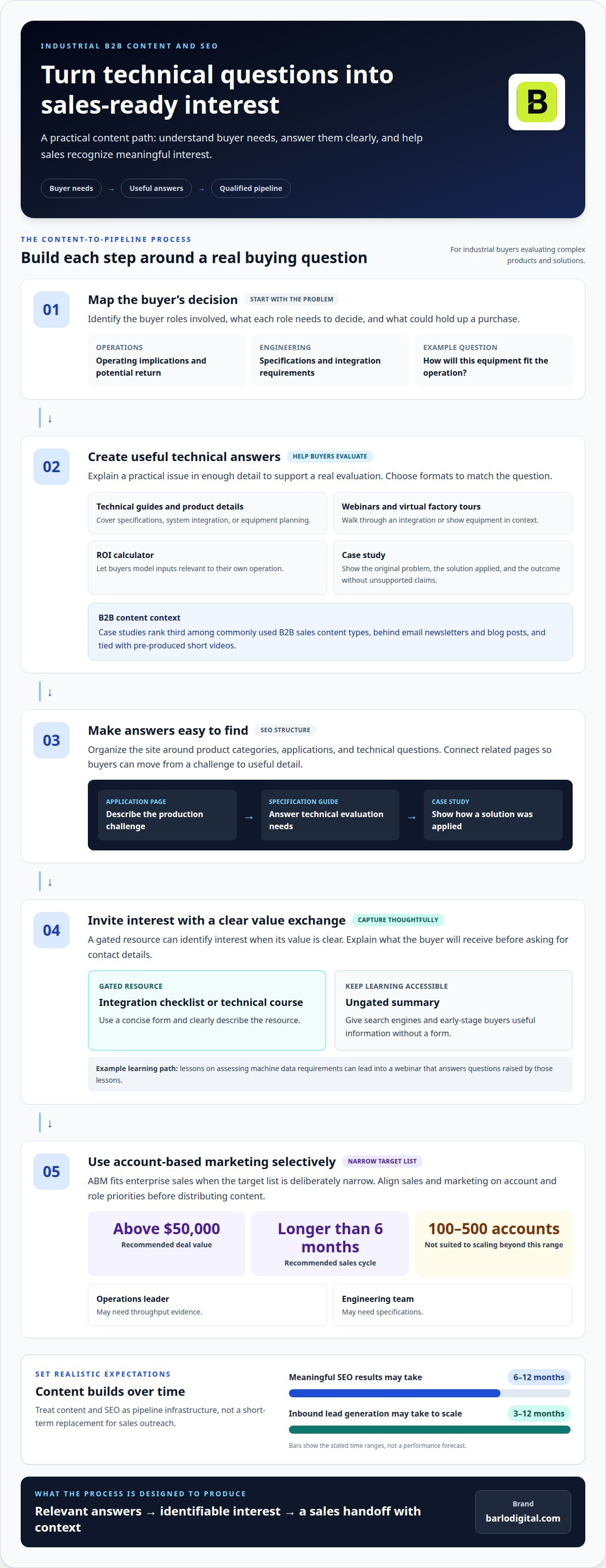
Industrial content should answer the questions that hold up a purchase. A plant manager evaluating automation needs product details, integration requirements, operating implications, and a clear explanation of potential return. Broad claims alone leave those questions unanswered. Map each buyer role to its decisions, obstacles, and information needs, then create pages and resources around specific searches, such as comparing control systems or planning equipment integration.
SEO gives those answers a route to buyers already researching a problem. Organize the site around product categories, applications, and technical questions, then connect related pages with clear internal links. A manufacturer might publish an application page, a specification guide, and a case study for the same production challenge. Content marketing and SEO take time: meaningful results may take 6-12 months, while inbound lead generation can take 3-12 months to scale. Treat them as pipeline infrastructure, not a short-term replacement for sales outreach.
Use multiple formats to explain technical value. A webinar can walk through a system integration, while an ROI calculator helps a buyer model inputs relevant to their operation. A virtual factory tour can show equipment in context. Industrial automation buyers generally need detailed product information before proceeding, so each asset should answer a practical question rather than merely collect attention. Case studies rank third among commonly used B2B sales content types, behind email newsletters and blog posts, and tied with pre-produced short videos. Use one to show the original problem, the solution applied, and the outcome without unsupported claims.
Gated resources can capture interest, but the value exchange needs to be clear. Put a detailed integration checklist or technical course behind a concise form, and explain what the resource covers before requesting contact details. Keep an ungated summary available so search engines and early-stage buyers can still learn about the topic. A course might break a complex process into lessons, such as assessing machine data requirements before choosing automation equipment. A webinar can then address questions raised by those lessons.
Account-based marketing fits enterprise sales when the target list is deliberately narrow. It is recommended for deals above $50,000 and sales cycles longer than 6 months; the approach is not suited to scaling beyond 100-500 target accounts. Personalize messaging by account and role: an operations leader may need throughput evidence, while an engineering team needs specifications. Sales and marketing should agree on those priorities before automation distributes content across email, search, and webinars. Otherwise, more channels simply multiply irrelevant messages.
2. What is B2B lead generation?
B2B lead generation identifies potential business buyers, earns their interest, and moves suitable prospects toward a sales conversation. Demand generation builds awareness; lead generation turns that awareness into identifiable interest. For an industrial supplier, a prospect might be an operations team researching replacement equipment, not simply anyone who downloads a brochure. The process connects a defined target market, relevant outreach, and a handoff sales can act on.
No single channel suits every industrial company. SEO can reach buyers actively researching, paid ads can place a specific offer before selected audiences, and email can open direct conversations. Trade shows create face-to-face contact, while distributors reach buyers through established relationships. Choose a mix based on buying intent, product complexity, sales capacity, and how buyers prefer to evaluate suppliers. Measure qualified conversations and resulting opportunities by channel instead of treating every inquiry as equally valuable.
Cold email starts with a focused, defensible list, not a large batch of loosely related contacts. Define target industries, company types, and buyer roles, then build records from appropriate sources. For example, an industrial automation campaign might target manufacturers and identify operations or engineering contacts. Each person on the list should have a clear business reason for outreach. Prioritize accounts by fit and relevance, and remove incomplete or mismatched records before starting a sequence.
Personalized messaging uses specific context rather than inserting a company name into a generic template. An email to an operations leader might refer to equipment uptime or production planning; a note to an engineer might ask about integration needs. Each message should state why the contact is relevant, offer a useful next step, and make it easy to decline. A provider can coordinate email, LinkedIn, and voice outreach around the same account, so each touch adds context instead of repeating the same pitch. Automated sequences commonly combine those touches over 7-14 days.
In the United States, applicable privacy, email, and data requirements depend on the audience, data source, and campaign. Before contacting prospects, document record sources, campaign purpose, relevant consent status, access, retention, and suppression requests, and account for applicable federal and state requirements.
Manage sequences around the buying process. A first email might introduce a relevant operational issue, a later LinkedIn touch could share a technical resource, and a voice attempt could invite a focused discussion. Review replies and engagement, stop outreach when someone opts out, and pass meaningful interest to sales with its context intact. This turns lead generation into a managed path from targeting to qualified sales follow-up, rather than a disconnected list of names and messages.
3. Lead-generation testing and optimization
Improve campaigns by identifying where industrial prospects stop progressing. Review search queries, landing-page engagement, form starts and completions, and qualified sales outcomes. If a page attracts engineering visitors but few useful inquiries, the problem may be message fit rather than traffic volume. Compare the page promise with the actual offer, then test one change at a time. For example, clarify whether a consultation covers equipment selection, integration planning, or another defined need.
Forms create friction when they demand information before explaining the exchange. Keep the request focused, and use the 3-5 fields generally considered ideal for B2B lead-generation forms. An industrial form might ask for name, work email, company, and the operational issue. Explain why the information is collected and how it will be used. Clear error messages help prospects correct omissions, while a confirmation page should state the next step or provide a relevant technical resource.
Testing turns tactics into evidence. Compare two landing-page or campaign versions, changing one element, such as the headline, call to action, or form placement. Judge the result by qualified inquiries and subsequent sales engagement, not clicks alone. A headline about production downtime, for example, may attract a different audience from one about integration support. Keep the audience and measurement method consistent, then document what changed and what happened.
SEO supports industrial lead generation when pages match the terms buyers use for applications, equipment, and technical problems. Review search intent, organize product and application pages, improve titles and page descriptions, and connect related content with useful internal links. Search engine optimization is not just a traffic source. Pages should help prospects assess fit with evidence such as specifications, integration details, or relevant case studies. Visibility without useful content brings visits, not qualified interest.
Website improvements should remove obstacles between discovery and inquiry. A provider checks page speed, navigation, readable technical content, working forms, and clear next steps across desktop and mobile. Mobile matters: 40 percent of consumers will turn to a competitor’s site after a poor mobile experience. On a phone, a manufacturer’s product page should keep key specifications readable, make navigation usable, and avoid forms that require excessive scrolling. After each change, review engagement and inquiry quality to determine whether the experience improved.
Optimization also needs a disciplined review cycle. Connect campaign and website changes to the same lead-quality definitions sales uses. If a new form increases submissions but reduces qualified conversations, the higher submission count hides a weaker result. If an SEO page attracts relevant prospects but generates few inquiries, test its next step and supporting proof. Keep a change log to distinguish improvements from normal variation and identify tactics that contribute to pipeline progress.
4. Ideal buyer identification and lead qualification
A lead list is valuable only when its companies resemble real buyers. Define an ideal customer profile using factors such as industry, application, equipment needs, and fit with the sales process. Then map the buying committee so outreach reaches people who influence evaluation, approval, and implementation. This keeps effort focused on companies that can use and purchase the solution, rather than those that merely show interest.
Industrial buying rarely sits with one contact. A plant manager may own operating priorities, an operations manager may assess production impact, and a systems integrator may evaluate technical fit. Qualification should account for those distinct roles. The provider can identify missing committee members and tailor follow-up to each person’s concerns, such as machinery timelines, integration questions, or return-on-investment factors. That produces a clearer picture of account readiness than a single contact record.
Reliable qualification starts with usable data. Check that company names, roles, business emails, and account details are consistent, then add relevant company context. Duplicates, outdated roles, and mismatched industries distort scoring and waste sales attention. Preserve the source and stated need for every landing-page inquiry so sales can see whether a prospect requested specifications, raised an integration issue, or asked about an application.
Lead scoring combines firmographic fit with behavioral signals. A simple model can use a 1-to-10 scale, while a more detailed example assigns 100 points to a demo request and 50 points to a pricing-page visit. Specification downloads and integration checklist activity can also signal interest. Scores should guide action, not replace judgment: a strong-fit company with a relevant technical question may deserve attention before a high score from an unrelated visitor.
Pipeline measurement exposes whether qualification is working. Track marketing-qualified-to-sales-qualified conversions, sales-qualified lead pipeline value, lead velocity, and channel cost per lead. A lead-generation evaluation rubric assigns pipeline quality a 40% weight and labels a close rate above 15% as excellent. These measures connect lead quality to sales outcomes. If volume rises while qualified conversion falls, the targeting or qualification rules need review.
Timing matters too. About 5% of B2B buyers are in the market in a given quarter, while the other 95% will buy later. A provider should distinguish immediate buying signals from longer-term fit, then route each appropriately. An active demo request may call for prompt sales follow-up; a technical resource download may justify further relevant engagement. That separation protects pipeline attention while keeping future-fit accounts visible.
5. Lead generation KPIs and pipeline measurement
Lead volume alone cannot show whether a campaign creates commercial value. Connect each source to qualified leads, opportunities, pipeline value, and closed revenue. This helps industrial teams identify which channels turn interest into active deals, rather than rewarding activity that never reaches sales.
Measure quality through sales acceptance and progression, then compare pipeline contribution and campaign ROI by source. Distinguish leads that fit the target audience from contacts that merely submit a form. Report campaign costs alongside qualified opportunities and revenue, using consistent attribution rules. For long industrial sales cycles, track both the original source and later touches that moved an account through the funnel.
Use a small, stable set of indicators. Track opportunities created, stage-2 conversion rates, and pipeline dollars by channel in a weekly report. Add lead-to-sales-qualified conversion, opportunity value, and time from first response to opportunity. These measures expose different failures: weak qualification, poor sales follow-up, or campaigns that attract attention but fail to convert.
Keep channel comparisons fair. A search campaign may capture buyers already researching a specific need, while an email campaign may initiate interest earlier. Compare leads at the same funnel stage and use the same time window. Separate active opportunities from early-stage contacts, and avoid judging a channel only by its latest click. Industrial B2B lead generation can take 3-6 months to produce measurable pipeline impact, so early reporting should distinguish leading indicators from revenue outcomes.
A Copper and Outfunnel survey of B2B sales and marketing leaders ranked lead quality first among metrics considered key to business success. That priority has practical consequences. A campaign producing fewer inquiries may still contribute more if those leads fit target accounts, advance to opportunities, and progress through sales stages. The provider should report the definition of a qualified lead alongside each result, so makers can judge performance against a shared standard.
ROI needs a clear calculation and honest attribution. Compare campaign-generated revenue with campaign costs, and state the calculation period and which revenue is attributed to the campaign. Report open deals as qualified pipeline, separately from closed revenue. Projected pipeline is not realized return. Review performance by source, audience, and offer, then use the findings to adjust budget and messaging.
Measurement breaks down when marketing and sales use different records or stage definitions. Align campaign tags, lead statuses, opportunity stages, and reporting fields before comparing channels. Check that a prospect's original source survives handoffs and that duplicate records do not inflate results. If reports show a drop between inquiry and sales acceptance, investigate the source and lead criteria involved before expanding spend.
Barlo Digital: Appointment setting for manufacturers and industrial suppliers
Barlo Digital provides appointment setting for manufacturers and industrial suppliers, helping turn targeted outreach into sales conversations. This service fits when your team has a defined buyer profile but needs consistent capacity to engage relevant accounts and arrange conversations with potential buyers.
Shape outreach around your products, target roles, and sales priorities. For example, outreach to operations leaders may focus on production needs, while conversations with engineering contacts may center on integration questions. Your team provides the product context and criteria for a qualified appointment. The aim is a clear handoff to sales, not a promise that every conversation will become an opportunity.
If appointment setting fits your pipeline needs, contact Barlo Digital about manufacturer lead generation.
Set the next pipeline priority
Identify the constraint most limiting your team's progress. It could be unclear ownership, weak follow-through, or difficulty deciding which accounts deserve attention. Set one priority and name the person responsible for addressing it.
Then decide what evidence would justify a change in approach. A clear review criterion helps your team distinguish real improvement from activity that only looks productive. Base the decision on your sales process, not a generic benchmark.
Clear priorities make growth easier to manage. Start with an issue your team can address now, then use what you learn to guide the next decision. For small and mid-sized B2B companies that lack in-house marketing leadership to guide these efforts, engaging fractional support from Budget Boosters can help establish high-level strategy and drive sustainable pipeline growth.
Frequently Asked Questions
What is B2B lead generation?
In practice, B2B lead generation is a system for turning anonymous market activity into usable sales context. A search visit alone does not tell a sales team who is involved or what prompted the visit. A captured inquiry, event conversation, or direct response can provide that starting point. Teams should define what qualifies as a lead before reporting begins, so a newsletter subscriber isn’t automatically counted as a sales prospect.
What are the most effective industrial B2B lead generation strategies?
A tactic works when it fits the buying situation and the company's ability to follow up. A product with a narrow application may benefit from direct account outreach, while one buyers actively compare may need strong product pages and search visibility. Review the time between first contact and sales action, the relevance of resulting conversations, and whether the approach reaches the roles involved in purchase decisions.
How do industrial companies use account-based marketing to generate qualified leads?
Account-based marketing helps teams focus on strategically important companies instead of treating every account alike. A practical account plan assigns an internal owner, defines the desired business outcome, and coordinates sales follow-up when new activity appears. It also lets leadership review account progress before a formal opportunity exists, such as whether the right department has engaged.
What content helps convert industrial buyers, such as technical guides, case studies, and product demos?
Useful content helps buyers complete a specific task. A maintenance checklist can support an equipment review, a comparison worksheet can organize requirements, and a product demonstration can show how a process works. Sales can also share content as a follow-up resource after a conversation. Track whether recipients use it in subsequent discussions rather than treating a download as proof of purchase intent.
What are typical costs and benchmarks for industrial B2B lead generation, including CPL and conversion rates?
Costs and conversion benchmarks vary by market, offer, channel, and the definition of a qualified lead, so generic figures can mislead. Compare similar campaigns using the same attribution window and lead criteria. Separate media spend from production and service costs when reviewing total investment. Use your own prior results for comparable audiences and offers as a benchmark, alongside sales acceptance and opportunity outcomes.
How can a lead-generation provider qualify, score, and nurture industrial leads through long sales cycles?
For long sales cycles, set clear status rules for active, paused, and re-engagement prospects. A lead that goes quiet may need a different follow-up trigger from one awaiting an internal equipment review. Sales feedback can reveal when an opportunity has stalled or changed direction. That history helps prevent mistimed or irrelevant outreach and provides a sound basis for re-engaging an account.
Which CRM and marketing automation tools are commonly used for industrial lead generation?
Industrial teams commonly use a CRM for contact and opportunity records, alongside marketing automation software for campaign workflows. The right combination depends on existing systems, reporting needs, and how sales handles handoffs. Before adding software, map who owns each record, what information must transfer, and which system holds the authoritative status. A small, reliable workflow is more useful than duplicated records and disconnected automation.
What are the risks of buying industrial lead lists, and how can companies verify data quality?
Purchased lead lists can create deliverability, relevance, and reputation problems when contacts are outdated or poorly matched. Before using a list, establish where the records came from, when they were collected, and what usage rights apply. Reviewing a small sample can reveal mismatched industries, generic inboxes, or obsolete roles. Track delivery failures and negative responses, then stop using sources that repeatedly produce unusable contacts.

Article by
Carlos Benavides
Carlos Benavides founded Barlo Digital and is its Director of Paid Media and Performance. He has fifteen years in direct-response marketing, more than $50M in lifetime ad spend, and a B.S. in Computer Science, which is why tracking at Barlo Digital is built by hand. Barlo Digital is a director-led paid media and search agency serving US ecommerce brands, home-service companies and practices.


