

More leads won’t repair a sales process that can’t separate a real opportunity from a name on a list. Lead generation for managed service providers means identifying businesses that fit an MSP’s services, reaching them through inbound or outbound channels, then nurturing and qualifying interest before sales time is spent.
The channel matters, but so does what happens after a prospect responds. A form submission is not automatically a sales-ready opportunity. Fit, need, timing, and follow-up determine whether a lead is ready for a conversation or needs more information.
This article explains how inbound and outbound outreach differ, what effective nurturing and qualification involve, and when outsourced appointment setting can support an MSP’s sales pipeline. You’ll see how the process connects targeting to handoff, and why lead quality depends on more than the number of contacts generated.
Key Takeaways
- Define the businesses an MSP can serve well, then set lead goals around fit and sales readiness, not contact volume alone.
- Use inbound channels to attract prospects already looking for answers and outbound outreach to approach selected businesses directly.
- Nurture prospects with useful follow-up, then qualify their fit, needs, and timing before handing them to sales.
- Make email and calling relevant to each prospect. Generic messages create noise instead of useful conversations.
- Outsourced lead generation can support prospecting and appointment setting when internal sales capacity is limited.
What is MSP lead generation?
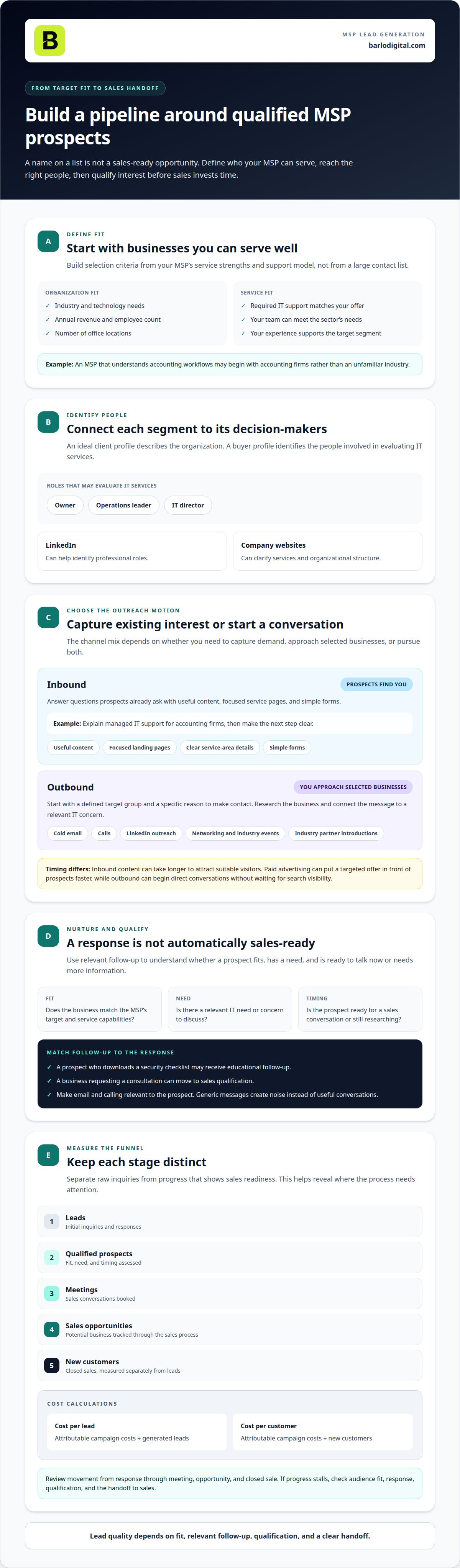
Effective lead generation for managed service providers identifies businesses that fit an MSP’s services, reaches relevant decision-makers, and qualifies prospects before sales invests time. It starts with a defined audience and goal, not a large contact list. For example, an MSP serving accounting firms should target prospects whose technology needs match its expertise and support model.
A provider translates the MSP’s offer into selection criteria. These may include industry, annual revenue, employee count, number of office locations, and required IT support. An MSP focused on small manufacturers might prioritize companies with multiple facilities, while another may serve accounting firms with specific technology needs. These criteria narrow the prospect pool to businesses the MSP can serve.
Next, the provider develops an ideal client profile and divides it into target segments. The profile describes the organization; a buyer profile identifies the people involved in evaluating IT services. A segment might include manufacturers with several facilities, while decision-makers could include an owner, operations leader, or IT director. LinkedIn can help identify professional roles, while company websites can clarify services and organizational structure.
Choosing an industry vertical is about fit, not trend-chasing. A provider considers the MSP’s service strengths, customer experience, and ability to meet a sector’s needs. If the MSP understands accounting workflows, accounting firms may be a stronger starting segment than an unfamiliar industry. Google searches can show how prospects describe their problems, helping shape relevant messages and outreach.
Goals must define what counts as progress. A provider can track qualified prospects, booked meetings, sales opportunities, and new customers as separate stages. This prevents a raw inquiry from being treated as a sales result. It also helps identify whether the breakdown comes from audience fit, response, qualification, or the handoff to sales.
How much does MSP lead generation cost per lead and per customer? Costs depend on the channels used, targeting and research effort, and how efficiently leads become customers. Calculate cost per lead by dividing attributable campaign costs by generated leads, and cost per customer by dividing those costs by new customers.
How can MSPs measure lead generation ROI and conversion rates? Track each prospect from initial response through meeting, opportunity, and closed sale. Reviewing progress through the funnel and comparing campaign costs with customer revenue can help assess lead generation performance.
What common lead generation mistakes and risks should MSPs avoid? Avoid targeting every business, treating unqualified names as prospects, and judging success by inquiry volume alone. A mismatch between the target segment and the MSP’s actual service capabilities wastes outreach and sales time.
- Define the audience: Specify industry, organization size, locations, and service fit.
- Identify decision-makers: Connect each target segment with the roles involved in evaluating IT services.
- Measure the funnel: Separate leads, qualified prospects, meetings, opportunities, and customers.
Inbound and outbound lead generation
Inbound and outbound generate demand differently. Inbound gives a business a reason to find an MSP; outbound puts a relevant message in front of a selected business. The right mix depends on whether the MSP needs to capture existing interest, start new conversations, or pursue both goals.
Inbound starts with questions prospects already ask. An MSP might publish a page explaining managed IT support for accounting firms, then offer a clear next step, such as requesting a consultation. Useful content, simple forms, and focused landing pages—such as those developed by Dulyfixed Small Business Solutions—guide visitors from researching a problem to making contact.
For SEO and local search, a lead generation provider aligns service pages and useful content with the terms business buyers use on Google. Clear service-area details help prospects understand whether an MSP serves their location and technology needs, without targeting a specific city or region.
Inbound also needs a destination that turns attention into an inquiry. A page about cybersecurity, for example, should explain the service in plain language, identify the types of businesses it supports, and make the contact action easy to find. Established providers such as Insoft Services demonstrate this by clearly outlining their networking and cybersecurity capabilities, helping ensure incoming inquiries match their delivery model. A checklist or newsletter signup can help prospects who want more information before speaking with sales.
Outbound starts with a defined target group and a specific reason to make contact. A provider might identify manufacturing companies with several locations, research their operations, and tailor outreach to a relevant IT concern. A message to an operations leader should explain why the service applies, rather than list generic technical offerings.
Cold email, calls, LinkedIn outreach, networking, and industry events each create different openings. A partner serving the same industry can also introduce an MSP to potential buyers. The provider coordinates these tactics around the target profile, giving prospects a consistent message rather than disconnected pitches.
Inbound can take longer to build because content and useful pages need to attract suitable visitors. Paid advertising can put a targeted offer in front of prospects faster, while outbound can start direct conversations without waiting for search visibility. None of these channels removes the need to qualify interest.
A coordinated plan defines the next step for each response. Someone who downloads a security checklist may receive educational follow-up, while a business requesting a consultation can move to sales qualification. If Google brings visitors who do not contact sales, the offer or landing page may need adjustment. If outbound replies produce few relevant meetings, revise the target group or message.
Lead nurturing and qualification
A prospect who downloads an MSP security guide may be researching, not ready to buy. Nurturing provides useful information while qualification determines whether sales should act. Without both steps, the pipeline mixes early research with active buying interest, making follow-up harder to prioritize.
Start by recording the prospect’s source and response to the offer. A website inquiry, webinar registration, referral, and LinkedIn reply signal different levels of intent. Keep the channel, company, contact role, stated need, and follow-up history together. That record lets the next message respond to what the prospect actually did.
Then segment prospects by fit and readiness. A marketing-qualified lead is judged to fit the target audience and be ready for marketing, even without showing specific interest in the organization. A prospect requesting a service discussion signals stronger intent than someone reading an introductory article. These contacts need different follow-up.
Nurturing should deepen the prospect’s understanding, not repeat a sales pitch. For example, after a business downloads a guide about backup planning, follow-up could explain recovery planning, outline questions to discuss internally, and offer a relevant conversation. Each message should address a likely concern and make one next step clear.
Qualification checks whether the organization’s needs match the MSP’s capabilities and whether a meaningful sales conversation makes sense. A provider can assess the stated problem, current support arrangement, decision-making role, timing, and service fit. A contact with a relevant need but no immediate buying plan may remain in nurture rather than move into active sales follow-up.
Define handoff conditions before campaigns begin. Sales and marketing should agree on the information required for an accepted lead, such as a relevant business profile, a clear technology concern, and an appropriate contact. If sales rejects a lead, record the reason. Repeated feedback about poor fit or unclear needs should inform changes to targeting or messaging.
Follow-up should be prompt, relevant, and patient. A prospect who is not ready can receive an educational email or an invitation to a later discussion, while an active inquiry gets direct contact. Avoid treating silence as consent or sending the same sequence indefinitely. A clear stop or pause rule protects the relationship and keeps outreach focused.
Review nurturing by segment and channel. Track which messages lead to replies, qualified meetings, and sales opportunities, not just opens or clicks. If a guide attracts readers but few suitable conversations, revise its audience or follow-up. If referrals produce qualified leads, retain the source details and examine what made those introductions relevant.
The result is a cleaner pipeline: early-stage prospects receive useful information, qualified buyers reach sales, and feedback improves future campaigns. Qualification is not a one-time label. It changes as a prospect’s needs, timing, and engagement develop.
Personalized email, cold email, and cold calling
Generic outreach burns attention without giving a prospect a reason to respond. An MSP contacting a regional accounting firm should connect its message to that firm’s business context, not send a catalogue of technical services. Personalization means choosing a relevant detail and explaining why it matters.
For a cold email, use the recipient’s role, organization, and a plausible business concern. An operations leader at a multi-location manufacturer may care about consistent IT support across sites. The message can briefly explain the relevance, then ask for a focused conversation. Avoid unsupported claims about the prospect’s systems or problems.
Personalized email also applies to existing relationships. A referral from a current customer gives the MSP a reason to mention the introduction and its shared context. For example, the sender can identify the referring contact, explain the connection, and ask whether a short discussion would be useful. That is different from implying that a cold prospect already knows the provider.
Cold email campaigns need a clear audience and one purpose. Segment contacts by industry or role, then write a message suited to that group. A campaign for accounting firm owners should not use the same opening as one for manufacturing operations leaders. Keep the offer specific, use a direct subject line, and make a reply or meeting request the next step.
Sequence matters. A first email can introduce the reason for contact; a later follow-up can add a useful detail, such as the MSP’s approach to supporting multiple offices. Each message should contribute something new. Repeating the same pitch with a changed subject line does not make it more relevant.
Cold calling gives a prospect a live conversation, but the opening must earn attention quickly. The caller should identify the MSP, explain the reason for calling, and ask a focused question. For example: “Are you responsible for IT support across your locations?” If the contact is not responsible, the caller can ask who handles that decision.
Preparation makes calling more useful. Before dialing, a provider can review the organization’s industry, locations, and contact role. That information helps the caller avoid an irrelevant pitch and explain why the call may matter. If the prospect declines, record the outcome and stop treating the contact as an active opportunity.
Email and calling can support each other without becoming a barrage. A caller might refer to a prior message, while an email can follow a relevant conversation with the requested information. Track replies, conversations, meetings, and qualified opportunities by campaign. If messages receive responses but produce poor-fit meetings, revise the target group or qualification criteria.
Keep measurement practical. Compare performance by segment, message, and channel, then retain the approaches that produce relevant sales conversations. A referral, a carefully researched cold email, and a concise call each need distinct context, but every contact should lead to a clear and appropriate next step.
Benefits of outsourcing lead generation
Outsourcing can give an MSP a defined prospecting function without pulling service staff away from client work. A team handling tickets and onboarding has limited time for list research, campaign execution, and sales follow-up. An external team can keep those activities moving while internal staff focus on technical delivery and sales conversations.
The practical gain is concentrated effort. A provider can research target companies, identify relevant contacts, coordinate outreach, and record responses in one process. For an MSP pursuing healthcare practices, that might mean separating practice owners from office managers and tailoring outreach to each role. Clear segmentation makes campaign activity easier to assess.
Outsourcing can also add consistency. Prospecting often stalls when internal staff handle it between urgent tasks. An assigned team can maintain campaign schedules, document contact history, and route replies using agreed qualification criteria. That reduces the risk of multiple people contacting the same prospect or leaving an interested contact without a clear next step.
Specialized execution can help identify where conversion breaks down. If a campaign generates replies but few relevant meetings, the issue may be the audience, offer, message, or qualification standard. If suitable meetings occur but rarely advance, sales follow-up or service fit may need attention. The value is not activity alone, but usable feedback across the funnel.
Outsourcing does not remove the MSP’s role. Internal leaders still need to define the services to promote, the businesses to target, and what makes a prospect qualified. Sales must provide feedback on meeting quality and outcomes. Without those inputs, an external team can execute consistently against the wrong audience.
Before work begins, agree on operating details: target segments, approved messaging, qualification criteria, data ownership, reporting, and how sales receives a prospect. For example, an MSP might require a prospect to fit its service area, have a relevant IT need, and include a contact involved in evaluating support. These rules make handoffs measurable.
Judge the arrangement by outcomes at each stage, not email volume or calls made. Review qualified meetings, sales opportunities, conversion between stages, and reasons for rejection. A report showing high activity but poor-fit prospects points to a targeting problem. A report without source and outcome details cannot show whether the program is producing useful demand.
Outsourcing may be a poor fit if the MSP cannot define its target market, respond to sales opportunities, or explain which services it wants to sell. Those gaps need internal decisions first. Once the offer and handoff are clear, an external team can support an MSP lead generation program built around focused targeting, outreach, and qualification.
Barlo Digital
Barlo Digital helps businesses bring structure to lead generation, from attracting prospects to measuring which channels produce qualified opportunities. For an MSP, the priority may be improving local visibility, clarifying how services are presented, or assessing whether advertising brings relevant inquiries. The work should connect targeting, messaging, and measurement to the sales process, rather than treat lead volume as the outcome.
We provide senior-level direction across paid media and search, with a director running every account. Learn more about our MSP lead generation service.
Set the next growth priority
The next move is to choose the pipeline problem that most limits growth. It may be weak visibility in search, poor-fit inquiries, or too few qualified sales conversations. Start there, then align the campaign and its measurement with the outcome the MSP needs.
For businesses that depend on search visibility, local SEO and AI search can help prospects discover and understand their services across the United States. The right approach to lead generation for managed service providers should reflect the MSP’s market, service focus, and sales capacity, rather than chase activity for its own sake.
Barlo Digital can help assess that starting point and shape a practical plan around the business’s growth needs. Contact Barlo Digital to discuss the next step. A clear priority gives your team a stronger basis for action.
Frequently Asked Questions
How Does a Lead Generation Provider Build an MSP Prospecting List?
A provider builds the list around the MSP’s service fit, target industries, and business criteria. It can combine company records with role information, then remove organizations outside the service area or unsuitable for the offer. For example, an MSP focused on multi-site support might prioritize companies with several offices and identify people responsible for technology decisions. The provider should track each record’s source and flag outdated or incomplete details.
What Is the Best Lead Gen Solution for a Managed Services Provider?
The best solution reaches a clearly defined buyer and supports a reliable sales handoff. A strong lead generation program for managed service providers may combine search visibility, targeted outreach, and appointment setting, depending on the MSP’s growth priorities. Before choosing an approach, establish what qualifies as a sales opportunity, who follows up, and how outcomes are recorded. Without those decisions, more leads can simply create more unworked inquiries.
What are the most effective lead generation strategies for managed service providers?
Effective strategies match the MSP’s expertise to a specific buyer need. An MSP experienced in supporting manufacturers could publish practical guidance for operations leaders, pursue relevant referrals, and contact suitable companies directly. A clear offer, such as a technology planning discussion, gives prospects a reason to respond. Review performance by qualified conversations and sales opportunities, then shift effort toward the audiences and messages that produce relevant business discussions.
How Can a Lead Generation Provider Help an MSP Define and Target Its Ideal Customer Profile?
A provider turns the MSP’s strongest customer relationships into practical selection criteria. It can compare the industries served, recurring support needs, location requirements, and decision-making roles that commonly lead to a suitable engagement. For instance, if successful accounts share a need for consistent support across offices, that becomes a useful targeting signal. The provider can also define exclusions, such as organizations needing services the MSP does not deliver.
Which marketing channels generate the best leads for MSPs?
No channel is best for every MSP. Search can capture buyers actively researching a problem, referrals can introduce the provider through an existing relationship, and outbound can reach selected organizations before they begin searching. Compare channels by the quality and progression of the prospects they generate, not by raw response volume. A channel producing fewer inquiries may be more valuable if those inquiries consistently fit the MSP’s services.
What are the best MSP lead generation tools, platforms, and agencies?
The right tools support accurate records, campaign attribution, and timely handoffs. An MSP can use its existing contact-management system to record source, company, contact role, interaction history, and sales outcome. Platforms should suit the campaign, such as search advertising for active demand or professional networks for role-based targeting. Choose an agency based on its ability to explain targeting, qualification, reporting, and how its work connects to the MSP’s sales process.
How Can a Lead Generation Provider Build an MSP Lead Generation Funnel and Qualify Prospects?
A provider maps each prospect action to a clear next stage. For example, someone requesting a consultation can be routed for sales review, while someone downloading an introductory resource can receive relevant educational follow-up. Qualification can capture the organization’s need, service fit, decision role, and buying context. The provider should also record why sales accepts or rejects each handoff, so the funnel’s criteria improve as real opportunities progress.
What Cold Outreach Strategies Can a Lead Generation Provider Use for MSPs, and What Legal Rules Apply?
A provider can use researched email, professional-network messages, and calling, with each message tailored to the recipient’s role and organization. Legal requirements depend on the channel, campaign details, and applicable federal and state rules. Before launch, have qualified US counsel review the audience, contact method, consent practices, disclosures, opt-out handling, caller identification, and recordkeeping. Keep campaign records and suppression processes organized so outreach can be managed responsibly.

Article by
Carlos Benavides
Carlos Benavides founded Barlo Digital and is its Director of Paid Media and Performance. He has fifteen years in direct-response marketing, more than $50M in lifetime ad spend, and a B.S. in Computer Science, which is why tracking at Barlo Digital is built by hand. Barlo Digital is a director-led paid media and search agency serving US ecommerce brands, home-service companies and practices.


