

Strong paid campaigns are judged by verified business outcomes, not clicks or platform-reported conversions alone. A company managing current paid digital advertising campaigns should first confirm that tracking records the right actions, then assess performance by campaign and test changes against a clear baseline. Without reliable measurement, reported results can conceal wasted spend.
It’s reasonable to expect campaigns to generate leads or sales, but performance also depends on what happens after someone clicks an ad. This article explains how to assess paid search management, verify that tracking connects ad activity to meaningful outcomes, and evaluate tests and optimization without mistaking short-term fluctuations for lasting gains. Use these steps to identify what’s working, where budget is leaking, and what needs closer attention.
Key Takeaways
- Judge paid search by qualified leads or sales, not clicks alone; compare campaign performance with the business outcome it is meant to produce.
- Test one meaningful campaign change at a time so you can identify what improved results and what simply shifted spend.
- Check that ad platforms and analytics record the same valuable actions. Tracking gaps can make weak campaigns look successful.
- Use reporting to connect spend, conversions, and business results, then set clear priorities for the next round of optimization.
- Assess an agency’s account oversight, testing process, and transparency before trusting it with campaign decisions.
Paid search and PPC campaign management
Google Ads benchmarks provide context, not a verdict on your account. Compare them with your own qualified leads or sales, average order value, and cost targets. A click is not a business result.
Start your review with search terms. In Google Ads, compare the terms triggering ads with the products or services you sell. Separate high-intent searches, such as “emergency roof repair,” from broad research queries, such as “roofing materials.” Then review each group’s clicks, conversions, and landing pages. Add irrelevant queries as negative keywords when they spend budget without reaching likely buyers.
Next, review the account structure. Each campaign should have a defined goal, budget, location, and audience or keyword theme. When one campaign combines unrelated products, its results can hide which offer attracts demand. Check settings, match types, ad copy, and conversion actions before changing bids. This sequence helps identify setup errors before treating weak performance as a strategy problem.
Free Google tools can help with this investigation. Google Keyword Planner supports keyword research, while Google Search Console shows queries that already earn organic impressions and clicks. Use both to compare paid targets with search demand. For example, a service page receiving impressions for “commercial HVAC maintenance” may point to a search-driven page or ad group worth testing. Organic visibility signals interest, but does not prove paid traffic will convert.
Match the landing page to the search. Someone looking for a specific product should reach that product page, not a generic homepage. Check that the headline, offer, and next step align with the ad. Then test the page on mobile and complete a test conversion. A broken form or mismatched message can waste budget, even when the keyword and ad are relevant.
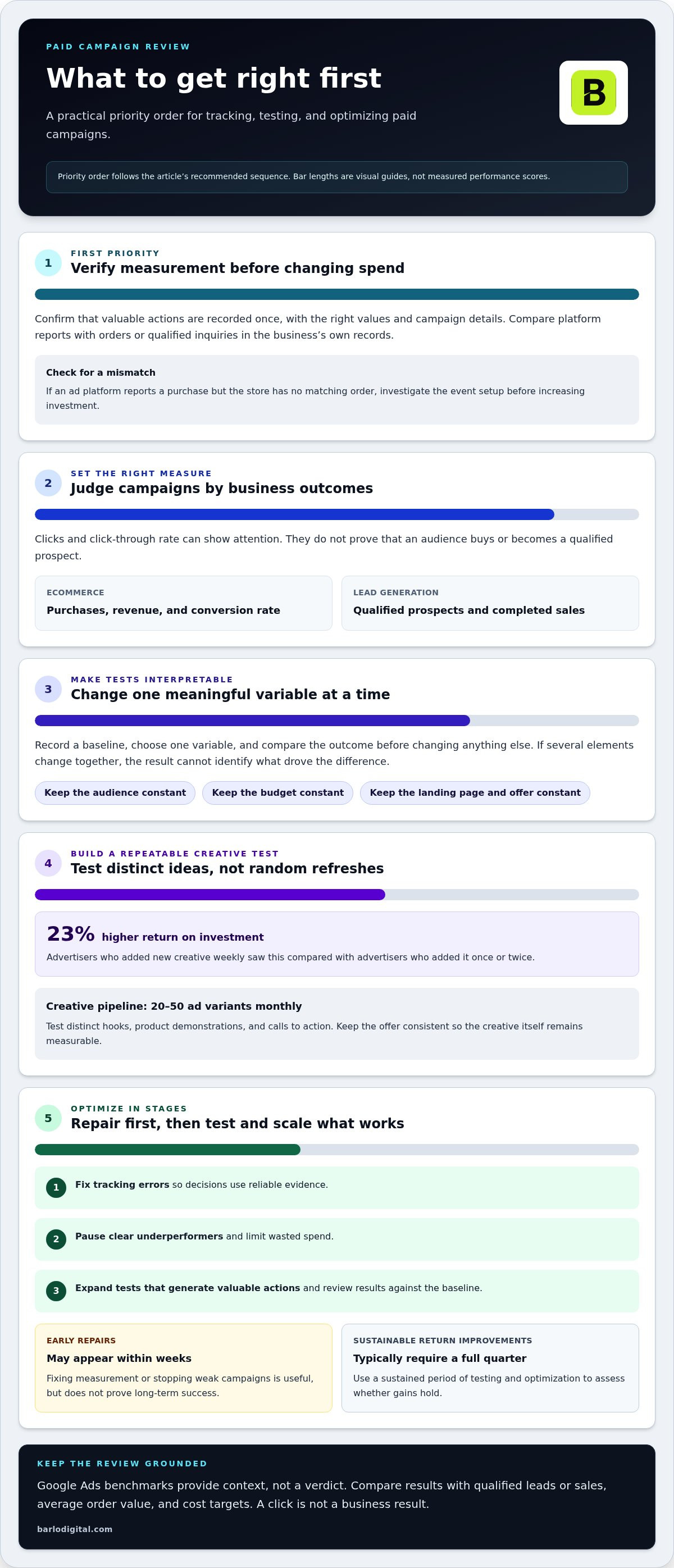
Optimization needs a sequence, not a burst of edits. Record the current settings and results, change one meaningful factor, then compare performance over a suitable period. Paid media agencies commonly need 60-90 days to audit, restructure, and optimize campaigns before meaningful efficiency improvements. Early fixes can include correcting tracking or pausing a clearly underperforming campaign. Don’t confuse those repairs with proven long-term success.
Assess paid search as part of the wider media mix. Social platforms such as TikTok can support discovery, while Google Search captures active demand. Traditional media may also influence later branded searches. Check whether tracking connects those interactions to sales, then decide how each channel earns its budget. A sound strategy follows buyer intent and verified outcomes, not platform preference.
Campaign testing, tracking, and optimization
A campaign test is useful only when it isolates a decision. Set a baseline, choose one variable, and record the outcome before changing anything else. For example, compare two headlines while keeping audience targeting, budget, landing page, and offer constant. If several elements change together, you cannot tell which change drove growth. That is guesswork, not optimization.
Creative needs a repeatable testing process, not an occasional refresh. Advertisers who added new creative weekly saw 23% higher return on investment than advertisers who added it once or twice. Build a pipeline that can produce 20-50 ad variants monthly, then test distinct hooks, product demonstrations, and calls to action. For a retail brand, compare a customer-use demonstration with a product-feature explanation. Keep the offer consistent so the creative itself remains measurable.
Tracking must connect ad interactions to meaningful actions. Check that purchase events, submitted forms, and booked appointments are recorded once, with the right values and campaign details. Then compare platform reports with orders or qualified inquiries in the business’s own records. If Google Ads reports a purchase but the store has no matching order, investigate the event setup before increasing investment. A broken measurement path can reward the wrong campaign.
Define the test’s success measure before launch. Click-through rate can show whether an ad earns attention, but it cannot prove that the audience buys. For ecommerce, track purchases and revenue alongside conversion rate. For lead generation, distinguish submitted forms from qualified prospects and completed sales. This prevents cheap, low-intent actions from appearing to drive growth and gives teams a clear basis for adjusting creative, targeting, or budget.
Optimize paid media in stages. Fix tracking errors first, then pause clear underperformers and expand tests that generate valuable actions. Early improvements, such as repairing measurement or stopping weak campaigns, may appear within weeks. Sustainable return on ad spend improvements typically require a full quarter of testing and optimization. A quick repair is useful, but it does not prove a new strategy will hold.
Evaluate channels as part of one investment plan. Programmatic ads, influencer content, social platforms, and retail media can influence different points in a buyer’s journey. Don’t assign credit only to the last click. Compare how each channel supports discovery, consideration, and conversion, then use consistent tracking to assess its contribution. A growing brand can shift budget toward channels that produce verified business actions, while tying creative tests and audience targeting to specific decisions.
When reviewing an agency, assess how it uses campaign evidence to guide creative and experimentation. Ask how it makes creative decisions and structures tests so the results inform the next step. Look for a clear connection between measurement, creative choices, and optimization, rather than treating them as separate tasks. Paid media agencies may deliver early improvements, such as fixing tracking issues or pausing underperforming campaigns, within weeks. Treat these as initial changes, not proof of lasting performance.
What results and reporting should a paid digital advertising agency provide?
A useful report connects campaign activity to business outcomes. It should show what was spent, what action followed, and what the agency recommends next. For an ecommerce brand, that means separating purchases and revenue from clicks or add-to-cart events. For a law firm, it means distinguishing qualified inquiries from page visits. A dashboard full of platform metrics can still obscure whether advertising is producing value.
Start by clarifying reporting definitions. Ask which events count as conversions, how duplicates are handled, and whether canceled orders or unqualified leads are excluded. A report that labels every form submission a success can inflate performance. For example, if a campaign generates inquiries but few become cases, the agency should identify that gap rather than celebrate the initial form count.
Look for results broken down by decisions you can act on. Reports should let you compare campaigns, audiences, search themes, creative, and landing pages. They should also show the date range and major account changes. If a campaign’s reported return shifts after a tracking adjustment, the report should explain why. Otherwise, you cannot distinguish actual performance from a change in measurement.
- Spend and delivery: Show investment by campaign and platform, alongside impressions and clicks.
- Business actions: Report purchases, qualified leads, booked appointments, or another defined outcome.
- Efficiency: Pair cost per result with the quality and value of that result.
- Decisions: State what changed, why it changed, and what the next test will measure.
Put the metrics in context. A low cost per lead may look efficient but mislead if sales rejects those leads. A higher-cost campaign may generate more revenue or better-fit prospects. Where records can be reliably matched, connect ad reporting to sales outcomes such as lead status or completed orders. Then explain attribution limits plainly: multiple channels may claim conversions from the same buyer.
Reporting should make uncertainty visible, not smooth it away. If purchase tracking stopped during a site update, mark the affected period. If a campaign changed its audience and creative together, don’t claim that one change caused the outcome. Clear notes preserve a useful record for future decisions and prevent weak evidence from driving more spend.
Require a forward-looking action plan. Each review should identify the strongest evidence, the unresolved issue, and the next decision. The agency should also make the commercial arrangement clear: define the work included, how fees are calculated, and which media spend is separate. Transparent terms and reporting let you assess performance and accountability without confusing activity with results.
What are the risks of hiring a paid digital advertising company?
The first risk is losing control of the advertising account. Without access to Google Ads, billing history, conversion settings, or campaign data, a business cannot inspect what is being managed. Keep ownership of core accounts and grant access through user permissions. This preserves visibility if the working relationship changes.
Another risk is optimizing for activity instead of commercial outcomes. An agency may report more clicks, impressions, or form submissions while sales remain flat. For example, a home-service company could receive quote requests from people outside its service area. Define a useful lead, then connect that definition to campaign reporting and sales follow-up.
Tracking errors create another failure point. A duplicated purchase event can make Google Ads appear more effective than the store’s order records show. A form event that fires without a completed submission can inflate lead counts. Review the event path from ad click to website action, then compare recorded conversions with the source system. Without this check, budget decisions rely on faulty evidence.
Misaligned incentives can distort recommendations. A percentage-of-spend arrangement may reward higher advertising budgets, even when extra spend does not improve business results. A fixed scope can create a different problem if it rewards routine activity instead of useful analysis. Read the agreement for included work, billing method, account ownership, and exit terms. Reports should make spend and fees easy to distinguish.
Operational neglect can be hard to spot in a polished presentation. If the strategist who builds the plan never reviews performance, important context can disappear between handoffs. Ask who makes campaign decisions and who implements changes. Then check whether reports name the changes, explain their purpose, and show what happened afterward. A sudden shift in conversion volume, for example, needs an explanation, not a generic statement about market conditions.
Unrealistic promises are a warning sign. A forecast estimates results based on assumptions about demand, conversion rates, margins, and tracking quality. It is not a guarantee. Ask which assumptions support the forecast and how performance will be judged if actual results differ. A sound plan identifies what will be tested and how weak performance will prompt a change in approach.
A mismatch between channel and audience can waste money, even when campaign execution is competent. Google Search may capture active demand, while social advertising often introduces an offer to people who are not searching for it. Review the intended buyer, purchase cycle, landing page, and conversion path before assigning budget. The strategy should fit those mechanics. If an agency cannot explain why a channel suits the business, its proposed spend has no defensible basis.
Paid media
Paid media is not simply a platform choice. It is a budget allocation problem: match each channel to buyer intent, then judge its contribution to business outcomes. Google Search can capture active demand. Meta and TikTok can introduce products to people who are not searching. The right mix depends on the offer, customer journey, creative, and measurement quality.
Benchmarks help frame a question, not answer it. TikTok-commissioned research with Nielsen found TikTok ads had 96% higher paid media return on ad spend than other digital media channels, and 2.9x higher sales efficiency. Those findings are specific to the research and its comparison. They do not establish that TikTok will outperform for every brand, product, or campaign. Check the study’s definitions, then compare them with your own verified results.
Choose channels based on the customer’s path to purchase. A high-consideration product may need multiple exposures before a buyer converts. A frequently purchased item may respond to direct product ads and a clear checkout path. Map the journey before assigning budget:
- Discovery: Identify channels that can introduce the offer to relevant audiences.
- Consideration: Use product details, reviews, or demonstrations to address buyer objections.
- Conversion: Direct high-intent audiences to a page with a clear next action.
- Measurement: Compare each channel against the same business outcome and attribution rules.
Paid media also requires operational discipline across platforms. Separate campaign objectives, audiences, and creative concepts so reports show what drives meaningful actions. If a retailer runs Meta and Google campaigns, for example, compare new-customer purchases separately from repeat orders. Otherwise, existing demand can make acquisition activity seem more effective than it is. Align budget decisions with margin, inventory, and the business’s ability to fulfill additional orders.
Watch for misleading comparisons. A platform may claim credit for a sale that another channel influenced. A short reporting window may miss delayed conversions, and a low-cost click may bring visitors who never reach the product page. Review attribution settings, conversion definitions, and sales records together. Compare results over consistent periods, noting major changes such as a promotion, site update, or inventory shortage.
Before adding or expanding a channel, define a test audience, offer, landing page, and success measure. Keep the test isolated enough to explain its result. Scale only when the channel delivers business value that supports the investment, not simply more impressions or platform-reported conversions. This keeps channel decisions tied to evidence rather than habit.
Choose an agency that aligns paid media strategy with a company’s ideal customer profile and growth goals. Evaluate its integration with CRM and marketing operations, so campaign data can inform broader decisions. Some agencies charge percentage-of-spend fees of 10-20%. Some paid media agency pricing models combine a base retainer with performance incentives tied to specific KPIs.
Barlo Digital: Ecommerce ad management (Meta, Google, TikTok)
Barlo Digital manages ecommerce campaigns across Meta, Google, and TikTok. A director runs every account, and senior-level specialists handle the work without an account-manager layer or handoff to junior staff. This structure keeps campaign decisions close to the people responsible for execution.
For businesses that need focused management across these platforms, our ecommerce ad management connects campaign work to the store’s sales objectives. If measurement is the central issue, an ecommerce tracking and measurement audit can help identify data gaps affecting those decisions.
Make the next campaign decision deliberately
The next step is not automatically a new platform, a larger budget, or another round of creative. Decide which operational gap matters most, then assign responsibility for fixing it. A company managing current paid digital advertising campaigns should base that decision on business priorities, not reporting volume or platform defaults.
Barlo Digital works across ecommerce ad management, ecommerce tracking and measurement audits, and local SEO and AI search. The right focus depends on whether the immediate need is campaign execution, measurement clarity, or visibility in local search. Start with the issue blocking a sound decision. Then set a clear measure of progress and review it consistently.
If you’re ready to discuss the right next step for your campaigns, contact Barlo Digital about your campaigns. A clear decision today gives your team a stronger basis for what comes next.
Frequently Asked Questions
Which companies offer paid digital advertising campaign services in the United States?
Paid media agencies and specialist advertising firms manage campaigns across the United States. When comparing companies that manage current paid digital advertising campaigns, consider account ownership, reporting access, and who makes day-to-day decisions. Barlo Digital manages ecommerce campaigns across Meta, Google, and TikTok. Ask how the person responsible for strategy will address a tracking issue or explain a change in campaign performance.
What platforms do digital advertising companies manage, such as Google, Meta, and TikTok?
Digital advertising companies may manage Google, Meta, TikTok, Amazon, or a selected mix. A company managing current paid digital advertising campaigns should choose platforms based on the audience, offer, and campaign goal. Before adding channels, clarify who controls billing and account access. Consistent conversion names across platforms also make it easier to compare reported purchases without confusing sales with lower-value actions.

Article by
Carlos Benavides
Carlos Benavides founded Barlo Digital and is its Director of Paid Media and Performance. He has fifteen years in direct-response marketing, more than $50M in lifetime ad spend, and a B.S. in Computer Science, which is why tracking at Barlo Digital is built by hand. Barlo Digital is a director-led paid media and search agency serving US ecommerce brands, home-service companies and practices.


