

Google Ads can work when campaigns reach relevant searches, send visitors to pages built to convert, and track meaningful business outcomes. A paid search agency manages these moving parts, but clicks and impressions alone do not show whether the spend is delivering value.
The real test is not whether ads are running, but whether the account connects budget to measurable results. Poor tracking can hide wasted spend, while loose targeting can attract searches that never become customers.
This guide explains what paid search management includes, how agencies handle budgets and performance tracking, and what to examine before choosing one. You’ll learn how to assess whether PPC fits your goals, what account ownership and reporting should look like, and which questions can reveal gaps before they cost you.
Key Takeaways
- Clicks are not proof of business results. Judge campaigns by whether tracked activity connects to meaningful outcomes.
- Effective management follows a repeatable cycle: understand the business, set a strategy, execute, then refine based on performance.
- Reliable reporting depends on sound analytics setup and conversion tracking, not just platform metrics.
- Budget decisions should reflect campaign goals, competition, and the quality of the account’s measurement.
- Before choosing an agency, look for clear account ownership, direct senior-level oversight, and reporting tied to business outcomes.
Can you guarantee results from your Google Ads campaign management?
Google Ads management covers targeting, budget settings, ad relevance, and measurement. It cannot control competitors’ bids, search demand, or whether a visitor becomes a customer. Since Google charges advertisers when someone clicks a search ad and reaches the advertiser’s site, weak targeting can turn spend into irrelevant visits.
A sound campaign starts with the audience and searches that indicate intent. Choose keywords relevant to the offer, then review search terms for mismatches. For example, a commercial equipment seller should distinguish purchase-ready searches from research queries. This helps target likely buyers rather than paying for every loosely related click.
Google Ads Quality Score uses a 1-to-10 scale based on expected click-through rate, ad relevance, and landing page experience. Treat it as a diagnostic, not a sales forecast. Check whether the ad answers the search, whether the landing page matches its promise, and whether the page gives visitors a clear next step.
Ongoing optimization means reviewing search terms, spend, clicks, conversions, and campaign settings. When irrelevant queries appear, add exclusions or tighten targeting. If a relevant ad gets clicks but few conversions, inspect the landing page and conversion tracking before raising bids. Each adjustment should address a documented issue, not a hunch.
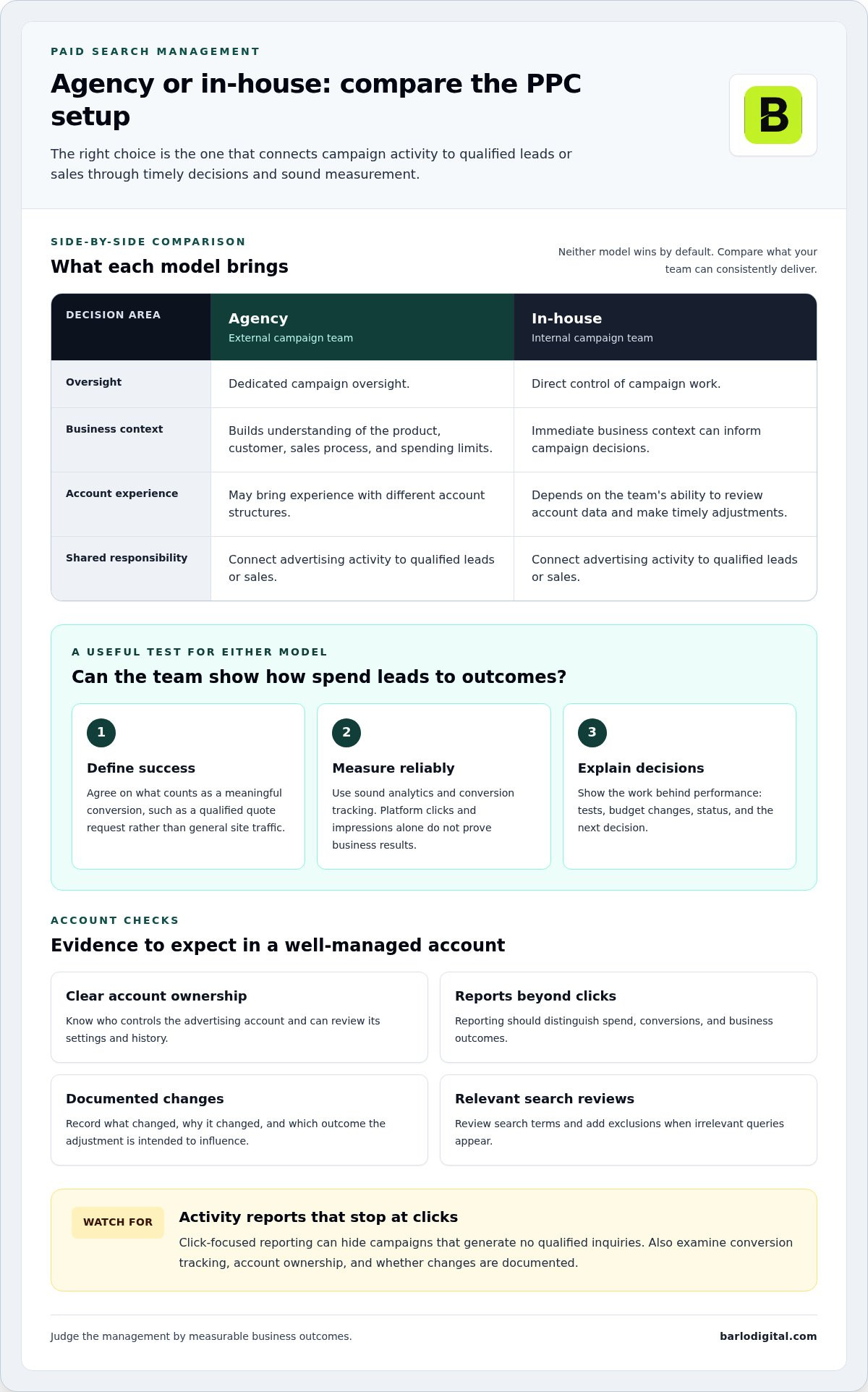
Compared with in-house PPC management, an agency offers dedicated campaign oversight and experience with different account structures. In-house teams have immediate business context and direct control. The practical question is whether either setup can review data, make timely adjustments, and connect Google Ads activity to qualified leads or sales.
Risks of hiring a paid search agency include unclear account ownership, weak conversion tracking, and undocumented changes. Reporting clicks as the main result, for example, can conceal a campaign that generates no qualified inquiries. Require access to the advertising account and reports that distinguish spend, conversions, and business outcomes.
A paid search agency can identify and address account problems by reviewing campaign data, but improvement depends on fixing the right issue and having enough relevant conversion data to assess the change. A broken conversion action may be corrected quickly, while evaluating a new audience or keyword strategy requires observing how actual searches respond.
Google Ads and Microsoft Ads call for separate campaign decisions. Microsoft Ads can reach searchers using Bing, while Google Ads serves searches on Google. Review keyword coverage, search terms, location settings, and conversion actions in each account. Do not assume an ad group or bid setting will perform the same way on both platforms.
Launch timing depends on the work needed beforehand: account access, keyword selection, ad writing, landing-page readiness, and conversion measurement. A practical sequence is to verify tracking, build tightly themed ad groups, then launch and inspect initial search terms. Preventing avoidable spend matters more than the launch date.
A listen-strategize-execute-refine management process
Strong campaign management follows a sequence, not a string of disconnected edits. Every decision should link business goals, account changes, and evidence from the advertising platform.
Listening starts with the commercial reality: the product, customer, sales process, and limits on ad spend. A business selling replacement parts, for example, may value qualified quote requests more than general site traffic. The manager should document that priority, identify existing campaign constraints, and agree on what counts as a meaningful conversion.
Strategy turns those inputs into a working plan, defining campaign structure, keyword themes, budget allocation, and the landing page for each ad. Execution builds or revises those elements in the account. A clear record of changes shows what changed, why, and which outcome each adjustment is intended to influence.
Testing, Budget Management, and Transparency
A/B testing compares one controlled variation with another, such as two headlines making different product claims. Keep the audience, offer, and landing page consistent during the test; otherwise, several changes compete to explain the outcome. Budget management should show how much is assigned to each campaign and why. Look for reports connecting each test and budget decision to its intended result.
Transparency means explaining the work behind performance, not just sending a dashboard. A useful update identifies the test, its status, the budget change, and the next decision. If an ad gets clicks but little sales activity, for example, the report should identify the gap and explain whether the next step is a new message, a landing-page change, or more observation.
Bidding, Keywords, and Landing Pages
Bid management determines how aggressively campaigns compete for selected searches. The right adjustment depends on business priorities, conversion evidence, and remaining budget. Negative keywords help prevent ads from appearing for irrelevant searches; a supplier could exclude searches for free plans if it sells paid equipment. Review search terms, add exclusions deliberately, and ensure each keyword leads to a relevant landing page.
Landing-page optimization tests whether the destination clearly answers the search. If an ad promotes a specific service, send visitors to that service page rather than a generic homepage. Compare page messaging, form friction, and calls to action. Change one main element at a time to identify which revision affects conversion activity.
Client Retention and Managed Spend
Retention alone does not prove that an advertising relationship is working. Businesses should assess whether campaign goals remain aligned, reports explain decisions, and spending supports agreed priorities. An account can drift even after years of management if old campaigns keep funding low-value searches. Regular reviews should compare current priorities with campaign structure and identify what to stop, continue, or change.
Refinement closes the loop. The manager uses test outcomes, search-term reviews, and landing-page evidence to choose the next adjustment and record the reason. This helps businesses distinguish purposeful optimization from activity without a measurable objective.
For ecommerce teams coordinating search with other channels, ecommerce ad management across Google, Meta, and TikTok can align campaign work with the wider advertising mix.
Analytics implementation and performance reporting
Reporting is useful only when each conversion has a defined meaning. List the actions that count, such as a completed purchase, qualified form submission, or booked appointment. Then check that analytics records each action once and attributes it to the correct campaign. Without this setup, reported conversions can misrepresent the business activity behind paid traffic.
Connect Google Analytics 4 (GA4) with Google Ads conversion tracking, then compare their recorded actions. Where relevant, connect customer relationship management data or import offline conversions so closed sales can be matched to campaign activity. For example, a form submission may be a lead, while a completed sale is revenue. Reporting should distinguish those stages instead of treating them as interchangeable results.
Google Ads performance can be assessed through impressions, website clicks, and sales revenue generated by ads. Read these measures together: impressions show whether ads appeared, clicks show whether people visited, and revenue indicates whether the activity produced sales. If clicks rise while revenue does not, inspect conversion tracking, lead quality, and the path from ad to purchase before calling the campaign successful.
Useful reporting gives readers a clear path from spend to outcome. A report should state the reporting period, campaign, conversions counted, and revenue attributed. It should also explain significant account changes, such as pausing a keyword or shifting budget between campaigns. Project support means someone can explain those choices using account data, not simply send a chart without context.
A proprietary reporting tool can organize data, but its interface does not make the numbers more accurate. Compare the dashboard’s conversion totals with the underlying Google Ads and GA4 records. Ask what each metric includes, how attribution is handled, and whether revenue comes from analytics or sales records. If two reports disagree, the definitions and data sources should explain the difference.
Use a repeatable review process: verify tracking, compare platform conversions with business records, inspect traffic and revenue trends, then document the next action. For an ecommerce store, compare recorded purchases with order data; for a service business, distinguish form fills from qualified inquiries. This keeps optimization tied to measurable outcomes rather than the easiest number to display.
Reporting should also be useful to the people making decisions. A business owner needs to know which campaigns produced meaningful outcomes, what changed, and what the next analysis will test. Clear definitions, accessible account data, and documented adjustments make performance easier to evaluate without relying on unexplained dashboard summaries.
Paid search budgets and account experience
A workable budget links available spend to campaign goals and account conditions. Assess what the account can support by separating the advertising budget from the agency’s management fee.
PPC Budgets and Spending Levels
Set a spending limit based on the outcomes the business needs, then allocate it across campaigns by priority. An online store, for example, can separate branded searches from product-category searches to assess each campaign’s spend and results. Revisit the allocation as conversion evidence develops rather than shifting budget because one campaign received more clicks.
Account history matters because existing settings and data can shape new decisions. Review campaign history, conversion actions, keyword coverage, and spending changes before rebuilding anything. An account with reliable purchase data is different from one tracking only page visits. Set a clear maximum spend and define who approves changes to that limit.
Budget planning also depends on how many channels are running and what each is expected to achieve. If search is part of a broader commerce plan, do not treat its budget as interchangeable with spending elsewhere. Give each channel a purpose, then assess whether its reported conversions support that role. This gives budget reviews a business basis, not just a platform metric.
Agency Monthly Budget Ranges
Marketing agencies commonly charge a flat monthly management fee or a percentage of managed advertising spend. These models are not directly comparable: a flat fee can remain stable as ad spend changes, while a percentage-based fee moves with the budget. Compare what each fee covers, including campaign management, reporting, and strategic support.
Pricing depends on the scope of work, account complexity, number of channels, and reporting needs. A single search campaign and a multi-channel account require different levels of oversight. Compare the proposed scope with the account’s actual needs instead of choosing based on fee structure alone.
Ask how spending is controlled. A clear plan identifies the approved advertising budget, who can authorize increases, and how spend is reported against the limit. For example, a manager should explain whether a proposed shift moves funds between campaigns or increases total spend. This prevents a performance adjustment from becoming an unexpected budget expansion.
Ownership is another measure of account experience. The business should retain access to its advertising account and know where campaign history and billing records are kept. Before work begins, document account permissions, budget authority, reporting access, and the process for reviewing changes. These steps make the relationship easier to assess and preserve continuity if priorities change.
Paid search agency selection criteria
Choose a paid search agency by examining how it handles account access, decisions, and measurement. A polished pitch matters less than a clear operating plan. Ask who manages the Google Ads account, how campaign changes are recorded, and whether you retain administrative access. These details reveal who controls the work and whether you can review it.
Start with the account itself. Confirm that your business owns the advertising account, billing access, and campaign history. Ask the agency how it approves budget changes and shares performance reports. If a marketing partner controls the only login, your ability to inspect activity or maintain continuity is limited.
Case studies should describe the business challenge, campaign changes, measurement method, and resulting business outcome. Look for context: sales revenue, qualified inquiries, or purchases matter more than clicks alone. Ask whether the example involved Google Search, display campaigns, or Shopping ads, since each format serves different goals.
Results from another company cannot predict yours. A case study is useful when it explains the steps behind the outcome and the conditions that shaped it. Compare the audience, landing page, conversion definition, and time period, for example. Be cautious of headline results without a baseline or explanation of what counted as success.
Assess whether the agency can explain its strategy in plain language. A useful plan connects search terms to campaign structure, landing pages, and business goals. Ask how it handles irrelevant queries, what triggers a bid adjustment, and how it distinguishes a real conversion from a low-value action. Specific answers reveal whether the process is operational or merely promotional.
Find out who does the work and who responds when performance changes. A digital marketing team should clarify its reporting cadence, decision owner, and escalation path. Ask for an example of a campaign adjustment and the evidence behind it. If the explanation stops at “optimization,” ask what actually changed in the account and what effect the change was meant to have.
Match channel coverage to the goal. Google Search can capture active search demand, display can support other campaign objectives, and Shopping ads present product listings. A provider should explain which channels fit your sales model rather than recommend every format by default. For an online store, ask how product data, Shopping campaigns, and purchase tracking connect.
Use a short selection test: verify account ownership, review a relevant case study, request a sample report, and ask who makes campaign decisions. Compare the answers with your priorities. Choose the agency that can connect its proposed work to measurable business outcomes and give you visibility into how the account is managed.
Barlo Digital: Ecommerce ad management (Meta, Google, TikTok)
Barlo Digital manages ecommerce advertising across Google, Meta, and TikTok, aligning channel decisions with each store’s sales goals. A director runs every account, with senior-level work and no account-manager layer.
This is a practical next step for Shopify brands that need campaign management across these platforms or clearer measurement before making budget decisions. Barlo Digital’s ecommerce tracking and measurement audit can identify gaps that make reported purchases and revenue difficult to trust. Better inputs give campaign decisions a firmer basis.
If you’re ready to review how your store’s campaigns and measurement work together, explore our ecommerce ad management.
Make the Next Decision With Clear Evidence
Your next step is to decide what the account must produce and whether current measurement can show it. A paid search agency should connect its proposed work to those priorities, not disguise uncertainty as a forecast.
Campaign performance depends on factors beyond an agency’s control, so no one can guarantee a specific result. You can still require clear ownership, reliable measurement, and a documented reason for major decisions. This gives you a sound basis for judging whether the work fits your goals.
If ecommerce campaign management is the right next step, review our ecommerce ad management services and decide whether they match your business needs.
Frequently Asked Questions
Do PPC ads really work?
Yes, PPC ads can bring targeted visitors when the search, ad, and offer align. A shopper searching for a specific product, for example, can see an ad leading directly to its product page. The business still needs a clear offer, a usable checkout, and accurate purchase measurement. Assess whether paid traffic leads to the action your business values, not just whether the ad gets attention.
How do I choose the top pay-per-click advertising firms for my business?
Compare firms with the same practical exercise: describe your sales process, then ask each to identify the first account issue it would investigate. Strong answers connect search intent to your offer and explain what evidence would guide the next decision. Also compare who does the work, how changes are communicated, and whether the firm’s experience matches your business model.
How much do PPC agencies charge for their services?
PPC agency fees are commonly structured as a flat management fee or a percentage of advertising spend. The fee is separate from the money paid to the advertising platform. Compare the included work, such as campaign setup, ongoing management, reporting, and channel coverage. A proposal should clearly state which tasks are included and which require separate scope.
What do PPC marketing agencies do?
PPC marketing agencies manage paid campaigns on platforms such as Google Ads. Their work can include account setup, search-term research, ad development, campaign adjustments, and performance reviews. Some also support landing pages or measurement. Before work begins, define who supplies product details, approves ad claims, and handles website changes so campaign tasks do not stall between the agency and your team.
How can Google Paid Search Ads help my business?
Google paid search ads can put an offer in front of people looking for related products or services. A retailer might direct a search for a particular item to its product page, while a service business could send a relevant searcher to a booking page. Value comes from matching search intent with a useful destination, then tracking the business action that follows.
How can I measure the success of my paid search campaigns?
Define success before launch by naming the business action that matters, such as a completed order rather than an add-to-cart event. Then compare campaign data with order records or lead outcomes. For a store, check whether purchases were completed and later canceled or refunded. This helps distinguish recorded activity from outcomes that contribute to the business.
How do you choose the best PPC agency?
Choose a firm that understands how your business turns interest into revenue. A long sales cycle, for example, needs more than a report of immediate form submissions. Ask how the team accounts for the time between inquiry and sale and uses your sales feedback. The answer should show a workable link between advertising data and real customer decisions.
What services does a paid search agency provide?
A paid search agency typically plans and manages campaigns on paid search platforms. The exact scope varies, so clarify whether it includes account setup, ad copy, keyword research, landing-page recommendations, and measurement support. Also ask which tasks your team must complete. Campaign changes cannot fix a product page with outdated information or a checkout process customers cannot complete.

Article by
Carlos Benavides
Carlos Benavides founded Barlo Digital and is its Director of Paid Media and Performance. He has fifteen years in direct-response marketing, more than $50M in lifetime ad spend, and a B.S. in Computer Science, which is why tracking at Barlo Digital is built by hand. Barlo Digital is a director-led paid media and search agency serving US ecommerce brands, home-service companies and practices.


