

A full-time hire isn’t the only way to manage media buying. Alternatives to hiring a full-time media buyer include freelance, project-based, part-time, fractional, agency, and platform-based support.
You may need someone to build campaigns, manage ongoing spend, or diagnose a specific performance problem. These are different jobs. Combining them in one full-time role can add unnecessary overhead or leave important work uncovered.
This guide compares nine ways to get media buying support, explaining how each arrangement works, where it fits, and what to weigh beyond the fee. You’ll also see how freelance rates compare with project and ongoing arrangements, followed by a practical guide to matching the structure to your workload and desired level of control.
Key Takeaways
- Match the engagement to the work: a defined campaign build, ongoing account management, and strategic oversight require different levels of support.
- Freelancers and project-based buyers can cover focused needs without adding a permanent role, but scope and deliverables shape the value.
- Compare freelance rates alongside experience, workload, and responsibility for execution, not as a standalone measure of cost.
- Part-time, fractional, and agency arrangements differ in continuity, access, and scope. Choose the structure that fits your actual workload.
- Before deciding, map the tasks you need covered and use the decision guide to narrow the options.
Choosing an engagement type
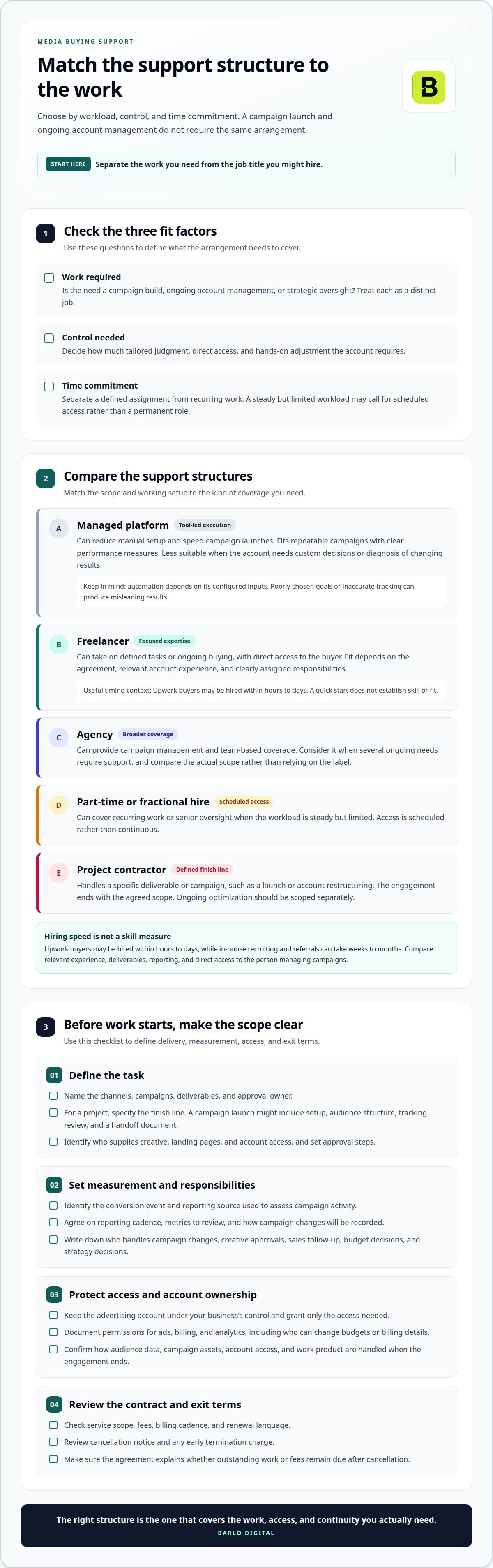
Choose based on three factors: the work required, the control you need, and the time commitment. A campaign launch and ongoing account management call for different staffing arrangements.
Managed Ad Platforms
Managed ad platforms combine automated buying tools with different levels of service. They can reduce manual setup and speed up campaign launches, but automation depends on its configured inputs. Poorly chosen goals or inaccurate tracking can still produce misleading results.
Compared with a person or agency, a platform typically offers less tailored judgment and may provide limited strategy or hands-on adjustments. It can suit a business with repeatable campaigns and clear performance measures. It is less suitable when an account needs custom decisions or a diagnosis of changing results. For specialized inventory such as Connected TV, dedicated platforms like reachafrica.com allow advertisers to reach premium audiences directly rather than relying on generalized full-service staffing.
Freelance Buyers and Agencies
Freelancers and agencies provide human campaign management, but differ in coverage and working structure. Upwork media buyers may be hired within hours to days, while in-house recruiting and referrals can take weeks to months. A quick start can help when a launch is near, but speed alone says nothing about skill.
Look for relevant account experience, clear deliverables, reporting practices, and direct access to the person managing campaigns. Ask how they define success and handle budget or objective changes. An agency may offer broader coverage, while a freelancer may provide a direct working relationship. Compare the actual scope, not the label.
Contracts and Account Ownership
Contract terms determine what work is included, how long you’re committed, and how the engagement ends. Before signing, review the service scope, fees, billing cadence, renewal language, cancellation notice, and any early termination charge. Temporary contract work is different from a permanent role.
Make sure your business controls its advertising accounts, billing access, audience data, and campaign assets. The agreement should explain what happens to access and work product when the engagement ends. A clear cancellation clause explains how much notice is required and whether outstanding work or fees remain due.
Compare options based on the workload they actually cover. These examples show why hiring structure matters: a fixed role and a short assignment carry different commitments. Use the table to narrow your choices before reviewing scope and terms.
| Option | Typical scope | Control and continuity | Best fit |
|---|---|---|---|
| Managed platform | Automated campaign execution | Tool-led, less tailored | Repeatable campaigns |
| Freelancer | Defined tasks or ongoing buying | Direct access; depends on agreement | Focused expertise |
| Agency | Campaign management and broader support | Team-based coverage | Multiple ongoing needs |
| Part-time or fractional hire | Recurring work or senior oversight | Scheduled access | Steady but limited workload |
| Project contractor | Specific deliverable or campaign | Ends with defined scope | Temporary work |
Choose the option whose scope, access, and exit terms match the work you need covered.
Freelance and project-based media buying
Freelancers and project contractors can handle campaign work without creating a permanent role. The key distinction is scope: ongoing management needs recurring attention, while a project should have a defined finish line.
Freelance Media Buying
A freelance media buyer works independently, either on recurring campaigns or a defined task. Upwork buyers may be hired within hours to days, which can help when an account needs prompt support. That speed alone doesn’t establish fit. Match the buyer’s channel experience and responsibilities to the account’s needs.
For example, a buyer might manage weekly campaign changes while your team handles creative approvals and sales follow-up. Put those boundaries in writing. Specify which platforms, campaigns, and reporting tasks the freelancer handles, and who makes budget and strategy decisions. A narrow scope makes delivery easier to assess without confusing activity with business impact.
Project-Based Media Buying
Project-based buying covers a defined piece of work, such as launching a campaign or restructuring an account. Unlike an ongoing freelance engagement, it ends when the agreed deliverables are complete. Treat that figure as a specific listing, not a universal project rate.
Define the project by its deliverables, not broad intentions. For a launch, that might include campaign setup, audience structure, tracking review, and a handoff document. Set approval steps and identify who supplies creative, landing pages, and account access. If ongoing optimization is needed afterward, scope it separately rather than assuming it comes with setup.
Outsourcing Risks
Outsourcing can create account-access and performance risks if ownership is unclear. Keep the advertising account under your business’s control, grant the buyer only the access needed, and document who can change budgets or billing. For example, a campaign manager may edit ads without owning the account or controlling payment details.
Performance can also be difficult to diagnose when reporting, tracking, and campaign changes lack clear ownership. Agree on the reporting cadence, metrics to review, and how changes will be recorded. A sudden drop in leads calls for a traceable record of edits and measurement checks, not competing assumptions about who changed what.
Use this sequence before work starts:
- Define the task. Name the channels, campaigns, deliverables, and approval owner.
- Set the measurement. Identify the conversion event and reporting source used to assess campaign activity.
- Set access boundaries. Record permissions for ads, billing, analytics, and creative assets.
- Plan the handoff. Specify the files, account notes, and open tasks delivered when the project ends.
For example, a business hiring an Upwork freelancer for a short campaign build should distinguish setup from ongoing optimization. A business using a temporary contractor should document the end date, final deliverables, and access removal. These steps make the arrangement easier to manage and reduce gaps between the contractor’s work and internal decisions.
Freelance media buyer rates
That range offers a reference point, not a complete project budget. The total depends on the hours required, campaign complexity, channels managed, and whether the buyer handles strategy, setup, optimization, and reporting.
Separate labor from media spend first. A freelancer’s fee covers campaign work; the advertising budget pays for placements. Ask for separate line items. If a proposal bundles management and ad spend, for example, request a breakdown before comparing it with another quote.
Hourly billing ties payment to time, but can make monthly costs harder to predict. A fixed project fee covers a defined scope, while an ongoing retainer usually covers recurring work. Before accepting either structure, clarify the included tasks, reporting, revision limits, and charges for work outside the scope. These terms show what the quoted amount actually covers.
That spread reflects different deliverables, not a reliable measure of buyer quality. A low-priced gig might cover one setup task, while a more expensive offer may include a broader package. Compare the promised output and responsibilities, not just the headline number.
To estimate value, match each proposed task to an output. Campaign setup, audience changes, budget adjustments, and performance reporting involve different amounts of work. Then compare the quote with the stated hours or deliverables. If one freelancer includes weekly optimization and another only builds campaigns, their prices aren’t for equivalent services.
Assess a buyer’s experience by matching past work to your channels, campaign type, and business goal. Ask for case examples that explain the initial problem, the buyer’s actions, and how results were measured. Request references who can describe communication, account handling, and reporting. A result without context can’t show whether the buyer’s contribution suits your situation.
- Check the scope. List platforms, campaigns, reporting, and optimization included in the fee.
- Separate spend. Identify advertising budget and management charges as distinct amounts.
- Review the evidence. Ask how results were measured and which work the buyer personally handled.
- Confirm billing terms. Record payment timing, extra-work charges, and project completion requirements.
A quote is useful only if its scope is measurable. For example, compare two proposals by campaign count, reporting frequency, and optimization duties. If the deliverables differ, ask for revised scopes before choosing. This turns a rate comparison into a practical assessment of workload, accountability, and expected output.
Part-time and fractional hiring options
Part-time and fractional arrangements provide ongoing media buying support without a full-time schedule. The main difference is whether the role covers execution, senior oversight, or both.
A part-time buyer handles ongoing campaign tasks within an agreed schedule. For example, they might review Google Ads weekly, adjust budgets, and report on lead volume. This suits a business with steady work that doesn’t justify a full workload. Limited hours also mean urgent changes or additional channels may compete with planned tasks.
A fractional media buyer typically provides senior-level direction for part of the working week or month. They might set channel priorities, review account structure, and guide an internal marketer who handles daily updates. This provides access to strategic judgment without assigning every execution task to the fractional buyer.
Fractional buyers and marketing consultants usually focus on guidance or specialized expertise; agencies can provide a broader team and ongoing execution. The difference depends on the agreed scope, not the title. A consultant who only advises won’t replace a buyer responsible for campaign changes, while an agency may cover several functions in one engagement.
Consider a retailer running campaigns on Meta and Google. If internal staff can make routine edits, a fractional specialist could review performance and set priorities. If no one can manage campaigns between reviews, a part-time buyer may fit better. An agency may make more sense when the work spans multiple channels or requires separate creative, analytics, and buying tasks.
Before choosing a structure, map recurring work against available capacity. List each task, its owner, and its decision-maker. Include budget changes, new campaign builds, reporting, conversion tracking, and creative approvals. This makes it clear whether you need hands-on execution or periodic oversight.
- Choose part-time execution for recurring tasks with a predictable schedule.
- Choose fractional oversight when an experienced buyer must guide existing staff.
- Choose consulting for analysis or recommendations without ongoing campaign operation.
- Choose agency coverage when several connected functions require coordinated delivery.
Set a practical review process before work begins. For example, agree that the buyer will present campaign changes and results at recurring meetings. Define which changes need approval and which the buyer can make independently. A written division of responsibilities prevents two people from changing the same campaign without coordination.
Choose based on workload, continuity, and decision-making authority. If campaign work piles up between scheduled hours, the arrangement lacks execution capacity. If internal staff can implement recommendations, fractional guidance may fill the gap. The right structure clarifies ownership and keeps routine campaign decisions moving.
Media Buying Agency Fees and Pricing Models
Agency fees depend on the work included, not simply the label “media buying.” Compare the pricing model, scope, and responsibilities in each proposal before deciding whether the offers are equivalent.
Common Agency Pricing Models
A monthly retainer charges a recurring fee for an agreed scope of services. It may cover campaign management, reporting, and planning. The agreement should state whether campaign builds, creative production, and tracking work are included or billed separately.
A percentage-of-ad-spend model ties the management fee to the advertising budget. The fee may change as spend changes. The agreement should explain how the percentage is calculated and whether a minimum fee applies. A flat monthly fee, by contrast, sets the management charge for defined work even when the advertising budget varies.
Project pricing covers a bounded assignment, such as a campaign launch or account restructuring. Performance-based pricing ties some compensation to agreed outcomes. For either model, define the deliverable or outcome, the measurement source, and any work outside the paid scope.
What Changes the Quote
Scope is the main point of comparison. Managing an established campaign differs from launching campaigns across channels, reviewing conversion tracking, and producing regular reports. A proposal should name the platforms and campaigns, optimization tasks, reporting frequency, and who supplies creative assets.
For example, two agencies may both propose “Google Ads management,” but one includes landing-page analysis while the other handles campaign changes only. The descriptions sound similar, but the work isn’t. Request a written task list that identifies account access, budget approvals, reporting ownership, and what happens when priorities change.
Agency pricing depends on the work involved, including channels, workload, advertising spend, reporting needs, and management scope. Compare proposals only after those factors and deliverables are clearly described.
How to Compare Proposals
Use the same comparison sheet for every proposal. Record the fee model, included tasks, billing terms, startup work, and cancellation terms. Then list exclusions, such as creative production or tracking fixes. This makes costs or responsibilities that a headline retainer might obscure easier to spot.
- Retainer: Compare recurring tasks and define what counts as extra work.
- Spend-based fee: Confirm the calculation and how budget changes affect charges.
- Project fee: Match payment to named deliverables and completion criteria.
- Performance-based fee: Define the outcome and the method used to measure it.
Before signing, align the fee with the workload and the metric used to evaluate it. Separate campaign management from media spend in the proposal, then assign someone to handle approvals and reporting. If the scope changes, document the change and its effect on fees before extra work begins. This keeps the agreement tied to actual responsibilities rather than assumptions.
Barlo Digital
Barlo Digital helps businesses distinguish campaign management problems from measurement failures. That distinction matters when an account reports activity but the numbers don’t show whether advertising is producing useful outcomes.
For ecommerce campaigns, our ecommerce ads audit reviews paid campaign performance. Our ecommerce tracking and measurement audit and Measurement Rescue address data and tracking problems that can distort reporting. Local businesses can use Local SEO and AI search to strengthen their visibility in local and AI-driven results.
Use the problem you need to solve to choose the next step: a campaign review, measurement work, or search visibility. This keeps the engagement focused on the operational gap rather than an assumed job title.
Choose the Support That Fits the Work
Alternatives to hiring a full-time media buyer are useful only if they address the actual performance gap. Before committing, identify the decision or task that’s currently stalled and make it the focus of your next conversation. A clear problem statement gives any engagement a practical starting point.
If paid campaigns need a closer review, Barlo Digital’s ecommerce ads audit is a relevant next step. It can help clarify whether campaign performance needs attention before you decide how to staff ongoing work.
Frequently Asked Questions
What are the alternatives to hiring a full-time media buyer?
Common alternatives to hiring a full-time media buyer include freelance support, project contractors, part-time hires, fractional specialists, agencies, and managed ad platforms. Choose based on the work left uncovered. For example, a business preparing a product launch may need a project buyer, while a team with recurring campaigns but limited expertise may need ongoing freelance or agency support. Define who approves budgets and reports results.
How much does a freelance media buyer charge in the US?
The final budget depends on hours, channels, campaign complexity, and whether the buyer handles setup, optimization, or reporting. Ask for a written scope that separates management labor from advertising spend. A campaign build and ongoing weekly optimization are different assignments, even when they use the same platform.
When should a business hire an in-house media buyer versus outsource?
Hire in-house when paid campaigns create steady work that needs daily coordination with internal sales, creative, or product teams. Outsource when needs are specialized, intermittent, or better suited to a defined scope. A business launching campaigns seasonally may not need permanent capacity. A team managing continuous campaign changes with close internal dependencies may benefit from a dedicated employee working alongside those teams, often sourced through regional job sites like SavannahJobs.com when looking for local candidates.
How can a small business manage paid ads without a dedicated media buyer?
A small business can limit complexity by focusing on a clearly defined campaign goal and a manageable set of channels. Assign someone to approve budgets and review outcomes, even if an outside specialist handles setup. Track meaningful business actions, such as completed purchases or qualified calls, rather than judging campaigns by clicks alone. Use a written change log to connect edits with shifts in performance.

Article by
Carlos Benavides
Carlos Benavides founded Barlo Digital and is its Director of Paid Media and Performance. He has fifteen years in direct-response marketing, more than $50M in lifetime ad spend, and a B.S. in Computer Science, which is why tracking at Barlo Digital is built by hand. Barlo Digital is a director-led paid media and search agency serving US ecommerce brands, home-service companies and practices.


