

A calendar full of meetings can still leave an IT sales team with little to work with. Appointment setting for IT companies means identifying and contacting prospective buyers, qualifying their fit, and arranging sales meetings with the right people. It works best when the target account, buyer role, qualification rules, and sales handoff are clearly defined.
The distinction matters: lead generation finds potential buyers, while appointment setting turns suitable prospects into scheduled conversations. The right approach depends on your sales team, deal complexity, target market, and how much control you need over outreach and qualification. This guide compares common options, explains what each includes, and shows how to choose a process that supports real sales opportunities, not just a busy calendar.
Key Takeaways
- Compare monthly, pay-per-appointment, and hybrid pricing by how each allocates cost, control, and performance risk.
- Set qualification criteria around the buyer’s role, account fit, and business need so sales meetings have a clear purpose.
- Build outreach around a defined target market, coordinated contact channels, consistent follow-up, and useful reporting.
- Judge campaign progress by the quality and consistency of meetings, not just how quickly the first one gets booked.
- Choose an appointment-setting company by the work it owns, the handoff it makes to sales, and how closely its process fits your sales operation.
What is B2B appointment setting?
B2B appointment setting is the work of finding potential business buyers, checking their fit, and booking a sales conversation. The appointment setter handles early outreach and qualification; the sales team takes over when a prospect is ready for a substantive discussion. For IT companies, appointment setting should connect a defined buyer, such as an operations leader evaluating managed services, with a relevant sales conversation.
Lead generation identifies or attracts possible buyers. Appointment setting adds direct contact, qualification, scheduling, and a handoff to sales. That handoff should capture why the prospect is interested, what they need, and who will attend. Without those details, a booked slot can look like pipeline while leaving the sales team with little to act on.
Tools should support the handoff, not create extra admin. Teams often use a CRM such as Salesforce or HubSpot, prospect research, business email, phone outreach, a shared calendar, and reporting. Connect the workflow so contact details, outreach history, qualification notes, meeting status, and follow-up ownership are recorded in the CRM.
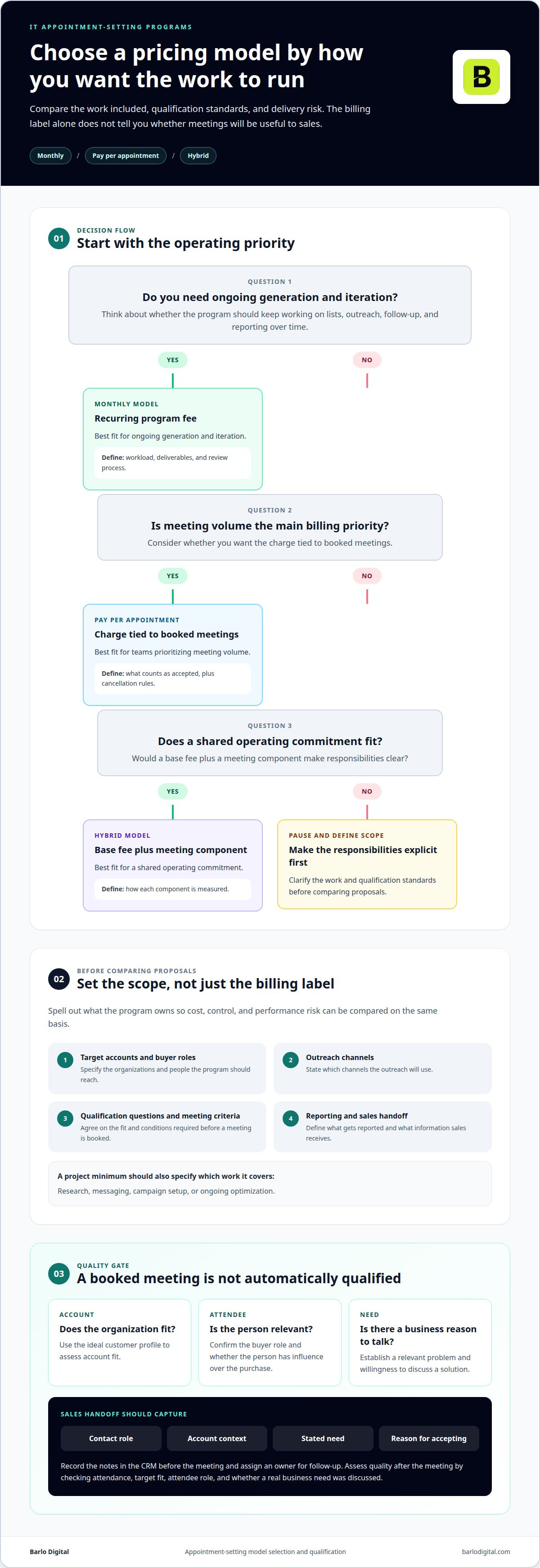
Appointment-setting services commonly use three pricing models. A monthly model covers ongoing list work, outreach, follow-up, and reporting. Pay-per-appointment charges for booked meetings, so the agreement should define what counts as an accepted appointment. A hybrid combines a base fee with a per-meeting charge. Since each model allocates delivery risk differently, compare the work included and the qualification standards, not just the billing label.
| Model | How billing works | Best fit | Risk to manage |
|---|---|---|---|
| Monthly | Recurring program fee | Ongoing generation and iteration | Define workload, deliverables, and review process |
| Pay per appointment | Charge tied to booked meetings | Teams prioritizing meeting volume | Set acceptance and cancellation rules |
| Hybrid | Base fee plus meeting component | Shared operating commitment | Clarify how each component is measured |
Define the scope before comparing proposals. Specify target accounts, buyer roles, outreach channels, qualification questions, meeting criteria, reporting, and the sales handoff. A project minimum should also state which work it covers, such as research, messaging, campaign setup, or ongoing optimization. For example, an IT provider targeting finance leaders should distinguish those buyers from technical evaluators.
For a specific program, the price depends on its scope and is provided after a quote request. Target-market complexity, outreach channels, qualification depth, and reporting requirements all affect the work involved. Choose a model that makes these responsibilities clear and ties appointment quality to pipeline outcomes.
For IT companies assessing B2B appointment setting, the right process is the one that gives sales useful, qualified conversations rather than calendar volume alone.
Sales-qualified appointments and prospect qualification
A booked meeting is not automatically a sales-qualified appointment. Qualification should establish the fit of the account and attendee, the business need, and the next step.
ICP Targeting
An ideal customer profile (ICP) defines which organizations fit your target market. For an IT provider, that might mean companies with a particular operating model, technology environment, or service need. Use those traits to screen accounts before contacting or scheduling them. ICP targeting assesses the account; meeting qualification determines whether a specific person and current need warrant a sales conversation.
Make the ICP actionable by turning it into list rules. Mark each account as a fit, possible fit, or outside scope, and record the reason. For example, a managed services provider might prioritize companies whose support needs match its service model. Lead generation may uncover interest outside the profile, but count those prospects as qualified meetings only when there is a clear reason to override the targeting rule.
Qualification Criteria
Qualification criteria determine whether a prospect is a useful fit for a sales meeting. Define the required buyer role, account fit, relevant problem, and willingness to discuss a solution. Also specify disqualifiers, such as a contact with no influence over the purchase or a need outside the IT company’s scope. Unlike ICP targeting, these criteria assess the person and conversation, not just the organization.
Set the questions before outreach begins. A setter can confirm the prospect’s responsibilities, current challenge, and reason for taking a meeting. Keep questions direct: the goal is to establish fit, not conduct technical discovery. For example, a prospect concerned about support gaps may qualify if they own the process and want to discuss relevant options. Interest alone should not inflate appointment volume.
Meeting Handoff and Quality
A useful handoff gives sales the contact’s role, account context, stated need, and reason for accepting. Add these notes to the CRM before the meeting and assign an owner for follow-up. Qualification criteria determine whether to book; the handoff gives sales the evidence needed to act.
Assess quality after the meeting, not just at booking. Record whether the prospect attended, matched the target, held a relevant role, and discussed a real business need. For example, a first-month scorecard might show two held meetings flagged as off-target because attendees had no role in maintenance planning. That helps teams improve targeting or qualification questions instead of simply chasing volume.
Targeting, list building, outreach, qualification, booking, and reporting
A reliable outbound program traces each step from target account to booked meeting. Every stage should give the next one useful information, rather than just adding to activity totals.
- Set the target. Define the market, account traits, buyer roles, and service need before building a list. An illustrative software campaign targets U.S. manufacturers with 100 to 500 employees. For an IT provider, that profile can guide research toward organizations whose operating needs fit the service being sold.
- Build and check the list. Gather company and contact details, then remove duplicates and accounts outside the target. Match each prospect to a relevant role, such as an operations leader or technology decision-maker. Record why the account qualifies. This makes list quality visible before setters begin outreach.
- Research and personalize. Use company information to find a specific reason for contact, such as a stated business priority or relevant operational change. Keep messaging tied to that evidence. A generic pitch about “improving IT” gives the prospect little reason to respond; a concise message linked to a relevant challenge makes the purpose clear.
- Coordinate outreach. Email, phone, and LinkedIn can work together as a multichannel sequence. One channel can introduce the reason for contact, while another provides a direct follow-up. Treat these figures as context, not a forecast for a specific campaign.
- Qualify and book. Use the agreed qualification questions during conversations, then offer a meeting only when the prospect fits. Confirm the attendee, purpose, time, and sales owner. Add the prospect’s stated interest and relevant context to the CRM so the sales team can prepare instead of repeating discovery.
- Report what matters. Track accounts contacted, replies, qualified prospects, meetings booked, meetings held, and sales acceptance. Segment results by target group and channel. If meetings are booked but sales rejects them, inspect the list and qualification notes. If replies are scarce, review the message and channel sequence.
For U.S. outreach, follow applicable email, consent, and privacy rules, as well as TCPA requirements for appointment-setting interactions. Keep records of contact activity and honor requests to stop outreach. Clear records also help explain why a prospect received a message and how a meeting entered the pipeline.
Reporting improves the process when it connects campaign activity to meeting quality. Review the same stages consistently, then change one input at a time, such as the account profile, opening message, or follow-up channel. This makes it easier to identify what caused a performance shift.
Appointment-setting campaign timelines
IT companies can expect first booked appointments within 7-14 days of campaign launch, while consistent weekly flow typically takes 6-8 weeks to develop. Measure progress from activity through sales outcomes, not calendar volume alone.
The first phase establishes a useful baseline. Confirm the ideal customer profile, target roles, list criteria, and meeting definition before outreach begins. Then prepare the messaging and booking process. If the ideal customer is a finance leader at a software company, for example, the outreach should address a relevant business concern rather than rely on generic IT claims.
Early appointments show whether the channel and message are reaching prospects, but they do not yet prove a stable pipeline. In the first weeks, review which accounts respond, which roles accept meetings, and whether sales considers those conversations relevant. If poor-fit contacts fill the calendar, tighten targeting or qualification before increasing outreach.
Separate leading indicators from revenue outcomes in your campaign timeline. Track outreach activity, replies, qualified prospects, meetings booked, meetings held, sales-accepted opportunities, and closed revenue. Connect each CRM stage to the account and channel. This helps distinguish a weak list from an ineffective message, poor attendance, or a handoff problem.
For example, an illustrative first-month scorecard reports 14 booked meetings. Six held meetings were accepted by sales as opportunities, while two meetings were rescheduled. Those figures describe a sample, not a forecast. The useful signal is the conversion between stages: booked meetings alone do not show whether the target profile is producing sales opportunities.
IT companies can measure appointment-setting ROI by comparing campaign costs with revenue attributed to opportunities that began with booked meetings. Track each step from meeting to accepted opportunity, closed sale, and revenue, then compare results across channels and target groups.
Review performance regularly. Early on, inspect targeting, message relevance, and prospect response. As meetings accumulate, check attendance and sales acceptance. Once the sales cycle produces outcomes, connect closed revenue to the originating campaign. Because revenue evidence can take time, keep stage-level measures visible as opportunities progress.
Use the 6-8 week development period to identify operational bottlenecks, not to excuse weak fit. If a channel produces replies but few qualified meetings, adjust the audience or call-to-action. If qualified meetings fail to progress, review sales follow-up and meeting context. This turns campaign reporting into a sequence of testable decisions.
A steady calendar matters, but it is not the final measure. A dependable program should generate meetings with the ideal customer profile, create opportunities sales accepts, and contribute to revenue over the sales cycle. Report these outcomes separately so booked volume cannot disguise poor qualification.
Appointment setting company definition and scope
An appointment-setting company handles prospecting work that helps a sales team hold qualified conversations with potential buyers. IT companies should choose an agency whose research, outreach, qualification, and handoff responsibilities fit their sales process.
The label alone tells you little. One provider may supply contact lists and setters; another may handle research, outbound messaging, follow-up, scheduling, and reporting. A third may work alongside internal sales development representatives. Compare the actual responsibilities, not the agency category or its meeting-volume claims.
Scope matters because IT sales can involve several roles. A managed services conversation may include an owner, an IT director, and a finance decision-maker. The agency should understand who starts the conversation, who assesses technical fit, and who can approve a purchase. It does not need to replace your sales team’s technical discovery or closing work.
Before selecting an agency, define the boundary between its work and yours. Specify who:
- Defines the target account and buyer roles.
- Researches contacts and prepares outreach.
- Handles replies, follow-up, and meeting scheduling.
- Records prospect context and transfers ownership.
- Reviews meeting quality with sales.
For example, if the agency books a meeting with an IT manager, your team should know who confirms attendance and leads the discussion. Unassigned steps can lead to missed follow-up and unclear accountability.
Distinguish appointment setting from related work. Lead generation identifies or attracts prospects; appointment setting contacts and qualifies them, then schedules sales meetings. Setters can support early conversations, but your sales team remains responsible for technical evaluation, proposals, and closing unless the agreed scope says otherwise.
Assess an agency’s understanding of your market with a sample account review. Ask it to explain why a specific software company fits your ideal customer profile, which buyer role matters, and what research should inform the opening message. Clear reasoning is more useful than broad claims about access to decision-makers.
Then examine how the work is managed. Look for defined meeting-acceptance rules, complete CRM notes, clear ownership after booking, and reporting that distinguishes booked meetings from held and sales-accepted meetings. A scorecard can reveal why: two held meetings may be off-target because attendees have no role in maintenance planning.
Choose based on the gap you need to close. Keep prospecting in-house if your team has the capacity and market knowledge. Use an external agency when research and consistent outbound execution are the constraint. A shared model can work when your team handles sales conversations but needs help filling the calendar. Define responsibilities in writing before launch.
Barlo Digital: Ecommerce ad management (Meta, Google, TikTok)
Barlo Digital helps IT service providers build a defined outbound process to reach qualified prospects and book relevant sales conversations. Our appointment setting for MSPs and IT services supports teams that need help moving from target-account research to scheduled meetings, with clear qualification and handoff expectations.
Appointment setting works alongside your sales process. Your team still leads technical discovery, proposals, and closing; the setting process focuses on creating suitable conversations and preserving prospect context. If that is the gap in your pipeline, review our B2B appointment-setting service and contact us to discuss your process.
Make the next pipeline decision deliberate
Before expanding outreach, make sure your IT team can handle the demand it generates. Sales capacity matters, as does the ability to onboard new accounts and deliver the services being sold. A pipeline plan that ignores either constraint can create pressure without sustainable growth. For appointment setting for IT companies, match campaign scope to your team’s capacity to serve new business.
Barlo Digital provides appointment setting for MSPs and IT services. If you’re ready to discuss whether that fits your growth plan, contact Barlo Digital about your campaign.
Frequently Asked Questions
How do I know if the meetings are any good?
Good meetings lead to a concrete sales action, not just a polite conversation. To test your rubric, have a sales representative and setter independently score sample meeting notes, then compare differences. If sales repeatedly sees timing objections while setters record strong intent, refine the definition of intent. This calibration reveals interpretation gaps before they skew campaign decisions.
What is appointment setting for IT companies?
For an IT provider, a useful outcome is a scheduled buyer conversation linked to a service need, such as a company exploring cloud migration support. Appointment setting does not replace technical discovery, solution design, or proposal work. It is a front-end sales function: it opens a relevant conversation, then hands it to the people responsible for diagnosing and delivering the technical solution.
What are the best appointment-setting strategies for IT services firms?
Build campaigns around a buying trigger, not a broad technology category. A firm supporting cloud migrations could create distinct messaging for organizations planning a migration and those seeking post-migration support. Keep each service promise aligned with delivery capacity, and use sales feedback to retire claims prospects misunderstand. This makes outreach relevant to the event prompting a conversation, not merely the prospect’s job title.
How much does appointment setting cost for IT companies in the US?
There is no single planning figure that fits every IT company. Set an internal spending ceiling using the expected gross profit from a new account and the share available for acquisition. Compare proposals against that ceiling and your cash-flow needs as opportunities mature. This ties the budget to your business economics instead of treating a market average as the right spend for your firm.
What is the average cost per qualified appointment for IT companies?
A single average can mislead because appointment value varies by IT service, buyer type, and sales cycle. A meeting about a small support need and one about a complex infrastructure project should not automatically share the same benchmark. Track results by service line and target segment. This shows which conversations justify the investment and prevents a lower-cost, lower-value segment from masking stronger opportunities.
Should IT companies use in-house appointment setters or outsource?
Base the choice on control and continuity, not workload alone. In-house setters may learn product language and receive internal feedback directly; an outside team can provide a dedicated execution function. Decide who owns messaging approval, contact records, and campaign learning if people or vendors change. If your positioning needs frequent input from technical staff, define that collaboration before assigning work externally. For businesses looking beyond traditional staffing models, Navo Inc. offers GenAI consulting to help teams deploy AI agents and develop a synthetic workforce for scaling operations.
What legal rules apply to B2B cold calling and email appointment setting in the US?
Appointment-setting outreach should be handled carefully and with attention to applicable requirements. Email outreach must also account for applicable email rules, consent requirements, and privacy obligations. Before launch, document the channels used, how contact preferences are handled, and who reviews script or template changes. Keep the workflow consistent across setters so compliance does not depend on individual judgment.

Article by
Carlos Benavides
Carlos Benavides founded Barlo Digital and is its Director of Paid Media and Performance. He has fifteen years in direct-response marketing, more than $50M in lifetime ad spend, and a B.S. in Computer Science, which is why tracking at Barlo Digital is built by hand. Barlo Digital is a director-led paid media and search agency serving US ecommerce brands, home-service companies and practices.


