

More outreach won’t fix a message without a clear operational case. To learn how to sell to manufacturing companies, use targeted email, phone, LinkedIn, and relevant trade shows, then connect your offer to a specific production, quality, labor, or supply-chain problem.
Manufacturers need a clear reason to give you time, grounded in how your solution affects their work. If your message cannot explain that connection, more follow-ups will only repeat the same mistake.
This article explains how to choose outbound channels, tailor outreach to the people and operations involved, and track results beyond opens and replies. You’ll also learn how to qualify opportunities by confirming a real operational need, a relevant decision-maker, and a credible next step. The goal is to replace scattered outreach with a process you can measure and improve.
Key Takeaways
- Anchor your pitch to a specific operational problem, such as production delays, quality issues, or supply constraints.
- Choose outreach channels based on how your target buyers research and evaluate solutions, then coordinate them around one clear message.
- Track campaign activity through meaningful steps, from targeted outreach to replies and qualified conversations, so weak points are visible.
- Qualify opportunities by confirming the operational need, the people involved in the decision, and a credible path to a next step.
- Prepare evidence that helps buyers assess fit, including relevant capabilities, implementation considerations, and business impact.
1. Contextualizing solution value within a manufacturer's operation
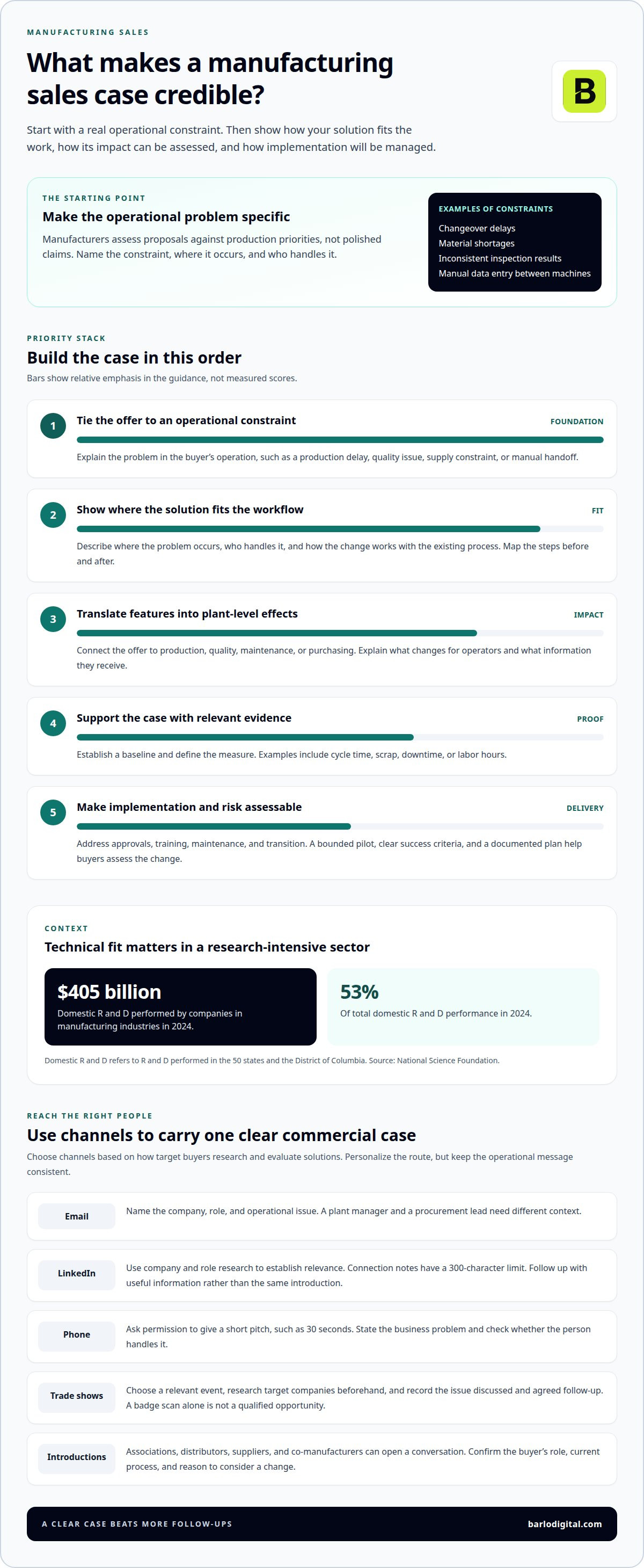
Manufacturers assess proposals against production priorities, not polished claims. Tie your offer to a defined constraint, such as changeover delays, material shortages, inconsistent inspection results, or manual data entry between machines. A strong case explains where the problem occurs, who handles it, and how the proposed change fits the existing workflow.
Research investment is one signal of that operating environment. In 2024, companies in manufacturing industries performed $405 billion of domestic R&D, representing 53% of total domestic R&D performance; domestic R&D means R&D performed in the 50 states and the District of Columbia (table 2), according to the National Science Foundation. That figure makes clear why a supplier should discuss technical fit and measurable operational value, not rely on broad promises.
Translate product features into plant-level effects. A supplier of inspection equipment, for example, should explain how it fits the inspection process, what information operators receive, and how the team identifies defects. A software provider should show how its system handles a specific handoff, such as moving a work order from planning to production. Operational efficiency improves when a solution removes a real bottleneck without creating another.
Streamlining operations takes more than automating one task. Map the steps before and after the proposed change, including approvals, training, maintenance, and the transition from the current process. A tool that reduces data entry but adds duplicate checks may simply shift the workload. Explain which tasks change, which stay the same, and how production teams will manage the transition.
What pricing models and payment terms are common when selling to manufacturers? Offers may use project fees, recurring service charges, or unit-based pricing, with payment tied to an agreed schedule or milestones. Match the structure to the deliverable, implementation effort, and purchasing process, then state the scope and acceptance conditions clearly.
How can suppliers prove ROI and reduce perceived risk? Establish a baseline, define the relevant measure, and show evidence against it, such as cycle time, scrap, downtime, or labor hours. A bounded pilot, clear success criteria, and a documented implementation plan make the decision easier to assess without promising unsupported results.
Common mistakes include pitching features without an operational use case, overlooking disruption during implementation, and assuming one contact represents every stakeholder. Before proposing a solution, ask how the issue affects production, quality, maintenance, and purchasing.
Long-term growth depends on results after installation. Review agreed performance measures with the operating team, resolve friction, and consider adjacent lines or processes only after the first application works. This evidence-based sequence turns a supplier relationship into a credible path to account growth.
2. Marketing channels for reaching manufacturers
Channel choice determines whether a useful offer reaches the right person or disappears in a crowded inbox. In manufacturing, combine direct outreach with targeted research and relevant in-person contact. Each channel should support the same commercial case, not introduce a different pitch. A disciplined channel plan clarifies how to sell to manufacturing companies without relying on a single outreach method.
Email works best when it names a specific company, role, and operational issue. A message to a plant manager about production scheduling should differ from one to a procurement lead about supplier capacity. Keep the opening focused, explain why the issue matters, and make the next step clear. A broad claim about “helping manufacturers grow” gives the reader little reason to respond.
LinkedIn can help identify relevant people and establish context before direct contact. Search by company and role, then review public posts or company updates for a current initiative. A connection note has a 300-character limit, so use it to explain the relevance of the request rather than deliver a full pitch. Follow-up should add useful information, not repeat the same introduction.
Phone outreach adds a direct route to a conversation, especially when email has not clarified who owns the issue. Ask permission to give a short pitch and state its expected duration, such as 30 seconds. Then name the business problem and ask whether that person handles it. If not, use the call to identify the correct function, rather than forcing a pitch to the wrong contact.
Trade shows can concentrate conversations with manufacturers, suppliers, and industry specialists. Start with one relevant trade show, then review its exhibitor and attendee information to identify target companies. Before the event, prepare a specific reason to speak with each prospect. Afterward, record the issue discussed and agree on a follow-up action. A badge scan without context is not a qualified opportunity.
Industry associations, distributors, suppliers, and co-manufacturers can also lead to useful introductions. These partners may understand where a solution fits because they work in the same production ecosystem. A referral does not prove demand, however. Treat it as a route to a conversation, then establish the buyer’s role, current process, and reason to consider a change.
Use company websites, product pages, hiring posts, and public announcements to personalize outreach. A new production line, for example, may create a relevant opening for a supplier serving that process. Use the detail to form a specific hypothesis, not to assume the company has a problem. Ask a focused question that lets the buyer correct your understanding.
Start with 1-2 primary channels and track which one produces relevant conversations, not just activity. Compare target-account fit, replies, meetings, and next steps by channel. Add another channel only when the first ones produce a clear signal. Understanding how to sell to manufacturing companies means treating channel performance as evidence, then allocating effort accordingly.
3. Outbound sales and controllable campaign metrics
Outbound performance comes from a system, not a pile of sent messages. Define your target account profile, identify the roles connected to the problem, and record each touch. A supplier addressing packaging delays, for example, might contact operations, procurement, and plant leadership with a distinct reason for each. Buyers need a relevant case, not identical copy sent across the supply chain.
What sales strategies work best for selling products or services to manufacturers? Lead with a specific operational issue, connect it to a practical solution, and support your claim with evidence. Coordinate email, phone, and LinkedIn outreach, then tailor follow-ups to each buyer’s role and response.
Keep emails focused. A short outreach email of around 100 characters can force the message to state one relevant reason for contact and one clear next step. This is a useful constraint, not a substitute for context. A message about reducing inspection rework should name the process or application, rather than claim broad benefits for every manufacturer.
Measure each campaign stage separately. Track qualified accounts selected, contacts reached, delivered emails, replies, positive replies, meetings booked, and opportunities accepted by sales. Record a reason for non-response or rejection, such as the wrong role, no current need, or poor timing. These details show whether the problem lies in targeting, message relevance, or follow-up.
Email open rates can provide a directional signal, but they don't prove buying intent. An aim of 45-70% depends on the target persona. Compare rates across similar campaigns, then inspect replies and booked meetings before changing the message. A strong open rate with no meaningful responses points to a weak offer, unclear next step, or poor audience fit.
Volume is controllable, but quality must stay visible. If daily outreach rises from 50 decision-makers to 100 while other factors remain unchanged, the example indicates that generated sales opportunities can double. It is an illustration, not a forecast. Track the added volume alongside account fit, positive responses, and accepted opportunities to catch deterioration early.
What sales strategies work best for selling products or services to manufacturers? Pair a clear value case with consistent follow-up and a defined handoff when interest emerges. Use the campaign record to see which approaches earn replies and which simply consume sales capacity.
How can you get meetings with manufacturing executives and plant managers? Select accounts that fit your offer, identify the likely owner of the issue, and approach that person with a concise reason to talk. Request a meeting focused on a concrete topic, such as assessing a production constraint or reviewing a supply-chain process.
Review results on a regular schedule and change one campaign variable at a time. If replies are weak, test role selection or message relevance. If meetings do not become opportunities, examine qualification and handoff. This keeps outbound decisions tied to observable evidence rather than raw activity totals.
4. Qualifying manufacturing sales opportunities
A booked meeting is not a qualified opportunity. Confirm that the manufacturer has a defined problem, that it matters operationally, and that there is a workable path to evaluation. A plant reporting inspection delays, for example, may have a relevant need, but the opportunity remains weak if no process owner will assess a change.
Who are the key decision-makers in manufacturing B2B sales? The buying group can include plant managers, operations leaders, engineers, quality teams, procurement, finance, and executives. Identify who owns the problem, who evaluates technical fit, who controls purchasing, and who approves the decision. Knowing how to sell to manufacturing companies requires mapping those roles instead of treating one contact as the whole buying group.
Use a consistent score rather than relying on a confident conversation. Rate five deal factors on a scale from 0 to 5: problem clarity, operational impact, stakeholder access, solution fit, and a defined next step. A high score in one area cannot compensate for missing basics. A clear problem with no access to its owner needs further discovery before forecasting.
Ask questions that reveal evidence. Which process is affected? How does the issue show up during a shift? Which team handles it now? What has already been tried? What would need to change for the plant to evaluate a different approach? Specific answers show whether the prospect has an active priority or is simply discussing an interesting idea.
What should a sales proposal for a manufacturing company include? State the problem and current process, proposed scope, relevant operational measures, implementation responsibilities, assumptions, and decision steps. For a production-line change, identify affected workflows and the information needed to evaluate results. Ground claims in evidence and distinguish projected impact from measured performance.
The typical manufacturing B2B sales cycle in the United States has no single duration that fits every opportunity. Technical validation, budget timing, procurement review, stakeholder alignment, and installation planning affect the pace. Track the next decision and its owner instead of assigning a close date based only on buyer enthusiasm.
Qualification should also test internal readiness. Maintenance may support a new system while operations worries about disruption, or procurement may require a review before a technical trial. Record each concern and who is responsible for resolving it. This account-planning discipline prevents one enthusiastic contact from being mistaken for organization-wide agreement.
Classify each opportunity by evidence and next action. Advance when the need, owner, fit, and evaluation step are clear; nurture when timing is the main barrier; disqualify when the problem or access is absent. A practical approach to how to sell to manufacturing companies treats qualification as a decision discipline, not a formality. That makes success measurable across the sector and keeps forecasts grounded in buyer behavior.
5. How do manufacturing companies evaluate and select vendors?
Manufacturers compare vendors against operating requirements, not presentation polish. A plant team evaluating inspection equipment may assess how it fits existing workflows, what information it produces, and how it affects quality checks. A proposal that skips these practical points leaves buyers to fill in the gaps.
Start with the buyer’s stated criteria. Confirm the production process involved, the teams affected, and the outcome they need to assess. A supplier discussing maintenance software, for example, should explain how it supports work-order handling, maintenance planning, and operator handoffs. General claims about efficiency cannot replace a clear account of operational fit.
Technical evaluations often involve people beyond the original contact. Engineers may assess specifications and integration needs. Operators may focus on ease of use and workflow impact. Quality teams may consider inspection records and consistency. Procurement may review scope, terms, and supplier requirements. Map each concern to the person responsible for evaluating it.
Manufacturers also look for evidence of quality and innovation. Use relevant case examples, product documentation, or test results to show how the solution performs in a comparable setting. Explain what was measured, under what conditions, and which results were observed. Separate evidence from projections so buyers can distinguish demonstrated performance from expected outcomes.
Implementation details can determine whether a strong technical offer is workable. Describe the installation or onboarding sequence, the information needed from the manufacturer, and the teams involved. If a new inspection process changes operator tasks, for example, explain how responsibilities and handoffs would be handled. Unclear deployment creates uncertainty before a purchase decision.
Connect the commercial review to specific deliverables. State what the buyer receives, each party’s responsibilities, how acceptance will be assessed, and which assumptions shape the proposal. If the offer covers one production line, clearly define that boundary. Vague scope invites disagreement when teams interpret the same proposal differently.
Supplier evaluation also tests communication. Answer questions directly, provide requested documents in a usable format, and record open issues with an owner and next step. When dealing with international trade, cross-border procurement, or overseas legal paperwork, official translation and legalization services like cancilleriatraduccionesoficiales.com ensure that regulatory documents meet compliance standards. If a buyer asks how a system handles a particular process, address that process rather than repeating general product benefits. Precision reduces friction across review teams.
Help the buying group reach a decision by summarizing the operational need, evidence reviewed, unresolved risks, and agreed evaluation steps. A concise comparison can show where your proposed solution meets stated requirements and where assumptions remain. This gives operations, engineering, quality, and procurement a shared basis for discussion.
Vendor selection rarely comes down to one persuasive meeting. It depends on whether the offer fits the work, the evidence supports the claims, and implementation is clearly defined. Address each criterion with specific information, then clarify the next decision: what the manufacturer needs to evaluate, who owns it, and what happens next.
Barlo Digital: Appointment setting for companies selling to medical practices
Barlo Digital supports manufacturers that need a more structured way to start sales conversations with relevant business buyers. Turn to us when your team has a clear offer but needs help reaching the people responsible for evaluating it.
Our appointment setting for manufacturers connects outreach with the next step in your sales process. Contact Barlo Digital to discuss your target accounts and outreach needs.
Turn your outreach into a repeatable sales process
Manufacturing sales improve when outreach follows a clear operating discipline: define target accounts, assign follow-up ownership, and review whether conversations progress to real evaluations. The answer is not simply more activity. Make sure the right buyers hear a relevant case and have a clear path to a meeting.
If your team needs consistent conversations with manufacturers and industrial suppliers, Barlo Digital provides appointment setting for this market. We can support the step between identifying target accounts and holding qualified sales discussions. Explore manufacturing lead generation support.
Use what you’ve learned to decide where your outreach process needs structure, then take a practical next step with Barlo Digital.
Frequently Asked Questions
What channels should you use in your outbound sales campaign?
Coordinate email, phone, and LinkedIn to reach buyers and learn about their needs. Send a relevant email, use LinkedIn to understand the contact’s responsibilities, and call when a direct conversation can clarify who owns the issue. A trade show can add in-person conversations when its exhibitors fit your target market. Track each channel’s contribution to meaningful next steps, not just message volume.
What kind of messaging should you send to your prospects?
Explain why you contacted that specific person and why the topic may matter to their work. A prospect responsible for quality may care about inspection consistency, while a maintenance lead may focus on equipment availability. Keep claims factual, avoid assuming the company has a problem, and make it easy for the prospect to correct your understanding. A useful first message opens a focused discussion instead of forcing a product pitch.
What should your outreach campaign look like?
Build a campaign around a defined group of target companies, suitable contacts, and a consistent follow-up process. Record why each company fits, who you contacted, what you sent, and the response or next action. For example, group prospects by production process rather than sending the same sequence to every manufacturer. Review replies and meeting outcomes regularly, then revise one part of the campaign at a time to see what changed performance.
Where can you get your B2B data, and what should you look for?
Build prospect records from company websites, trade show exhibitor directories, industry association directories, and public company announcements. Record each company’s products, relevant operations, contact name and role, source, and review date. Confirm the contact still works in the stated function before outreach. Avoid purchased or shared lead lists: outdated roles and poor company fit waste contact attempts and make campaign results harder to interpret.
How do you identify and research manufacturing companies as prospects?
Start with the production process or customer group your solution serves, then identify manufacturers whose public information suggests a plausible fit. Review product pages, facility descriptions, hiring notices, and news about equipment or expansion. Use those details to form a specific outreach hypothesis, not to claim the company has an unreported problem. Record the evidence and likely operational owner so your first contact has a clear, relevant reason.

Article by
Carlos Benavides
Carlos Benavides founded Barlo Digital and is its Director of Paid Media and Performance. He has fifteen years in direct-response marketing, more than $50M in lifetime ad spend, and a B.S. in Computer Science, which is why tracking at Barlo Digital is built by hand. Barlo Digital is a director-led paid media and search agency serving US ecommerce brands, home-service companies and practices.


