

A booked meeting is not automatically a sales opportunity. An appointment setting agency reaches prospective buyers, qualifies whether they fit your criteria, and schedules conversations for your sales team. The distinction matters: activity creates value only when the right people show up and can move toward a sale.
Outsourcing prospecting can free salespeople to focus on selling, but appointment-setting services vary. Some providers manage outreach and qualification; others emphasize meeting volume, with less control over who accepts an appointment. The pricing model also affects what you pay for and what your team still needs to manage.
This guide explains what appointment-setting agencies do, how their pricing models work, and how they compare with in-house SDRs and lead vendors. You’ll learn what to measure beyond meetings booked, how to spot gaps in qualification and follow-up, and which approach may fit your sales process.
Key Takeaways
- Separate meeting volume from meeting quality by defining who qualifies and what makes an appointment useful to sales.
- Assess targeting, list building, outreach, qualification, and follow-up as distinct parts of the service.
- Compare pricing models by what each one pays for and which costs or responsibilities remain with your team.
- Weigh outsourced appointment setting against in-house SDRs and lead vendors based on control, workload, and fit with your sales process.
- Use the decision guide to identify whether your main need is qualified conversations, internal prospecting capacity, or a source of leads.
What is an appointment setting company?
An appointment-setting company contacts prospects and schedules sales meetings. A strong process links prospect research, qualification, calendar confirmation, and your ideal customer profile.
In the United States, applicable requirements depend on the call or text method and campaign details. Separate the channels and document how outreach will be handled before a campaign begins.
Outsourcing can reduce direct control over prospect conversations and create brand or qualification mismatches. No-show rates can exceed 30% without dedicated meeting confirmation and nurture sequences, so booking volume alone is a weak measure.
Lead Research and Qualification
Lead research checks whether a prospect fits your ideal customer profile before outreach. Qualification then tests details needed for a useful sales conversation, such as the prospect’s role and stated business need. Calendar confirmation comes later, after the prospect agrees to meet. Ask to see a sample record with the research and qualification fields.
Appointment Quality and Calendar Confirmation
Appointment quality depends on who attends and whether the meeting has a clear business purpose. Calendar confirmation is a separate operational step: the prospect receives the meeting details, and the sales team can see the scheduled time in its calendar software. No-show rates can exceed 30% without dedicated confirmation and nurture sequences. Track held meetings, not just bookings.
BANT-Qualified Appointments
BANT assesses Budget, Authority, Need, and Timeline. It gives sales teams a consistent qualification framework, but it is not a substitute for prospect research or a calendar invitation. For example, a meeting with someone in a relevant role may still lack evidence of a current need or buying timeline. Define acceptable evidence for each criterion before outreach begins.
Use the same definitions when comparing providers. A B2B outreach and qualification process should make the target roles, qualification questions, and appointment handoff clear. Otherwise, two providers can report “qualified meetings” while delivering different prospects.
Compare the work by its purpose and proof:
| Option | Main task | Evidence to assess |
|---|---|---|
| Lead research | Find and assess prospects | Fit with your ideal customer profile |
| Calendar confirmation | Support attendance | Confirmed meeting details and held meetings |
| BANT qualification | Assess buying readiness | Budget, Authority, Need, and Timeline |
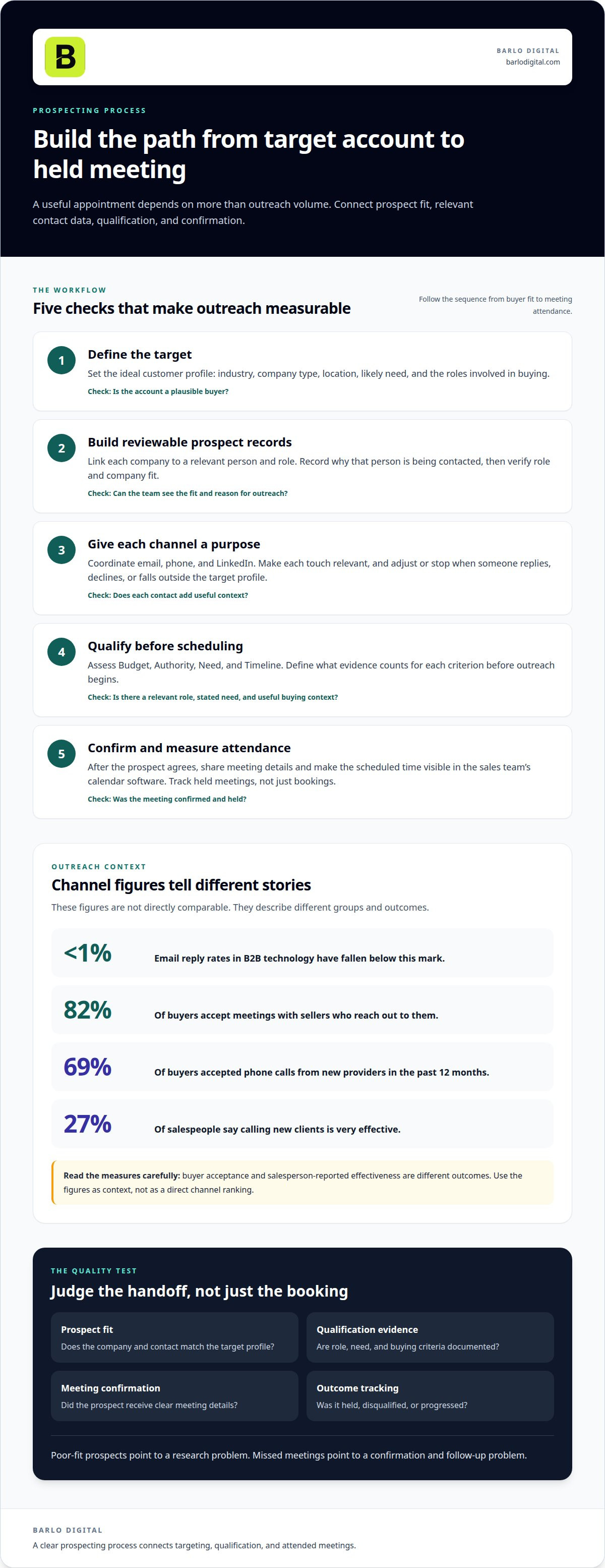
Match the process to the bottleneck: poor-fit prospects call for better research, while missed meetings call for confirmation and follow-up.
Targeting, list building, outreach, and qualification
Targeting determines whether outreach reaches a plausible buyer or wastes effort on the wrong account. Start with your ideal customer profile: industry, company type, location, likely need, and the roles involved in buying. For example, a manufacturer selling maintenance software might target operations leaders and exclude companies without relevant equipment. Specific criteria make list building and qualification easier to review.
List building turns those criteria into prospect records. Each record should link a company to a relevant person, role, and reason for outreach. In an IT services sale, a technical decision-maker may influence the evaluation, while an owner may control the purchase. Treat these as distinct roles, not interchangeable names. Review sample records for the person’s current role, company fit, and documented reason for contact.
Channel choice should follow the buyer and the offer. In B2B technology, email reply rates have fallen below 1%. At the same time, 82% of buyers accept meetings with sellers who reach out to them. These figures point to a targeting problem, not a reason to flood inboxes. A useful sequence gives each contact a relevant business reason to respond.
Phone can matter for reaching IT decision-makers. In the past 12 months, 69% of buyers accepted phone calls from new providers, while 27% of salespeople say calling new clients is very effective. Those measures describe different groups and outcomes. Use calls to test interest or clarify fit, then record the result so the next message reflects the conversation.
A multichannel sequence coordinates email, phone, and LinkedIn rather than repeating the same pitch everywhere. An email might identify an operational issue, a call test whether it matters, and a LinkedIn message add professional context. Give each touch a clear purpose. Stop or adjust the sequence when a prospect replies, declines, or falls outside the target profile.
Email infrastructure affects whether messages reach inboxes and replies are tracked accurately. Review the sender identity, mailbox ownership, reply routing, and how responses enter your sales software. A sound process separates campaign messages from personal follow-up and prevents representatives from contacting the same prospect without context. Monitor deliverability to catch a sudden drop in successful delivery before it becomes a wider list problem.
- Target: define the company profile and relevant decision-makers.
- Build: check each prospect record against those criteria.
- Sequence: assign a distinct purpose to each channel.
- Review: track replies, disqualifications, and conversations that progress.
These steps make outreach measurable. A team can trace each conversation from target selection through qualification instead of judging performance by message volume alone.
Pay-per-appointment and performance-based pricing
Pricing models distribute financial risk differently between the buyer and provider. Compare what triggers payment, which work is included, and what outcome your sales operation needs.
Pay-Per-Appointment Pricing
Pay-per-appointment pricing charges for each meeting that meets agreed criteria. It ties payment to appointments instead of a fixed monthly engagement, but the billable event must be precise. Specify whether the prospect must fit your target profile, attend, or meet qualification standards. Otherwise, a booking may trigger payment without producing a useful sales conversation.
Performance-based terms may tie payment to held meetings or later sales outcomes. Those terms require clear attribution. Define how the agreement treats cancellations, reschedules, duplicate prospects, and opportunities already in your pipeline. A hybrid model combines recurring payment with appointment-based charges, separating ongoing campaign work from meeting volume. More than 80% of outsourced SDR firms use dedicated retainer models exclusively, so payment per appointment is not the only available structure.
Pricing by Company Size and Engagement Costs
Monthly pricing can vary with campaign scope and company needs. Company size may affect the number of stakeholders, target accounts, and reporting requirements, but it does not determine the work on its own. A focused campaign for a specialized audience may require extensive research, while a broader campaign may need more list management and outreach coordination.
Engagement costs depend on the scope and are provided after a quote request. Factors include the target market, list-building responsibilities, outreach channels, qualification criteria, and reporting. Compare proposals with the same deliverables. If one includes prospect research and another expects your team to provide records, the fees do not cover the same work.
Evaluate the economics using outcomes your sales process values. Separate meetings booked from those held and accepted by sales. Then compare the cost of each useful outcome with the value your pipeline assigns to a qualified opportunity. This can reveal when a low booking charge produces poor attendance or conversations with poor-fit prospects.
- Monthly retainer: assess the work covered and recurring responsibilities.
- Per appointment: define the exact event that triggers payment.
- Hybrid: separate fixed campaign work from appointment-based charges.
Before signing, document how reschedules, cancellations, and disqualified meetings affect billing. Clarify whether personalized messaging, list preparation, and reporting are included. A written definition prevents each side from counting different outcomes as completed services. Choose the model that aligns payment with what your sales pipeline needs.
Appointment setting agencies compared with in-house SDRs and lead vendors
These options address different bottlenecks. An outsourced team manages outreach and meeting setting; in-house sales development representatives (SDRs) work within your sales operation; lead vendors supply contacts for your team to pursue.
Start the comparison with ownership. Identify who researches prospects, starts conversations, qualifies interest, follows up, and records outcomes. If your sales team lacks outreach capacity, a managed operation may fit. If your strategy calls for daily control over messaging and prospect feedback, internal SDRs offer closer integration. If your team already handles outreach, lead data may be the missing input.
| Option | Who performs outreach? | Primary handoff | Best fit |
|---|---|---|---|
| Appointment-setting provider | External team | Scheduled, qualified meetings | Need execution and booked conversations |
| In-house SDRs | Your employees | Prospects and meetings to sales | Need direct control and internal learning |
| Lead vendor | Your sales team | Contact records | Need prospect data, not outreach execution |
An outsourced appointment-setting operation can add execution without requiring you to build an internal team. In-house teams also experience annual churn of 35%. Those figures make hiring a capacity decision, not simply a comparison of monthly fees.
Lead vendors provide a different input. A contact record is not a conversation, a qualified prospect, or a sales opportunity. Your representatives still need to verify fit, make contact, and guide interested buyers through the sales pipeline. Compare records with completed outreach and held meetings, rather than treating every delivered name as equivalent.
Handoffs determine whether a model supports your sales team. Agree on fields such as company, contact role, outreach history, stated need, meeting date, and next action. A salesperson opening a CRM record should see why the prospect agreed to talk, not just a calendar invitation. A client portal can show campaign activity and handoff records, but the data is useful only if it is current and actionable.
AI tools can support lead generation by organizing records, summarizing conversations, or prioritizing follow-up. They do not replace a defined target profile or human review of a prospect’s fit. Ask which decisions the software automates and which remain with a representative. Tools that generate activity without clear ownership can create duplicate outreach and cluttered records.
Choose an external team for execution, internal SDRs for closer control and learning, or a lead vendor when your team needs contact data and can handle outreach.
Appointment setting agency definition and scope
An appointment-setting provider is an external sales-development partner that helps turn selected prospects into scheduled conversations. Its scope may stop at booking or include prospect research, qualification, confirmation, and handoff. “Appointment setting services” describes a category of work, not a standardized package.
Define the scope before comparing providers. In writing, identify who owns each step: selecting accounts, finding contacts, writing messages, conducting outreach, qualifying replies, booking meetings, and reporting outcomes. One engagement may deliver calendar bookings while your sales team handles qualification. Another may screen prospects before scheduling.
The deliverable matters too. A booked meeting is a calendar event, not a sale, contract, or guaranteed opportunity. A useful handoff record might include the prospect’s company, role, stated interest, meeting time, and reason for agreeing. These details help a salesperson prepare rather than start without context.
Scope should reflect the type of sale. A software provider selling to IT leaders may need conversations with technical decision-makers. A commercial supplier may need meetings with purchasing or operations staff. A home improvement company may need an estimate appointment with a homeowner. Each scenario calls for distinct qualification questions, scheduling details, and sales-team follow-up.
Make campaign messaging and account ownership explicit. Specify which claims representatives may make, what information they can collect, and how they record responses. If a prospect asks about implementation, for example, the representative should capture the question and route it to the appropriate salesperson rather than improvise.
Set up reporting that tracks work from outreach to outcome. Useful status labels include contacted, replied, qualified, booked, rescheduled, held, and disqualified. Shared definitions prevent the provider and sales manager from counting outcomes differently. Review records alongside meeting results, then adjust targeting or messaging if poor-fit conversations recur.
An external provider may schedule the first conversation, while your internal team handles demonstrations, proposals, negotiations, and closing. State these boundaries in the agreement so a booking is not mistaken for full-cycle sales coverage. The provider should also clarify its handoff and reporting responsibilities.
Before signing, map the handoff in a simple sequence:
- Provider: document the agreed prospect and appointment details.
- Sales team: review the record and prepare for the conversation.
- After the meeting: record whether it was held and what happens next.
The practical takeaway: compare the work, handoff, and measurable deliverable, not the provider’s label. A clearly defined scope shows what gets booked, what your team receives, and where its responsibility begins.
Barlo Digital: Ecommerce ad management (Meta, Google, TikTok)
Barlo Digital is a fit when the growth problem is ecommerce demand, not outbound prospecting. We manage ecommerce advertising across Meta, Google, and TikTok, helping brands run campaigns tied to online sales rather than scheduled B2B meetings.
The distinction matters. If your sales team needs conversations with IT decision-makers, appointment setting addresses that workflow. If your business sells products online and needs paid media execution, our ecommerce ad management is the relevant service. Measurement also matters: weak conversion tracking can make campaign decisions unreliable, so a tracking and measurement audit may fit when purchase data is unclear.
For ecommerce brands evaluating paid acquisition, visit our ecommerce ad management page to see how we can help.
Choose the next move based on the real bottleneck
Before committing to an appointment setting agency, decide whether your constraint is prospecting capacity or demand generation. If your team can convert qualified conversations but lacks outreach execution, appointment setting may address the gap. If the challenge is attracting buyers to an online store, focus on a different part of the growth system.
Barlo Digital can help when the next step is paid acquisition or measurement, rather than simply adding meetings. Our services include ecommerce ad management across Meta, Google, and TikTok, an ecommerce tracking and measurement audit, and local SEO and AI search. The goal is to identify the right growth problem before committing resources.
Bring the decision you’re weighing and the operational constraint behind it. Contact Barlo Digital to discuss your options, then choose the next step with a clearer view of what your sales process actually needs.
Frequently Asked Questions
How do I know if the meetings are any good?
Judge meetings by what happens after the invitation, not by booking count alone. Compare the attendee’s role, company fit, stated reason for meeting, and the sales team’s next action. If conversations repeatedly stall because attendees lack purchasing influence, tighten the role criteria. Review CRM outcomes by campaign and source to find patterns and adjust targeting before repeating the same mistake.
How does pay-for-performance SDR pricing work?
Pay-for-performance pricing ties some or all payment to an agreed result, such as a booked or held meeting. Define the qualifying event and address cancellations, rescheduling, duplicate contacts, and prospects already in your pipeline. A booked meeting that does not happen may count differently from one attended by an eligible prospect. Settle these rules before launch to avoid invoice disputes.
What does an appointment-setting provider do?
An appointment-setting provider handles work that moves selected prospects toward scheduled sales conversations. Depending on the engagement, tasks may include account research, contact identification, outreach, qualification, scheduling, and reporting. Your team should establish where the provider’s responsibility ends. The provider might arrange an initial conversation while your salesperson handles demonstrations, proposals, and negotiations. Clear boundaries help prevent gaps in the handoff.
How much do providers charge?
Costs depend on the payment model and work included, so there is no single useful price for every engagement. Scope factors include audience complexity, research responsibilities, outreach channels, qualification depth, and reporting. A narrow technical market may require different work from a broad prospect list. Compare proposals against the same deliverables and billing definitions. Pricing for a specific engagement depends on the case and follows a quote request.
What pricing models do providers use?
Common structures include a monthly retainer, payment per appointment, or a hybrid of fixed and outcome-based components. Each allocates costs differently. A retainer covers ongoing campaign work; per-appointment terms tie payment to defined bookings; a hybrid separates continuing work from appointment volume. Compare models using the same definition of success, such as a meeting held with an eligible prospect, and account for the work your team must still do.
How do I choose a reliable appointment setting agency?
Choose based on process clarity and useful reporting, not polished claims. Ask to review a sample report showing outreach activity, prospect status, and meeting outcomes. Confirm who approves messaging, how your team receives records, and how targeting changes are handled. A dependable provider should explain the handoff plainly. If ownership is unclear during the sales discussion, execution may also be difficult to manage.
How do external providers compare with in-house teams and freelancers?
An external provider generally supplies a managed process, an in-house team offers closer daily control, and a freelancer provides individual execution. The right fit depends on how much management your company can take on. A sales leader with established messaging may prefer an internal hire, while a team needing coordinated research and outreach may value broader external execution. Compare supervision, continuity, internal learning, and follow-up ownership.
What industries benefit most from appointment-setting services?
Appointment setting can suit industries where sales depend on reaching specific decision-makers or arranging a defined consultation. Examples include MSPs and IT services, manufacturers, staffing firms, commercial insurance agencies, and suppliers selling to medical practices. Home improvement, roofing, and solar businesses may need in-home estimate appointments. A strong fit has a clear target buyer, a relevant reason to talk, and a sales process ready to follow up.

Article by
Carlos Benavides
Carlos Benavides founded Barlo Digital and is its Director of Paid Media and Performance. He has fifteen years in direct-response marketing, more than $50M in lifetime ad spend, and a B.S. in Computer Science, which is why tracking at Barlo Digital is built by hand. Barlo Digital is a director-led paid media and search agency serving US ecommerce brands, home-service companies and practices.


