

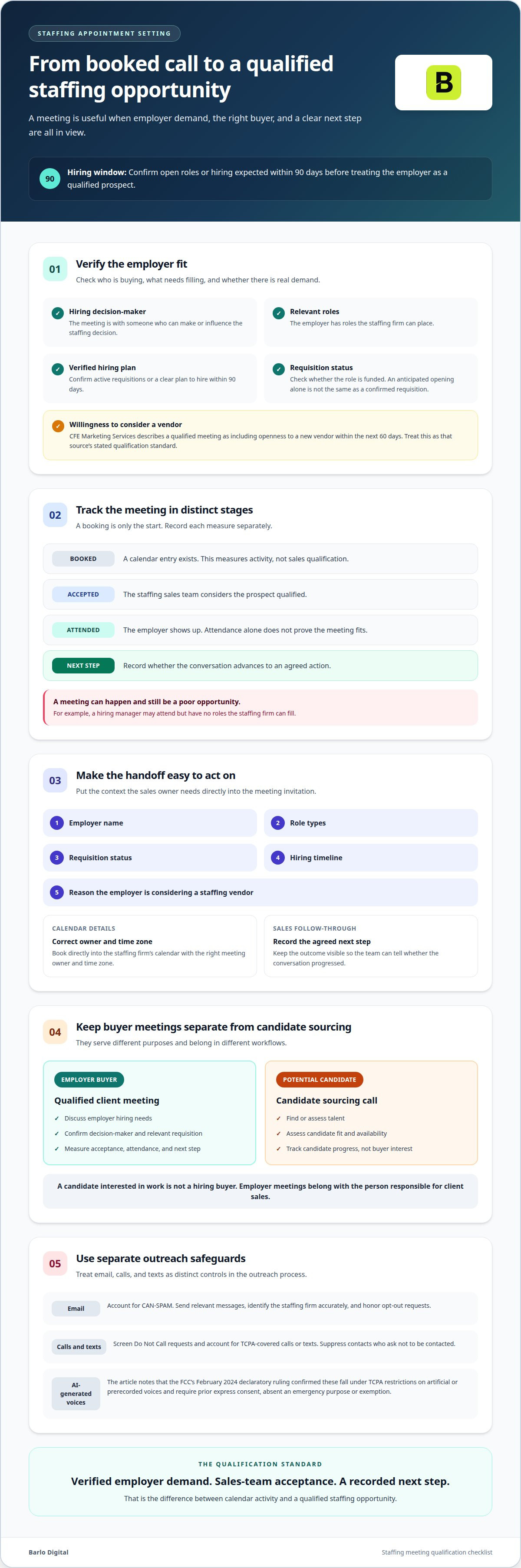
Yes, an appointment setter can cold call employers for a staffing firm. Effective appointment setting for staffing agencies starts with reaching the right hiring decision-maker, then confirming the employer has open roles or expects to hire within 90 days. A booked call without that fit is calendar activity, not a qualified sales opportunity.
You’re right to weigh outsourced appointment setting against hiring in-house: the cheaper-looking option can carry costs in management time, training, tools, and missed sales work. This article explains how appointment setting for staffing agencies can reach employers, what makes a staffing buyer worth a meeting, and how to compare the two models without treating booked appointments as proof of value. You’ll also see which measures show whether meetings are attended, meet your qualification standard, and lead to a real next step.
Key Takeaways
- Separate a booked meeting from a qualified opportunity by confirming hiring needs, decision-making authority, and openness to a staffing vendor.
- Compare outsourcing with in-house hiring by weighing management time and operating costs alongside the setter’s direct compensation.
- Judge appointment-setting providers by whether meetings show up, meet your qualification standard, and progress to a concrete next step.
- Set clear expectations for outreach, handoffs, and reporting so your sales team can act on qualified employer conversations.
Qualified meetings with recruitment and staffing company buyers
A qualified meeting connects a staffing firm with a hiring decision-maker who has roles the agency can fill and a reason to consider a vendor. Confirm hiring timelines and requisition status, then track attendance. These details distinguish a live opportunity from a calendar entry.
For outreach, treat CAN-SPAM email, TCPA-covered calls or texts, and Do Not Call screening as separate controls. The FTC’s Telemarketing Sales Rule exempts most calls between telemarketers and businesses; according to the FCC, its February 2024 declaratory ruling confirmed that AI-generated voices fall under TCPA restrictions on artificial or prerecorded voices and require prior express consent, absent an emergency purpose or exemption.
To reduce spam complaints, send relevant messages, identify the staffing firm accurately, and honor opt-out requests throughout follow-up. Suppress contacts who ask not to be contacted, and avoid sending every prospect the same pitch.
Meeting Quality and Show-Up Rates
A booked meeting measures calendar activity; an accepted meeting shows whether the staffing sales team considers the prospect qualified. Track attendance separately, then record whether the conversation advances to an agreed next step. For example, a hiring manager may attend but have no roles your agency can fill. That meeting happened, but it did not create a useful sales opportunity.
Requisition-Based Meeting Qualification
Require evidence of active hiring or confirmed hiring within 90 days before treating a prospect as qualified. CFE Marketing Services defines a qualified meeting as one with a hiring decision-maker who has open or upcoming roles the agency places and is open to a new vendor within the next 60 days. Confirm whether the requisition is funded, not just anticipated.
Calendar Booking and Meeting Logistics
Book the prospect directly into the staffing firm’s calendar with the correct meeting owner and time zone. Include the employer, role types, requisition status, hiring timeline, and reason for considering a vendor in the invitation. These are logistics that prevent missed or misrouted meetings; qualification establishes whether the opportunity fits.
Client meetings pursue employer demand; candidate sourcing identifies people for available or prospective roles. Keep the workflows distinct. A candidate interested in work is not a hiring buyer, and a prospect meeting belongs with the person responsible for employer sales. A structured B2B appointment-setting process should make that distinction clear in its handoff.
| Option | Primary purpose | Qualification evidence | Measure |
|---|---|---|---|
| Qualified client meeting | Discuss employer hiring needs | Decision-maker and relevant requisition | Accepted, attended, next step |
| Unqualified booked meeting | Calendar activity only | No matching role or clear hiring plan | Show-up without sales acceptance |
| Candidate sourcing call | Find or assess talent | Candidate fit and availability | Candidate progress, not buyer interest |
Set a meeting standard that requires verified employer demand, acceptance by the sales team, and a recorded next step.
Outsourced appointment setting versus hiring an in-house sales rep
Outsourcing and hiring in-house solve different capacity problems. The right model depends on whether your staffing firm needs outreach execution, broader sales ownership, or both.
A managed appointment-setting agency brings an external operating team, but your firm still needs to define target accounts, placement strengths, and meeting standards. Neither option replaces a staffing salesperson who can assess client needs and move a deal forward.
Email-Based and Phone-Based Setting
Email supports repeatable, documented follow-up, while phone calls create live conversations and can surface objections immediately. A staffing firm can combine the two: use email to give an employer context, then call to discuss hiring needs and request a meeting. Evaluate each channel by qualified conversations and accepted bookings, not message volume alone.
An in-house hire gives you direct control over daily priorities and can build knowledge of the firm’s recruiting specialties over time. A managed agency can handle consistent prospecting without requiring your firm to recruit and supervise another employee.
Appointment Setting and Business Development
Appointment setting focuses on starting qualified employer conversations and booking them with the right sales contact. Business development goes beyond booking and may include account strategy, relationship management, proposal work, and progressing opportunities. If your staffing firm needs someone to own the sales cycle, a setter alone won’t fill that role.
Pay-per-result pricing ties payment to a defined outcome, but the contract must specify what counts as a result. Paying for raw calendar bookings can reward volume without accounting for attendance or sales acceptance. A monthly retainer pays for an agreed scope of ongoing work; assess it against delivery, meeting quality, and reporting. With either model, define lead ownership, qualification criteria, cancellation handling, and how unqualified meetings are recorded before outreach begins.
Choose an in-house hire when close daily oversight and broader internal responsibilities matter most. Choose managed support when the gap is consistent prospecting capacity, while keeping sales ownership with the people who can advance staffing opportunities.
Comparing appointment-setting agencies for US recruitment firms
Compare vendors on targeting, outreach execution, meeting quality, and reporting, not booked volume alone. Ask how each identifies employer demand, adapts its message to your staffing niche, and distinguishes an interested prospect from a calendar entry.
Strategies differ by staffing niche and US region because hiring needs, job titles, and employer language vary. A firm placing healthcare professionals may target hospital hiring leaders, while an industrial recruiter may focus on plant operations and production roles. Regional campaigns should account for local employer markets and time zones when scheduling calling and follow-up.
Compare providers against the same criteria. Use a sample target account and ask each vendor to explain its process, from prospect research to sales handoff. Look for specifics:
- Targeting: How does the team identify companies with relevant open roles?
- Outreach: Which channels are used, and how does messaging change by decision-maker?
- Qualification: What evidence makes a meeting acceptable to your staffing sales team?
- Reporting: Can you distinguish attempts, conversations, bookings, attendance, and accepted meetings?
- Coverage: Can the team serve your target industries, locations, and time zones?
For company research, a provider can combine your placement specialties with public hiring signals, such as employer career pages and job postings. It should connect a relevant opening to roles your recruiters fill, rather than treating every company with a careers page as a prospect. LinkedIn can help identify relevant business contacts, but finding a contact alone does not prove active hiring or buying intent.
Ask how outbound volume is controlled. A staffing firm’s program may use 50-100 new prospect touches per week, with follow-up spaced across 7-10 touches over 10-14 business days. These figures describe an operating approach, not a guarantee of results. The provider should show how calls, email, and other outreach are coordinated without sending the same generic message repeatedly.
Compare scale by coverage and account fit, not headcount claims. A provider focused on a narrower market may know its employers more closely, while broader coverage can suit a firm recruiting across multiple markets. For example, a healthcare recruiter may prioritize hospital targeting, while a technical recruiter working across the country may need consistent research across time zones.
During evaluation, request a sample report showing prospect criteria, outreach activity, meeting outcomes, and why each meeting qualifies. A high booking count without those details can hide weak targeting. Choose a vendor that can explain its process, show relevance to your niche, and report the full path from researched account to sales-accepted conversation.
Appointment setter staffing costs and pricing models
Compare the full operating cost, not just an in-house setter’s compensation or a vendor’s monthly fee. For a staffing firm, include sourcing, training, manager time, campaign execution, and whether meetings meet the agreed standard.
An in-house setter costs more than their pay. Hiring takes time, and a manager must train the employee on placement specialties, target companies, and how to qualify employer conversations. For example, a recruiter focused on healthcare roles needs a different account brief from a team placing industrial technicians. These requirements affect ramp-up and supervision.
A managed appointment-setting agency may include prospect research, outbound execution, booking, and reporting in its scope. Your staffing firm still needs to provide its placement focus, target employer profile, relevant roles, and criteria for an accepted meeting. Without those inputs, an external team can generate activity that misses your sales priorities.
Compare providers’ published service prices and the work each price covers. Cost factors include target-account scope, outreach channels, qualification depth, market coverage, and reporting requirements. A program for one staffing specialty may differ from a campaign targeting employers across several industries. The structure should reflect the work required, not an assumed number of calendar bookings.
Common contract structures shift risk in different ways:
- Monthly retainer: Sets payment for an agreed service scope. Specify research, outreach, booking, and reporting responsibilities.
- Pay per result: Ties payment to a defined outcome. Define whether that means a booked meeting, an attended meeting, or a sales-accepted opportunity.
- In-house employment: Gives the staffing firm direct control. The firm carries hiring, supervision, training, and continuity responsibilities.
Pay-per-result pricing can look simple until the contract defines “result.” A meeting with an employer that lacks relevant roles may have little commercial value. The contract should explain how cancellations, no-shows, duplicate prospects, and rejected meetings are handled. It should also state who owns prospect records and who updates the calendar.
Before signing, assign an owner to each deliverable. The provider may handle sourcing and outreach; your staffing firm may define target roles, accept meetings, and lead sales discussions. Reporting should distinguish outreach attempts from bookings and accepted meetings. That separation helps show whether weak outcomes stem from targeting, execution, or your firm’s qualification criteria.
Make a like-for-like comparison: estimate internal management effort, list outsourced deliverables, and apply the same meeting-quality standard to both options. A staffing firm that needs daily control may prefer an employee; one that needs structured outreach without extra internal supervision may prefer a managed arrangement.
Appointment setter responsibilities and qualification
A staffing appointment setter turns a target account into a prepared sales conversation. The work covers research, outreach, qualification, booking, and handoff. Give each stage a clear owner, or activity can rise while useful employer conversations remain scarce.
Before a campaign starts, the setter needs your staffing firm’s placement focus, ideal employer profile, target roles, and decision-maker titles. A firm placing warehouse supervisors, for example, should not receive a contact list built around unrelated executive hiring. Account research should connect an employer’s hiring signals to roles your firm can fill.
During outreach, the setter identifies the employer’s hiring contact and explores whether there is a relevant business need. The conversation should establish whether the company has suitable openings, who influences the vendor decision, and what timing matters. A contact who only wants candidate résumés is not automatically a staffing buyer. The setter must distinguish candidate interest from employer demand.
- Research: Match companies and contacts to the firm’s placement specialties.
- Outreach: Use relevant calls and messages, then record responses and follow-up.
- Qualification: Capture open roles, hiring timing, decision authority, and vendor openness.
- Booking: Schedule the conversation with the correct sales owner and meeting context.
- Handoff: Share notes that help the staffing executive prepare, not just a name and calendar invite.
Use consistent fields to qualify prospects. For a technology staffing firm, useful notes might include the role family, required skills, hiring urgency, and whether the contact controls vendor selection. If the prospect’s need falls outside the firm’s recruiting capabilities, record why instead of forcing a meeting onto the calendar.
After booking, the setter confirms the meeting details and sends the sales team a concise summary. Follow-up can reflect the employer’s stated timing and interests, such as sharing relevant market intelligence after an immediate placement need has passed.
Separate outreach volume from commercial progress in performance reports. Track attendance, sales-team acceptance of meetings as qualified, and progression to a next step. For example, a meeting accepted by the staffing executive but ending without an agreed action points to a different issue than a no-show or a prospect outside the target profile.
Define those responsibilities before launch: the staffing firm supplies placement priorities and sales ownership; the setter researches, contacts, qualifies, books, and documents. A staffing agency lead generation program should make those handoffs and account priorities part of its operating process.
Barlo Digital: Appointment setting for staffing agencies
Barlo Digital provides appointment setting for staffing agencies that need structured employer outreach and qualified sales conversations. We shape campaigns around your placement specialties and target employers, then book meetings about hiring needs your team can serve. This service suits firms that need consistent prospecting while keeping recruiters focused on client conversations and placements.
Your placement focus, target account profile, and sales team’s qualification criteria shape the campaign. Clear inputs help distinguish a relevant employer opportunity from a meeting that only adds activity to the calendar.
To discuss an employer outreach program for your staffing firm, contact Barlo Digital about appointment setting.
Build a pipeline your team can act on
Your next decision is operational: identify who owns employer outreach, what makes a prospect worth a conversation, and how your sales team will act after a meeting. Write down those standards before the next campaign begins. They give an in-house hire or outsourced partner a clear target and make appointment setting for staffing agencies accountable for more than calendar activity.
Barlo Digital provides appointment setting for staffing agencies. A defined placement focus, target account profile, and sales process give outreach clear direction. The campaign should fit the meetings your team can handle and the employer opportunities it wants to pursue.
Use those standards to decide what your firm needs next, then focus on conversations your sales team can act on.
Frequently Asked Questions
Can an appointment setter cold call employers for my staffing firm?
Yes. A human appointment setter can call employers to discuss staffing needs and arrange sales conversations. The FTC says most calls between telemarketers and businesses are exempt from its Telemarketing Sales Rule. The FCC treats AI-generated voices as artificial or prerecorded voices under TCPA restrictions, generally requiring prior express consent absent an emergency purpose or exemption. Keep human calling, AI voice use, and contact suppression procedures distinct.
Can an appointment setter be hired part time?
Yes. A staffing firm can hire a part-time setter if the expected outreach workload fits the available schedule. Set clear coverage hours, target-account priorities, and handoff procedures so prospect responses don’t go unattended—or utilize automated phone reception via oscarpicksup.com to field incoming callbacks around the clock. For example, a firm testing outreach in one specialty can begin with limited weekly coverage, then adjust the role as response patterns and sales capacity become clearer.
How is appointment quality typically measured?
Measure quality through three separate outcomes: whether the prospect attends, whether the sales team accepts the meeting as qualified, and whether the conversation advances to a defined next step. Keep each denominator consistent. For instance, calculate attendance from booked meetings and acceptance from meetings reviewed by sales. This shows whether losses come from no-shows, poor targeting, or weak sales follow-through.
How much does it cost to hire an appointment setter?
That is a starting point for direct staffing costs, not the full cost of operating the role. Recruiting, onboarding, payroll expenses, outreach tools, and manager time can add to the budget. Compare the total with the hours your sales leaders would spend supervising outreach and reviewing meeting quality.
Is there a pay-per-result appointment setting option for recruiters?
Pay-per-result pricing is an available model, but the contract must define the result precisely. A booked slot, an attended conversation, and a sales-accepted meeting are different outcomes. For example, payment tied only to calendar bookings may reward volume without requiring employer fit. Specify how cancellations, duplicates, and rejected meetings count before the campaign begins.
Should a recruitment agency pay per appointment or a monthly retainer?
Choose per-appointment pricing when the payable outcome is clearly defined and independently recorded. A retainer can suit ongoing outreach where research, follow-up, and reporting continue between bookings. For example, a campaign entering a new specialty may require substantial account research before meetings appear. Compare the work included and the quality standard, not just the payment trigger.
What is the difference between an appointment setter and an SDR?
An appointment setter is usually responsible for creating and scheduling sales conversations. An SDR, or sales development representative, may also research accounts, qualify prospects, and maintain follow-up before handing opportunities to a closer. Job titles vary by employer, so define duties in the role description. For a staffing firm, specify whether the person only books meetings or also assesses hiring needs.
What show rate should I expect from an appointment setter?
A 75% show rate can be used as an example for planning, not as a universal benchmark. Attendance depends on factors such as prospect relevance, scheduling clarity, and confirmation follow-up. Track attended meetings against all booked meetings over the same reporting period. Then segment results by outreach source or staffing specialty to see where the process is producing missed appointments.

Article by
Carlos Benavides
Carlos Benavides founded Barlo Digital and is its Director of Paid Media and Performance. He has fifteen years in direct-response marketing, more than $50M in lifetime ad spend, and a B.S. in Computer Science, which is why tracking at Barlo Digital is built by hand. Barlo Digital is a director-led paid media and search agency serving US ecommerce brands, home-service companies and practices.


