

More leads do not fix a weak pipeline. Effective lead generation for medical device suppliers improves efficiency by focusing outreach on relevant accounts, mapping the people involved in buying decisions, and using intent signals to time follow-up.
That matters because medical device sales depend on more than reaching a large audience. A contact may be clinically interested but lack purchasing influence, while a target account may need technical evidence before considering a supplier. Poor targeting wastes sales time on conversations that cannot move forward.
This guide explains how specialist providers use precise targeting, buyer insights, intent data, and different agency models to make lead generation more useful to sales teams. It covers how segmentation and practical content can qualify opportunities, and what to assess when choosing a provider. The standard is operational: leads should fit the market, reach the right stakeholders, and give sales a credible reason to follow up.
Key Takeaways
- Match content to the buyer’s stage, using practical education to build understanding before asking for a sales conversation.
- Map clinical, technical, quality, and sourcing stakeholders so outreach reaches people who can shape or advance a purchase.
- Segment target accounts by their needs and fit, then tailor evidence and messaging to the problems each group must solve.
- Use intent signals to make outreach more relevant and timely, rather than treating every prospect the same.
- Choose an agency model based on the work your team needs covered, from targeting and campaign execution to appointment setting.
1. Lead Gen Efficiencies for Medical Device Companies
Effective medical device marketing gives buyers useful information before asking for a sales meeting. Early-stage content can explain a clinical problem, device category, or manufacturing process. Later-stage comparisons can address technical fit, implementation needs, and supplier capabilities. For example, a manufacturer evaluating a disposable device housing needs different information from a hospital comparing clinical products.
Match each asset to the buyer’s decision. A blog post can explain a process or application, while an in-depth report can help buyers assess options. Product comparisons and technical documents can support active evaluation. This makes conversion more meaningful: a request for detailed information signals more intent than a casual page view.
Useful content earns trust by answering real questions, not repeating promotional claims. For a product launch, explain the intended use, relevant technical details, and the problem the product addresses. Keep clinical evidence distinct from general marketing language. Content should help buyers understand potential value for their organization and, where relevant, patient care.
A supplier’s website should make its capabilities easy to assess. Dedicated pages can describe services such as cleanroom manufacturing, molded housings, coatings, or sub-assemblies. Include relevant process details, validation capabilities, and quality credentials. ISO 13485 certification is a quality credential OEM quality staff may ask suppliers to provide. Clear information helps quality and sourcing teams assess fit before contacting sales.
Gated content captures contact details in exchange for material with practical value. Place a form beside an in-depth report, technical guide, or product comparison. Ask only for information that supports follow-up, such as professional role and organization. Too many fields create friction; too few can leave sales unable to assess whether the contact is a fit.
There is no single average cost per lead for medical device suppliers. Costs depend on the channel, audience precision, content offer, and qualification work included. A low cost per contact can conceal poor fit, so assess cost alongside qualified opportunities and usefulness to sales.
Providers qualify and score leads by assessing account fit, buyer role, engagement, and readiness to buy. A qualified opportunity might involve a target healthcare facility, a clinical champion, an identified budget or trial timeline, and an understanding of the Value Analysis Committee review process. Scoring these signals helps sales prioritize relevant conversations.
Common risks include broad targeting, promotional content without practical detail, and forms that capture contacts sales cannot use. Scientific content syndication can put useful reports in front of relevant professional audiences, but distribution must match the target buyer. Align campaign criteria with sales, then review whether contacts match the intended accounts and roles.
2. Precision targeting and stakeholder mapping
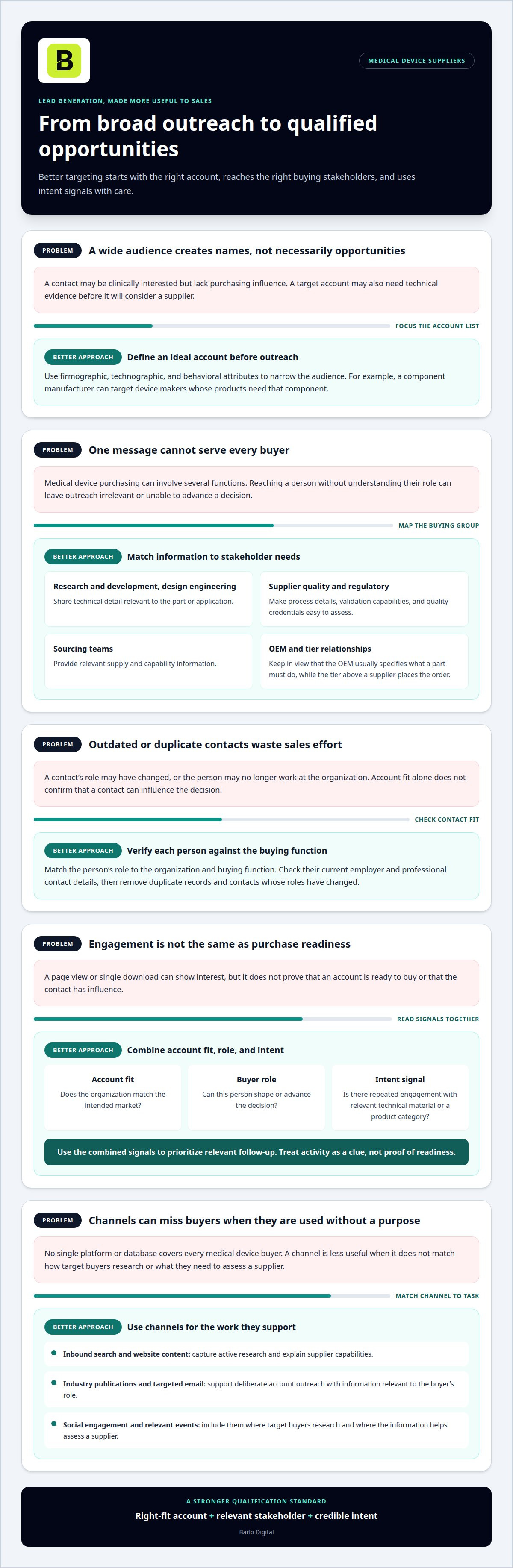
Broad targeting fills a pipeline with names, not qualified opportunities. Effective lead generation for medical device suppliers starts with defining an ideal account through firmographic, technographic, and behavioral attributes. A component manufacturer, for example, can target device makers whose products need that component. Defining account fit narrows the audience before outreach begins.
Next, map the people involved in purchasing. Medical device buying can involve research and development and design engineers, supplier quality staff, regulatory professionals, sourcing teams, and contract manufacturers. The OEM usually specifies what a part must do, while the tier above a supplier places the order. Tailor messages accordingly: technical detail for engineering, supply information for sourcing.
Account fit alone is not enough. Verify contacts by matching each person’s role to the organization and buying function, then checking their current employer and professional contact details. Remove duplicate records and contacts whose roles have changed. This makes outreach more precise and helps avoid contacting someone who cannot influence the decision.
Industry publications and targeted email serve different purposes. A technical article can reach engineers following a manufacturing topic. Email can deliver role-specific information, such as process details to engineering or capability information to quality teams. Inbound search and website content capture active research; publication placements and targeted email support deliberate account outreach.
IoT-enabled targeting can use relevant device or system signals to inform timing and engagement. For example, operational data may indicate when a connected product or process needs attention. The signal still needs to connect to a legitimate business need and the right buyer. IoT data should sharpen targeting, not replace account qualification.
Buyer intent adds another signal. Repeated engagement with technical material or interest in a product category can help prioritize follow-up. One download does not prove purchase readiness. Combine intent with account fit and contact role before adjusting messaging. That is the practical distinction between activity and a qualified opportunity in lead generation for medical device suppliers.
In the United States, qualified leads can come from inbound search, industry publications, targeted email, social engagement, and relevant events. The right mix depends on where target buyers research and what information helps them assess a supplier.
No single platform or database covers every medical device buyer. Combine business and professional records, company websites, publication engagement, and campaign data, then verify contacts against account criteria. This creates a more usable audience for sales, rather than a larger, unfiltered list.
3. Healthcare industry segmentation and buyer pain points
Healthcare is not one market. A hospital, an ambulatory surgery center (ASC), and a specialty clinic differ in care settings, workflows, and purchasing structures. Segmentation should reflect where a device is used, which clinical team uses it, and what operational problem it addresses. A campaign aimed at every healthcare organization blurs these distinctions and wastes outreach.
For medical device companies, useful segments connect a facility type to a specific need. A device used in operating rooms may require a different message from equipment used in outpatient care. A supplier supporting a hospital service line can focus on that team’s workflow, while an ASC-focused message can address its distinct operating environment. These distinctions make growth targeting more precise.
Procurement involves several roles, not just one decision-maker. Clinicians may assess clinical use; engineers or technical staff may evaluate fit; procurement and sourcing teams manage purchasing processes. In a hospital, value analysis committees can review a proposed device. Their meetings may occur monthly, so align outreach and supporting materials with the facility’s review cycle.
An ASC may involve clinical leaders, surgeons, administrators, and purchasing staff. Their priorities can differ: clinicians focus on use in care, while administrators and purchasing teams consider operational fit and acquisition needs. Match each role to the question it needs answered. A single generic pitch rarely gives every stakeholder enough information to evaluate a device.
Evidence must match the decision. Clinical buyers need relevant clinical evidence or technical detail, not broad claims about innovation. Economic stakeholders need a clear explanation of how the product could affect workflow, resource use, or organizational value. For example, a device proposal can connect its technical characteristics to the procedure or service line where it would be used.
Procurement can require sustained evaluation. A procurement team may need six months of data before issuing a purchase order for a medical device. During that period, useful materials can address product performance, implementation considerations, and the organization’s evaluation questions. The goal is not to force a decision, but to help stakeholders assess the product using relevant information.
Hospital evaluations may also depend on value analysis committee review. Make the device’s clinical purpose and organizational value easy to assess before that review. If stakeholders need different evidence, provide distinct materials for clinical, technical, and procurement audiences. This keeps the buying discussion focused on the needs behind each review.
Segment performance by facility type, clinical service, and buyer role. Compare which groups engage with the evidence and progress through procurement. If one segment responds to technical material but stalls before evaluation, the gap may be economic evidence or an unanswered workflow concern. This diagnosis gives medical device companies a clearer basis for refining targeting and supporting sustainable growth.
4. Using intent data to personalize outreach
Intent data helps medtech teams distinguish active research from passive exposure. Combine signals such as repeat visits to a technical page, engagement with product material, and interest in a relevant category. These signals suggest what a prospect may be researching, not whether a purchase is approved or imminent.
Use the signal to shape the next message. A sourcing contact reading manufacturing-capability content may need process details. A clinician engaging with product information may need evidence related to clinical use. Tailor outreach to the account, role, and observed topic instead of sending the same campaign message to every contact.
Timing matters. When an account repeatedly engages with material about a product category, prioritize a relevant follow-up while the topic is active. If engagement stops, continued sales pressure can damage the relationship. Intent should guide message relevance and prioritization, not trigger assumptions about budget, authority, or readiness.
Trade shows provide a useful in-person signal. A booth conversation, demo request, or stated interest in follow-up can inform post-event outreach. Coordinate campaigns by recording the discussion topic and sending relevant material afterward. Trade shows support direct interaction, digital marketing can sustain engagement between events, and sales outreach can address account-specific questions. Each channel takes time and coordination, and none alone proves buying intent.
Before an event, focus campaign messaging on product questions likely to bring target buyers to the booth. Afterward, distinguish contacts who requested a technical discussion from those who collected general information. This prevents a generic follow-up from treating every attendee as an active opportunity.
Intent data has limits. A shared network, multiple employees, or broad research can produce signals that do not belong to a single buyer. Connect activity to an account cautiously, then use a relevant question or useful resource to confirm interest. A click is a reason to refine outreach, not to claim purchase readiness.
For U.S. medical device campaigns, HIPAA is a relevant consideration in healthcare outreach. Keep business prospecting separate from patient information, and route questions involving health data to compliance review. FDA-related product messaging should also receive appropriate review, especially when campaign content discusses clinical use or product claims.
That separation matters in practice. A message to a hospital sourcing contact can discuss supplier capabilities, while patient-level health information does not belong in ordinary prospecting data. Define which signals campaigns collect, why each matters, and how it will shape messaging before outreach begins.
5. Medical device lead generation agency models
An agency model defines who owns planning, campaign delivery, qualification, and sales handoff. First decide whether the internal team needs strategy, execution, sales conversations, or a combination. A supplier with capable marketers but limited sales capacity needs a different arrangement from a team that needs help building the campaign itself.
A strategy-led agency focuses on audience definition, positioning, channel selection, and measurement criteria. This model suits teams that can execute internally but need a clearer operating plan. The agency can define how marketing and sales will assess progress, while internal staff manage delivery. The main risk is a strategy that remains a document instead of becoming consistent campaign work.
An execution-focused agency manages campaigns against agreed objectives. The supplier provides product information, target markets, and sales feedback; the agency handles the defined marketing tasks. This approach can suit teams with an established strategy but limited execution capacity. Its effectiveness depends on accurate inputs, clear approvals, and a process for sharing campaign results with sales.
Appointment-setting agencies focus on arranging relevant sales conversations. This model can suit suppliers selling to medical practices when direct engagement is the immediate need. Define a qualified meeting before work begins. Specify account fit, contact role, and the business purpose of the conversation. Without that standard, meeting totals can rise while sales receives contacts that cannot advance.
Commercial terms also shape agency incentives. With a per-lead model, acceptance criteria are especially important. A retainer or project scope needs clearly defined work, reporting, and ownership. For medical device suppliers, the useful comparison is not just the billing label, but what the provider delivers, how it qualifies leads, and whether sales can use the output.
A hybrid model divides work between the agency and internal teams. For example, the agency can run campaigns and manage initial contact, while the supplier’s sales staff handles technical discussions and procurement follow-up. Assign a clear owner to each handoff. This prevents duplicate outreach or delays caused by teams assuming someone else is responsible.
Judge the arrangement by accepted leads, meetings held, account fit, and progress into sales discussions, not raw contact volume. Review these measures with marketing and sales, then adjust the scope if the work does not address the actual bottleneck. The right model reduces operational friction and clarifies what the agency is accountable for.
If your team needs qualified conversations with medical practices, explore appointment setting for companies selling to medical practices.
Barlo Digital: Appointment setting for manufacturers and industrial suppliers
Barlo Digital helps manufacturers and industrial suppliers create sales conversations with relevant business buyers. For medical device suppliers, appointment setting can support outreach when target accounts and buyer roles are clear, but internal teams lack capacity to pursue them consistently.
We also set appointments for companies selling to medical practices. This work suits teams that can define their target accounts, relevant contacts, and what makes a conversation worth holding. These criteria give outreach a practical standard instead of treating every response as progress.
Clear qualification and sales handoffs connect appointment setting to the pipeline. The focus is on conversations with relevant buyers, not activity for its own sake.
Build a pipeline your sales team can act on
The next step is to make marketing and sales accountable to the same definition of progress. For lead generation for medical device suppliers, that means connecting campaign activity to the conversations sales accepts and the opportunities it advances. Without that link, teams can report activity while the pipeline stays unchanged.
Set a review rhythm that turns sales feedback into operational decisions. When a contact is rejected, record why. When a conversation advances, identify which account traits, buyer roles, or messages helped. Use these signals to refine the next campaign rather than adding volume to a process that has not earned it.
That discipline also clarifies where outside support belongs. If your team needs more consistent conversations with target buyers, discuss the scope, qualification criteria, and handoff with Barlo Digital. Contact Barlo Digital to discuss lead generation, and take the next step with a clearer operating standard.
Frequently Asked Questions
What efficiencies do leading lead generation providers offer to medical device companies?
They reduce wasted sales effort by linking campaign activity to clear handoff criteria. For example, a provider can separate contacts who requested product information from those who only viewed a general article, then route each group appropriately. Efficiency is not simply faster outreach. It means fewer unproductive follow-ups and clearer feedback on which campaign activity produces conversations sales considers relevant.
How do lead generation providers generate qualified leads in the medical device sector?
Define qualification with sales before launching campaigns, then apply the same criteria to inbound and outbound contacts. A practical review can record account fit, the contact’s business role, stated interest, and the next agreed action. Sales can mark whether each handoff was accepted and why. This feedback helps refine qualification over time instead of treating every form submission as a sales-ready opportunity.
How are technological advancements impacting lead generation strategies in the medical device industry?
Analytics and automation help teams organize prospect activity and prioritize follow-up. For example, a reporting workflow can show which campaign generated a response and whether sales accepted the contact. Technology can also make it easier to coordinate data across marketing and sales processes. It cannot replace clear definitions: inaccurate account records or poorly chosen scoring signals can still direct attention to the wrong prospects.
How does investing in specialised lead generation services benefit medical device companies?
Specialized support can translate a technical market into campaign criteria that sales can use. A provider familiar with medical device buying can distinguish a product inquiry from interest in manufacturing capabilities, for example. That distinction shapes the message, handoff, and performance review. The value depends on whether the provider addresses a real gap, such as limited campaign capacity or weak sales follow-up.
How soon does it produce meetings?
Healthcare lead generation campaigns may start generating meetings within 30-60 days, depending on targeting and industry. That is a possible campaign timeframe, not a guaranteed result for every supplier. The setup period, audience fit, offer, and follow-up process all affect when meetings begin. A useful progress review tracks meeting quality and target-account fit, not just the date of the first booked conversation.
What are the most effective lead generation strategies for medical device suppliers?
The strongest approach connects a relevant audience, useful information, and a defined sales handoff. For example, a campaign can invite a qualified business contact to request a technical discussion, then route the request to the right sales owner. Email, search, industry content, and events can each support this process. Choose channels based on where intended buyers engage, then compare accepted conversations rather than raw response totals.
How can lead generation providers identify and target hospitals, clinics, and other buyers?
Build account groups around factors such as facility type, clinical service, geography, and device application. Then map relevant business roles within each organization and check that contacts still match their stated employer and function. For instance, a campaign for surgical equipment should distinguish a hospital department from a clinic with a different use case. This keeps account selection tied to the product’s actual market.
How can lead generation providers help medical device suppliers generate leads while complying with FDA advertising rules?
Build a review step into campaign production so the supplier’s regulatory or compliance team approves product descriptions and promotional claims before publication. Use approved language and avoid creating clinical or performance claims independently. Lead forms can focus on business contact details and the prospect’s professional interest. The supplier remains responsible for its product claims and compliance decisions.

Article by
Carlos Benavides
Carlos Benavides founded Barlo Digital and is its Director of Paid Media and Performance. He has fifteen years in direct-response marketing, more than $50M in lifetime ad spend, and a B.S. in Computer Science, which is why tracking at Barlo Digital is built by hand. Barlo Digital is a director-led paid media and search agency serving US ecommerce brands, home-service companies and practices.


