

Poor marketing data makes every downstream decision less reliable. The consequences of poor data quality in marketing begin with inaccurate, incomplete, inconsistent, or outdated information, then spread to distorted analytics, poorly targeted campaigns, wasted staff time, and weaker productivity. The damage is operational, not just a reporting problem.
It’s easy to blame a campaign when results look wrong. But if tracking misses conversions, records conflict, or audience details are stale, the report can point to the wrong cause, and the next budget decision may repeat the mistake.
This article explains what poor marketing data quality means and how it affects measurement, targeting, and team workflows. You’ll see how unreliable numbers can misdirect spend, force staff to reconcile errors, and delay decisions, along with what stronger data practices can change.
Key Takeaways
- Spot how outdated or inaccurate customer details can distort audience segments and make messages miss the people they’re meant to reach.
- Assess data quality across completeness, validity, accuracy, consistency, uniqueness, and timeliness to locate the underlying failure.
- Trace conflicting reports, missing conversions, and inconsistent campaign names before trusting performance data or shifting budget.
- Recognize how time spent reconciling records and correcting errors takes attention away from analysis and campaign improvement.
- Connect data cleanup and reliable measurement to faster decisions, clearer reporting, and more productive marketing work.
What Is Bad Data?
Poor data quality means customer or product records contain errors that can change marketing decisions. A wrong age range, outdated location, missing purchase history, or incorrect product price can redirect a campaign before it reaches its intended audience. A record may look complete while still describing the wrong person or transaction.
Poor data quality affects personalization, segmentation, and customer experience by assigning people to the wrong groups or using details that no longer apply. For example, an outdated location can trigger an irrelevant regional offer, while an incorrect purchase history can promote an item someone already bought. The U.S. Senate Committee on Commerce, Science, and Transportation notes that errors in consumer data can put people in the wrong segment and change the offers they receive.
Demographic errors weaken segmentation because age, location, household details, and preferences help determine who receives each message. If a record puts a customer in the wrong region, a local promotion may miss nearby buyers and reach people who cannot use it. If a preference field is blank, the system may default to a broad audience. The result is guesswork instead of relevant targeting.
Customer and product errors can also cost sales. Imagine a retailer’s records still show a discounted price after the offer ends. An email may promise the wrong amount, causing checkout disputes and undermining confidence in future promotions. A wrong product category can also suppress a suitable recommendation or direct a customer toward something that does not meet their needs.
Incorrect messages create friction at the point of contact. A greeting with the wrong name, an offer repeated after purchase, or a reminder for an unrelated service can make it seem the business ignored the customer’s history. Each mistake can prompt an unsubscribe, a complaint, or a lost conversion. Repeated errors make communications feel careless rather than useful.
Missing or outdated contact details create a different failure: the intended message never arrives. A customer who changes email addresses may miss a renewal notice or relevant product announcement. If a phone number is entered incorrectly, a follow-up about an unfinished order may reach someone else. These gaps hide conversion opportunities and can lead teams to mistake silence for a lack of interest.
- Incorrect customer detail: A wrong region sends a local offer to the wrong audience.
- Outdated product detail: A retired item remains in a recommendation or promotion.
- Incomplete contact detail: A useful follow-up cannot reach the intended customer.
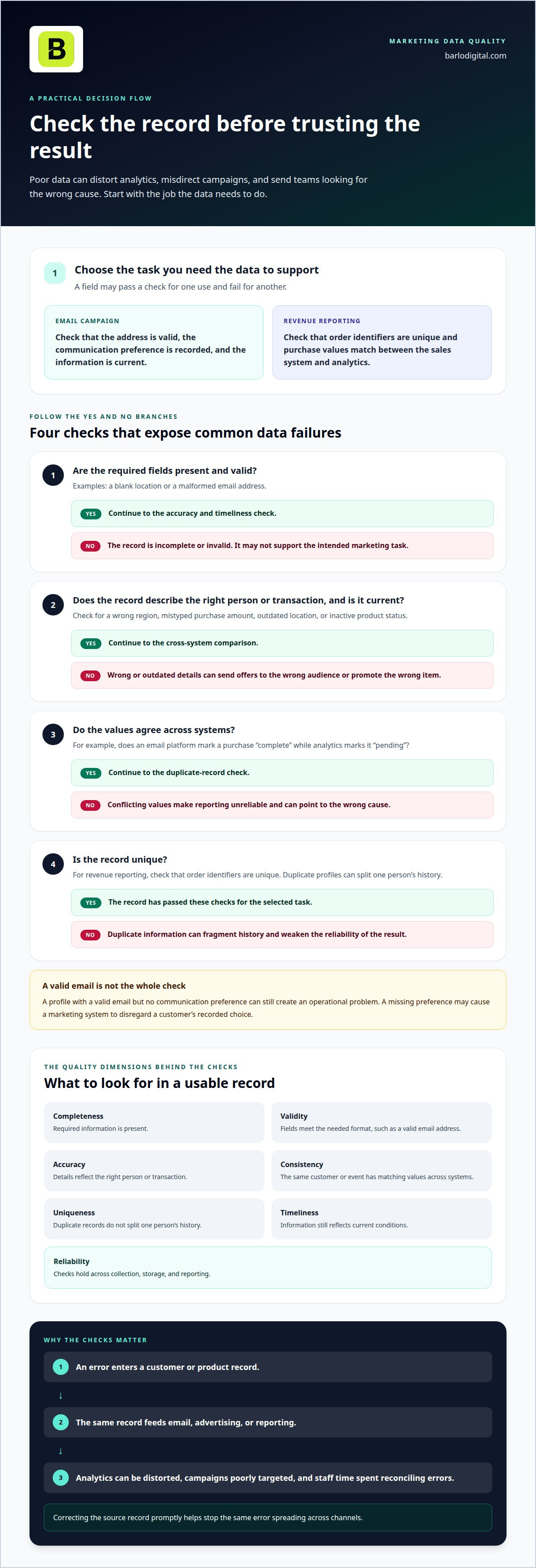
These failures compound when the same record feeds email, advertising, and reporting systems. A wrong segment can distort campaign results and shape future decisions around a false picture of customer behavior. Correcting the source record promptly helps stop the same error spreading across channels.
What does it mean to have poor data quality?
Marketing data quality describes whether information can support decisions, not simply whether a database contains records. A profile with a valid email but no communication preference can still create a serious operational problem.
Core Data Quality Dimensions
Completeness, validity, accuracy, consistency, uniqueness, timeliness, and reliability determine whether records are usable for a specific marketing task. Each dimension catches a different failure: a blank location is incomplete, a malformed email is invalid, and a mistyped purchase amount is inaccurate.
Consistency means the same customer or event has matching values across systems. If an email platform labels a purchase “complete” while analytics records it as “pending,” reporting becomes unreliable. Uniqueness prevents duplicate profiles from splitting one person’s history. Timeliness asks whether information still reflects current conditions, such as an active subscription or current product status.
These dimensions work together. A record can be accurate when entered but become outdated later, while a complete profile can still contain invalid fields. Reliability depends on checks holding across collection, storage, and reporting. For example, a valid product identifier must remain consistent as an order moves from an ecommerce platform into an analytics report.
Start a practical review with the intended use. For an email campaign, confirm that the address is valid, the preference is recorded, and the information is current. For revenue reporting, check that order identifiers are unique and purchase values match between the sales system and analytics. A field may pass a check for one use and fail another.
Privacy and Compliance Risks
Privacy and compliance risks arise when inaccurate or incomplete records lead to customer information being collected, stored, or used incorrectly. For example, a missing communication preference can cause a marketing system to disregard a customer’s recorded choice.
That mismatch is more than a data-cleaning task. Mishandling or misusing customer data can contribute to privacy breaches, damage a brand’s reputation, and erode consumer trust. A record attached to the wrong person could expose another customer’s details in a message or account interaction. The error begins in the data, then becomes a customer-facing incident.
Reliable records matter for compliance because teams need accurate information about how customer data was collected and used. If a preference field is blank or inconsistent across systems, staff may be unable to establish the customer’s communication status. Inaccurate marketing data can increase the risk of noncompliance with applicable U.S. privacy requirements and lead to penalties.
Keep privacy-related fields separate from general profile details. A name or purchase category cannot substitute for a communication preference. Consistent definitions, controlled access, and regular review help prevent incomplete records from driving inappropriate campaigns or exposing customer information.
Inaccurate analytics and underperforming campaigns
Campaign performance reports are only as reliable as the events, labels, and customer records behind them. A tracking error can make a working campaign look like a failure or conceal wasted spend.
Revenue and Mailing Campaign Losses
Poor-quality marketing data can reduce revenue when campaigns reach the wrong audience or fail to reach intended recipients. A mailing list full of inactive addresses, for example, sends promotions into a void and makes delivery and response data less useful.
Bad records also undermine the next decision. If an order is missing from analytics, a team may judge a campaign by incomplete sales information and cut an effective message. NIST notes that inaccurate input data or analytics can lead to erroneous conclusions and major spending with no benefit or a negative impact.
Mailing errors can compound throughout a campaign. Duplicate contacts may receive the same offer repeatedly, while a wrongly classified customer misses a relevant message. The result can be lost conversions, avoidable complaints, and less confidence in future communications.
Wasted Advertising Spend
Bad customer data wastes advertising spend when audience lists include the wrong people, omit qualified prospects, or rely on outdated behavior. A campaign aimed at recent buyers, for example, may keep paying to reach customers who have already purchased.
Incorrect conversion data makes wasted spend harder to spot. If a platform records a form submission as a sale, optimization can favor ads that generate low-value actions. The campaign then shifts budget based on a misleading signal, not actual business outcomes.
Tracking errors and inconsistent campaign names also fragment reporting. If one campaign appears under several labels, analysts may misread its total performance or compare unlike results. Data silos can produce conflicting figures, leaving decision-makers unsure which channel deserves budget.
Bad customer data wastes spend by steering delivery toward audiences unlikely to convert, while inaccurate analytics can reward the wrong ads. Budget allocation then rests on false insights rather than verified outcomes.
The most useful fixes combine event validation, standardized campaign naming, regular analytics audits, and clear data governance. Data validation and cleansing tools can flag malformed entries and duplicates; monitoring can surface missing conversions or sudden reporting changes. An ecommerce tracking and measurement audit can help identify implementation gaps that distort campaign reporting.
A focused review follows the data from ad click to recorded conversion. Check whether the correct event fires, transaction values match, and campaign labels remain consistent across reports. Fixing the source error matters more than adjusting bids around unreliable results.
Staff time spent finding and correcting errors
Flawed records create work before a marketing team can act. A campaign manager may spend the morning tracing why a weekly report and an email platform show different subscriber totals. The immediate task is not analysis but finding where the mismatch began.
Manual merging adds another layer of risk. Two spreadsheets, for example, may use different customer identifiers, date formats, or status labels. Combining them can create duplicates, overwrite current values, or attach a purchase to the wrong profile. Staff then have to compare rows and repair errors introduced by the merge.
Data silos make investigations slower. The sales system may show a lead as qualified while the marketing platform still marks the same record as new. Without a shared definition or reliable connection, staff must find the source of truth, reconcile fields, and explain why reports disagree.
Automation does not remove the problem. It repeats it faster. If an incomplete product field feeds a nurture workflow, customers may receive messages about the wrong category. If a status update fails, an automated reminder may continue after the customer has completed the requested action.
Those failures consume attention twice over. Someone must correct the record, then check whether the automation affected other contacts. A team member may pause a workflow, inspect recent sends, identify affected profiles, and prepare a correction. Every repair interrupts planned work such as campaign reviews or creative testing.
Manual processes also create recurring errors. A staff member copying leads from a form export into a contact database might miss a field or paste values into the wrong column. Someone later spots the mismatch and repeats the same checks. Without clear ownership and consistent entry rules, the correction will not prevent a repeat.
Organizations can reduce rework by tracing errors to their entry point, not just fixing the visible record. Map how a lead moves from form submission to database, segmentation, and automation. At each handoff, define required fields, accepted formats, and what happens when a value is missing.
- Compare: Match record counts and key fields between connected platforms.
- Trace: Identify the form, import, or integration where the mismatch first appeared.
- Prevent: Add validation rules and assign an owner for recurring data checks.
Automation can handle repeatable validation, but its rules need clear ownership. For example, a workflow can flag a missing email address instead of sending a message that cannot reach its recipient. This keeps staff focused on decisions rather than repeatedly repairing the same flawed process.
Marketing productivity losses from data management
Data problems cost more than cleanup time. They delay decisions, block analysis, and leave marketing plans waiting for answers. If a weekly dashboard cannot reconcile leads with sales records, a team may postpone a budget decision rather than act on current performance.
Productivity suffers through work that never gets done. An analyst reconciling campaign totals cannot spend that time finding which audience or message deserves further investment. A manager chasing a missing conversion report may miss a planning window for a seasonal promotion. The cost is not just correction, but strategy delayed or abandoned.
Unreliable records also create a queue of avoidable questions. A marketing lead asks for performance by product, region, or channel, but each answer requires manual exports and reconciliation. When dashboards disagree, staff need an analyst to explain basic figures. That dependence slows decisions across teams and makes self-service reporting less useful.
These delays distort planning cycles. Suppose a retailer sees reported sales drop suddenly after a tracking change. The team may pause a campaign while investigating whether demand fell or measurement broke. If the source issue remains unresolved, the next review brings the same uncertainty, and decisions continue to rely on incomplete evidence.
Data management can also consume time through repeated work. Staff may clean a spreadsheet for one report, then repeat the cleanup for another platform. Shared definitions for campaign names, conversion events, and key fields reduce this rework. Clear ownership of each data source helps teams resolve discrepancies where they begin.
To improve efficiency, prioritize fixes by their impact on decisions. Start with information that determines budget allocation, revenue reporting, or audience selection. Document the source, owner, required format, and validation rule for each critical field. Then monitor recurring errors so broken imports or definitions are corrected upstream, rather than patched in every report.
Prevention matters because retroactive repairs can leave errors in connected systems. Correcting a source record is not enough if an export, dashboard, or automation workflow retains the flawed value. A defined review process should trace the correction through each downstream use and confirm that later reporting reflects the update.
Reliable data lets analysts spend more time producing insights and less time explaining conflicting reports. It also gives decision-makers a clearer basis for testing strategies, responding to missed opportunities, and directing staff toward higher-value work. A practical test is whether teams can answer routine questions without rebuilding the underlying data each time.
If poor reporting is obstructing campaign decisions, review our ecommerce ad management approach to see how campaign work can be tied to clearer performance signals.
Barlo Digital
Barlo Digital helps businesses investigate whether unreliable marketing data is distorting campaign decisions. We connect measurement problems with the reports and advertising activity they affect, helping teams see where performance signals break down and what needs attention.
For ecommerce businesses, our tracking and measurement audits examine how activity is recorded across marketing systems. For businesses running paid campaigns or search programs, we assess whether the available data supports clear decisions about performance and next steps. This is useful when reports conflict, conversions appear missing, or campaign results no longer match what the business observes.
We don’t provide standalone CRM software or purchased lead lists. Our work centers on marketing measurement and the campaigns it informs. If you want to discuss data issues affecting your marketing, contact Barlo Digital.
Make reliable measurement the next decision
Before changing a campaign, make measurement integrity a condition of the next budget decision. The consequences of poor data quality in marketing persist when teams optimize around signals disconnected from real business outcomes. Treat dependable measurement as part of campaign planning, not a task to postpone until reports conflict.
Choose an upcoming decision and define the evidence it requires. For example, specify which recorded outcome would justify increasing, reducing, or holding spend. That rule gives the team a clear standard for evaluating the data before acting, rather than debating reports afterward.
Make the next review concrete: identify the decision, the evidence needed, and who will use it. A clear standard gives your team a stronger basis for action and a practical starting point for better marketing decisions.
Frequently Asked Questions
Does bad data actually make businesses lose money?
Yes. Bad data can cause financial losses by directing effort toward the wrong customers or misleading decisions about where to invest. For example, if a lead’s company type is recorded incorrectly, a sales team may spend time pursuing a prospect that does not fit its offer. The loss can include wasted advertising, staff time, and opportunities missed while teams act on faulty information.
V: Why act now?
Act before an error spreads through connected systems and becomes harder to isolate. One incorrect customer status can flow from a form into an audience, an automated message, and a performance report. Fixing the original entry point can prevent repeated corrections across these processes. Start with data that informs a current budget, sales, or customer communication decision.
What are the main consequences of poor data quality in marketing?
The consequences of poor data quality in marketing include unreliable reporting, misdirected campaigns, missed sales opportunities, and time spent repairing records. The specific impact depends on where the error enters and which decisions rely on it. For example, an incorrect product category can affect recommendations, audience selection, and revenue analysis. Mapping those dependencies helps teams identify the most consequential data problems first.
How does inaccurate marketing data affect campaign performance and ROI?
Inaccurate marketing data can make a campaign appear more or less effective than it is. If a platform attributes a purchase to the wrong channel, decision-makers may shift investment away from a source that actually contributes sales. Compare platform-reported conversions with completed transactions and consistent campaign identifiers. This helps distinguish a real performance change from a measurement problem before budget decisions compound the error.
How much does poor data quality cost businesses in the United States?
That estimate describes broad economic impact, not a guaranteed loss for an individual business or a marketing-only total. A company’s exposure depends on how inaccurate records affect advertising, decisions, and staff workload. Trace data errors to specific business outcomes to understand their financial impact.
What are the effects of inaccurate marketing data on lead generation and sales conversions?
Inaccurate lead data can reduce conversions before a sales conversation begins. A request assigned to the wrong territory may wait in the wrong queue, while an incorrect phone number prevents follow-up. Sales teams can also waste effort on duplicate or unsuitable records. Review lead source, routing destination, contactability, and final sales status to find which failure is blocking qualified prospects.
How can poor data quality damage brand reputation and customer trust?
Repeated mistakes can make customers question whether a business understands their needs or handles their information carefully. A customer who receives an offer for a returned product, followed by an unrelated reminder, sees a clear gap between the brand’s promise and its records. Complaints, unsubscribes, and reduced response can follow. A clear correction process helps limit repeated errors and gives teams a consistent response when messages go wrong.
What privacy and compliance risks can inaccurate marketing data create under U.S. laws?
Inaccurate records can create privacy and compliance risks when they misrepresent a person’s communication preferences or link information to the wrong individual. For example, a mistaken profile match could send one customer another person’s details. Applicable requirements depend on the data and business context, so teams need accurate records of data use and preferences. Treating privacy fields as controlled information helps reduce misuse and preventable customer harm.

Article by
Carlos Benavides
Carlos Benavides founded Barlo Digital and is its Director of Paid Media and Performance. He has fifteen years in direct-response marketing, more than $50M in lifetime ad spend, and a B.S. in Computer Science, which is why tracking at Barlo Digital is built by hand. Barlo Digital is a director-led paid media and search agency serving US ecommerce brands, home-service companies and practices.


