

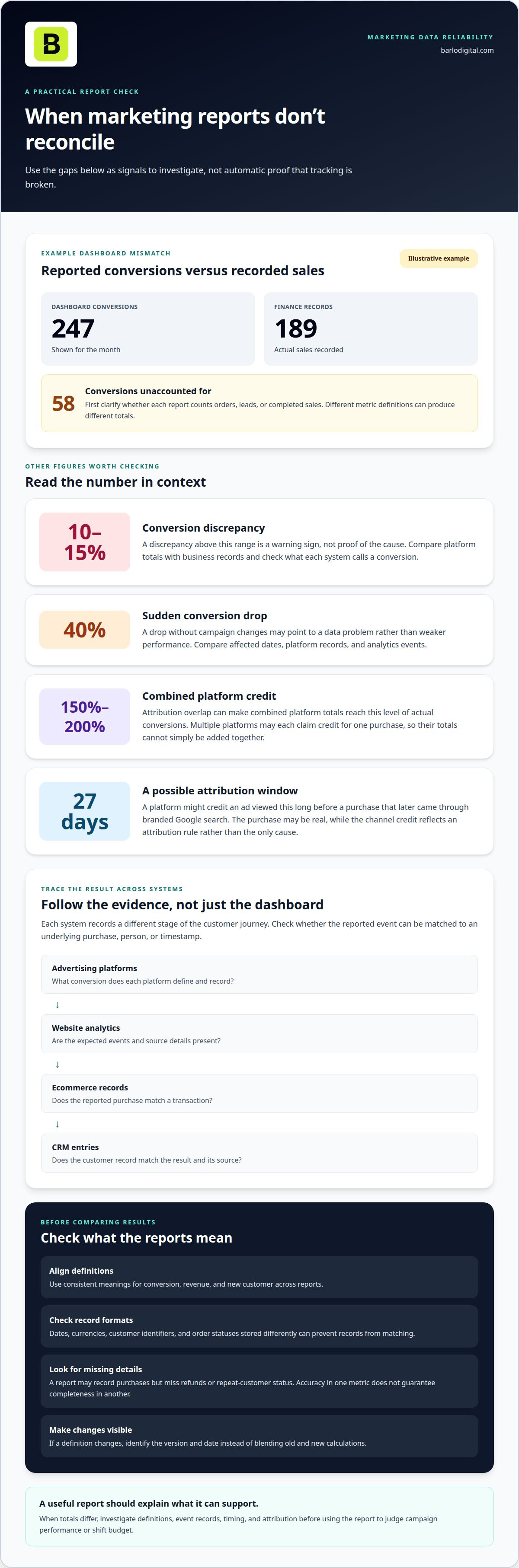
A polished dashboard can still be wrong. Signs your marketing data is unreliable include conversion totals that don’t match sales records, duplicate contacts, sudden unexplained swings, and missing or inconsistent tracking. A conversion discrepancy above 10-15% is a warning sign, not proof of the cause.
It’s reasonable to question reports when ad platforms, website analytics, and sales systems tell different stories. The issue is more than messy reporting: unreliable data can distort which campaigns seem effective and where the budget goes.
This guide explains how to assess report reliability by comparing platform data with business records, tracing results to their underlying events, checking completeness and consistency, and finding duplicates. It also covers how attribution overlap can inflate conversions and lead to poor budget decisions. The aim is to clarify what the reports can support, what they cannot, and where measurement needs attention.
Key Takeaways
- Reliable reporting depends on consistent tracking and clear definitions, not a polished dashboard.
- Conflicting revenue totals can reveal attribution gaps or mismatched metric definitions.
- Assess data for accuracy, completeness, availability, and whether teams can use it to trace results.
- Duplicate records can distort audience counts and make campaign response rates look stronger or weaker than they are.
- Unreliable attribution can push budget toward campaigns that appear to perform but don’t produce matching business results.
What is data reliability (in a marketing context)?
Marketing data is reliable when expected information arrives consistently, in the format and timeframe teams need. Reliability becomes visible when advertising, analytics, ecommerce, and CRM records agree on what happened.
Cross-Checking Data Across Systems
Cross-checking means tracing a reported result across advertising platforms, website analytics, ecommerce records, and CRM entries. It matters because each system records a different stage of the customer journey. A campaign click may appear in an ad platform, a purchase in ecommerce, and the customer relationship in a CRM. If one purchase appears twice, or disappears between systems, the reports need investigation.
Comparing Platform Conversion Counts
Comparing platform conversions means checking whether advertising and analytics reports count the same completed actions. Meta and Google may each claim credit for a purchase, while ecommerce records show one transaction. That mismatch does not automatically mean tracking is broken. Attribution settings, conversion definitions, and reporting windows can differ. Start by identifying what each platform defines as a conversion and which event it records.
Format Inconsistencies and Attribution Overlap
Format inconsistency occurs when systems store the same information differently, such as dates, currencies, customer identifiers, or order statuses. Those differences can prevent records from matching across retailers and internal tools. Attribution overlap occurs when multiple platforms credit themselves for one conversion. Combined platform totals can reach 150% or 200% of actual conversions, a clear signal that channel reports cannot simply be added together.
Reliability means more than matching totals. A report can be accurate for one metric but incomplete for another. For example, a platform may record purchases but miss refunds or repeat-customer status. Teams need consistent definitions for “conversion,” “revenue,” and “new customer” across reports. Otherwise, dashboards can show different results even when neither calculation is internally faulty.
Timing matters, too. An advertising platform might credit a conversion to an ad viewed 27 days earlier, even when the customer later purchased through a branded Google search. The recorded conversion may be real, but the channel credit reflects an attribution rule, not necessarily the only cause. Comparing the purchase record, source data, and platform window exposes that distinction.
Consistency also affects how customer information is handled. According to the European Union, GDPR fines can reach up to 20 million euros or 4% of annual worldwide turnover, whichever is higher. Reliable records help teams identify which information is held, where it sits, and whether separate systems describe the same person accurately.
How can a team tell that its marketing reports are unreliable?
To detect missing, stale, or misattributed conversions, trace reported events to underlying purchases, people, and timestamps. Warning signs include unexplained revenue gaps, inconsistent metric definitions, and conversion swings that do not align with campaign changes.
Conflicting Revenue Figures and Metric Definitions
Conflicting revenue figures occur when reports assign different totals or meanings to the same business result. One dashboard example shows 247 conversions for the month, while finance records 189 actual sales, leaving 58 conversions unaccounted for. Leaders need to establish whether the reports count orders, leads, or completed sales. Without that definition, an organization can deliver precise-looking reports that answer different questions.
Unstandardized Categories and Metrics
Unstandardized categories and metrics arise when teams use different labels, filters, or calculation rules for the same outcome. One report might classify a campaign as “paid social,” while another uses a platform name. A conversion might include form submissions in one report but exclude them in another. These differences block fair comparisons and make it harder to identify which results are genuinely campaign-driven.
Document definitions for each metric and dimension, including how revenue, lead source, and campaign category are recorded. Apply the same rules across platforms and reporting periods. If a definition changes, identify the version and date rather than quietly blending old and new calculations. Otherwise, apparent growth or decline may reflect a reporting change, not business performance.
Unexplained Metric Volatility
Unexplained volatility means a report shifts sharply without a matching change in campaigns, tracking, or business activity. A sudden 40% drop in conversions without campaign changes may indicate a data problem rather than weaker performance. The diagnostic work compares the affected dates, platform records, and analytics events. Trust requires a visible explanation for the change, not a revised dashboard that conceals the discrepancy.
For example, Meta might report 150 conversions while the sales team closes 110 deals from that channel. The gap needs a defined explanation, such as attribution rules or a difference between platform conversions and closed deals. If neither the metric definition nor the underlying records explain it, the report isn’t a sound basis for shifting budget.
Missing, Stale, or Misattributed Conversions
Missing, stale, or misattributed conversions occur when essential events, dimensions, or timestamps are absent, outdated, or assigned to the wrong source. Check whether each reported KPI can be traced to underlying people, purchases, or events. This reveals whether a conversion arrived late, lacked a source, or was credited to a channel that does not match its recorded path.
Completeness depends on whether the data model contains the dimensions needed to interpret results, including source, campaign, and conversion event. A sudden blank in one dimension can make totals unusable even when the conversion count appears stable. Document metric ownership, definitions, and procedures so leaders can see what each report measures and where its evidence comes from.
Accuracy, completeness, availability, and usability of marketing data
Assess data quality by testing whether records are accurate, complete, accessible, and useful for decisions. No single accuracy or completeness percentage applies across every platform; the right test depends on the events and dimensions needed to explain revenue.
Test UTM tags, pixels, and conversion tracking by following a controlled visit through each recorded event, then comparing the results with the underlying transaction or lead record. Missing parameters, absent events, or duplicate conversions show where measurement breaks.
Auditing Data Quality
A data quality audit compares records with their source systems to identify accuracy, completeness, and consistency errors. It matters because a report can look complete while assigning revenue to the wrong campaign or omitting refunds. A professional traces sample transactions from the original event through analytics and sales records, then documents the mismatch and affected metrics.
The audit also tests whether reports remain available and usable for decision-makers. For example, a revenue report that arrives late or groups campaign sources inconsistently can distort a weekly comparison. Clear records of definitions, data owners, and corrections help distinguish an actual performance change from a reporting defect.
Marketing Data Completeness
Completeness measures whether data contains the metrics and dimensions needed to interpret results. A purchase count without source, campaign, or order status cannot show which activity drove revenue or whether an order was later refunded. Identify the required fields, then check which are missing from relevant records.
Completeness also depends on access and usability. If analytics data exists but leaders cannot connect it to customer or transaction records, it cannot answer a business question. This gap can hide inaccurate totals and weaken decisions, even when the database contains many records.
Testing Tracking for Errors
Tracking tests follow a controlled journey from tagged visit to recorded conversion. A professional checks whether UTM values persist into analytics, whether the pixel records the intended event, and whether conversion tracking sends the event once. The resulting records are compared with the corresponding lead or purchase to locate missing, duplicated, or misclassified events.
Those checks are central to an ecommerce tracking and measurement audit, especially when analytics and transaction records disagree. Testing should also cover different landing pages and conversion paths, since one working form does not prove every path records accurately. Each error needs a specific source, affected metric, and correction.
Privacy compliance belongs in the same review because personal records must remain accurate and manageable. According to the European Union, an organization has one month to respond to a data deletion request under GDPR. A professional assessment considers whether records can be located across connected systems, rather than treating deletion as a task confined to one database.
Duplicate and redundant marketing and retail data
Duplicate records make one person, purchase, or event appear more than once. They can inflate audience totals, distort response rates, and make campaign performance look stronger or weaker than it is. Inconsistent tracking can also split one customer journey across separate records, obscuring which source or campaign contributed to the outcome.
A CRM example shows the scale: a database lists 10,000 contacts, but 2,400 campaign records are duplicates. After removing them, the actual response rate is about 17%. The original contact count overstated the audience, making the campaign’s performance harder to judge. A professional identifies duplicate records by matching fields such as email, phone, or customer identifiers, then checks whether apparent matches represent one person or distinct records.
Duplicate marketing data can enter when platforms, forms, or integrations collect the same event more than once. For example, a conversion tag may fire on both a confirmation-page load and a form submission. If both events count as conversions, reports overstate results. Trace events and timestamps to identify the trigger, then determine whether tracking should record one action or separate actions.
Connection errors can create duplicates or missing records as data moves between systems. A failed sync might resend a contact when service resumes, while a field mismatch can create a new record instead of updating an existing one. Even small connection errors can signal a broader data issue. Check transfer logs, record identifiers, and update rules to find where repeated entries begin.
Retail data has its own risks. Two entries for the same SKU can produce incorrect inventory counts, out-of-stocks, or overproduction. If campaign reporting also uses inconsistent product identifiers, a sale may not connect cleanly to the advertised item. A professional compares product IDs and transaction records across systems, then isolates whether the duplication began in catalog setup, an integration, or reporting.
Duplicates also distort campaign decisions. When a team collects the same inactive contact several times, a launch may reach fewer unique people than the send count suggests. A separate example sends a re-engagement campaign to 8,000 inactive contacts and records a 12% response rate. Without checking unique recipients and event rules, the team cannot tell whether repeated records affected the result.
Effective corrective action starts by preserving source records and documenting matching rules before merging or deleting anything. Distinguish true duplicates from shared addresses, household accounts, and repeat purchases. After cleanup, compare unique contacts, orders, and responses with earlier reports. This shows whether corrected records materially changed the metrics used to assess campaigns.
Financial losses linked to poor data quality
Unreliable numbers can make weak campaigns look profitable and strong campaigns look expendable. Recognizing signs your marketing data is unreliable matters because bad figures can waste ad spend or prompt budget shifts based on conversions that do not connect to business outcomes.
Data Quality and Marketing Performance
Data quality determines whether performance reports connect marketing activity to real outcomes. If an attribution error over-credits a channel by 20%, leaders may direct more budget toward it, despite weaker returns. Reliable measurement ties spend to outcomes that matter, such as purchases or qualified leads, instead of treating every platform-reported conversion as equivalent. This principle applies across offline channels as well; for example, businesses coordinating regional print campaigns often turn to providers like LeafletPro UK to verify flyer deliveries with GPS data rather than relying on unconfirmed distribution reports.
These figures describe a hypothetical scenario, not a forecast for any specific organization.
Wasted Ad Spend and Poor Decisions
Wasted spend occurs when inaccurate reporting directs budget toward campaigns that appear successful but produce little. A team could approve a threefold marketing budget increase based on dashboard conversions, then discover those numbers do not correspond to actual sales. If signs your marketing data is unreliable go unaddressed, decisions may follow a false return signal.
Teams need governance that assigns ownership for metric definitions, data sources, and corrections. A documented process connects campaign results to business records and explains which numbers leaders should use. Without clear ownership, conflicting report versions can circulate while no one takes responsibility for resolving the gap.
Quality monitoring should track whether important metrics remain complete and consistent over time. When conversion totals change suddenly, distinguish campaign performance from tracking or attribution changes. This helps leaders measure return using comparable figures, rather than treating every dashboard refresh as new evidence.
Regular reviews also expose recurring problems before they influence another budget decision. Document the affected source, metric, and reporting period, then record the correction. This history helps explain whether later results reflect better marketing, repaired measurement, or a changed definition.
When an audit shows ad decisions depend on unreliable tracking, an ecommerce ads audit can assess how reported performance relates to campaign investment.
Barlo Digital
Barlo Digital helps teams connect marketing activity to dependable business results. When reports conflict, conversions go missing, or tracking errors make campaign decisions uncertain, we assess measurement and identify where the data chain breaks. Our services include ecommerce tracking and measurement audits, tracking fixes, and paid media decisions grounded in clearer reporting.
We’re a director-led agency. A director runs every account, and senior-level work is not handed to junior staff. If unreliable reporting is affecting how you evaluate marketing, contact Barlo Digital to discuss your measurement concerns.
Make the Next Decision on Better Evidence
Clear measurement is not a reporting preference. It is the basis for deciding what to keep, change, or stop. If signs your marketing data is unreliable are affecting those decisions, make the next move a focused review of whether your tracking supports the outcomes your business cares about.
Barlo Digital connects measurement work with practical marketing decisions. Our ecommerce tracking and measurement audit examines whether the information behind campaign reports can support those decisions. For a closer look at that service, explore our ecommerce tracking and measurement audit.
Better evidence gives leaders a firmer basis for action. Start with the records your decisions depend on, then ensure the measurement behind them can support the next step.
Frequently Asked Questions
When is a data reliability assessment necessary?
Schedule an assessment before a major budget shift, analytics migration, campaign relaunch, or executive review that depends on disputed figures. It is also useful when reports change after a website release or tracking update. For businesses rolling out new digital assets or investing in strategic web design brisbane, pairing the rollout with measurement verification prevents structural tracking errors from polluting reports early on. The review can isolate whether the change reflects customer behavior, a system change, or a reporting fault. That distinction matters before leaders use the numbers to approve spending or judge a team’s performance.
Where should a professional start when fixing unreliable marketing data?
Start with the business decision the data needs to support, such as identifying which source produces qualified leads. Then map the relevant records from the first interaction to the business outcome. This prevents teams from repairing low-impact fields while a critical sales stage remains unmeasured. Define the scope, systems, stakeholders, and decision criteria before technical changes begin.
Why do Google Ads and Meta show different conversions for the same campaign?
Google Ads and Meta can use different attribution settings, count different conversion actions, or assign credit using different reporting dates. One platform may include an eligible ad interaction that the other excludes. Check the selected conversion action, attribution method, reporting window, and time zone in each platform. Then compare completed business outcomes separately from platform-attributed conversions, rather than expecting dashboards to match automatically.
What are common signs marketing data is inaccurate or unreliable?
Watch for conversion totals that change after a delayed import, revenue records with impossible values, and source labels that disappear after a landing-page redirect. Other warning signs include a campaign reporting leads before its form was live or an event firing on pages where it should not. These symptoms point to specific failure points. Their timing and location can help narrow the investigation.
What causes discrepancies between Google Analytics, ad platforms, and CRM reports?
Discrepancies often arise because systems capture different stages and apply different rules. Google Analytics may record a session, an ad platform may attribute an interaction, and a CRM may count a qualified lead only after a sales update. Lost campaign parameters, delayed CRM imports, and changes to lead status can widen the gap. Compare records using consistent dates and business-stage definitions.
What data quality checks should a professional run regularly?
A professional should review whether critical events still fire, campaign parameters arrive intact, and system imports complete successfully. They should also inspect sudden changes in event volume, rejected records, duplicate identifiers, and fields that become blank. Compare a sample of recorded conversions with source transactions or lead outcomes. The review log should record the issue, affected reports, correction, and person responsible for follow-up.
How do consent rules and cookie restrictions affect marketing data accuracy in the United States?
Consent choices, browser settings, and cookie restrictions can limit which interactions are recorded or connected across visits. Analytics may therefore show fewer identifiable journeys than actually occurred, while advertising platforms may report modeled or platform-specific results. The effect varies by user settings, technology, and implementation. Distinguish missing observable signals from actual declines in demand, and document how measurement handles them.
What steps can a professional take to audit and fix unreliable marketing data?
First identify the business outcomes and reports affected, then map the data path and test representative interactions. Next, isolate tracking, integration, or definition failures and rank corrections by their impact on decisions. After approved fixes, retest the same path and document what changed. This creates evidence that a repair worked, rather than relying on a dashboard that simply looks cleaner.

Article by
Carlos Benavides
Carlos Benavides founded Barlo Digital and is its Director of Paid Media and Performance. He has fifteen years in direct-response marketing, more than $50M in lifetime ad spend, and a B.S. in Computer Science, which is why tracking at Barlo Digital is built by hand. Barlo Digital is a director-led paid media and search agency serving US ecommerce brands, home-service companies and practices.


