

A calendar full of meetings can still hide a broken sales process. Appointment setting outsourcing assigns prospect research, outreach, qualification, and scheduling to an external team, freeing sales representatives to focus on qualified conversations and closing. It works best when the meetings match your target market and have a clear path to revenue.
A provider should do more than fill calendar slots. You need precise targeting, outreach that reflects your sales process, and a way to track whether booked meetings become genuine opportunities.
This article explains what appointment setters do, how outsourced outreach works, what to assess when choosing a provider, and which measures reveal performance. It also shows why appointment volume alone can mislead, and how to evaluate meeting quality, conversion, revenue, and feedback from your sales team.
Key Takeaways
- Judge outreach by whether it reaches the right decision-makers, not by how many messages the team sends.
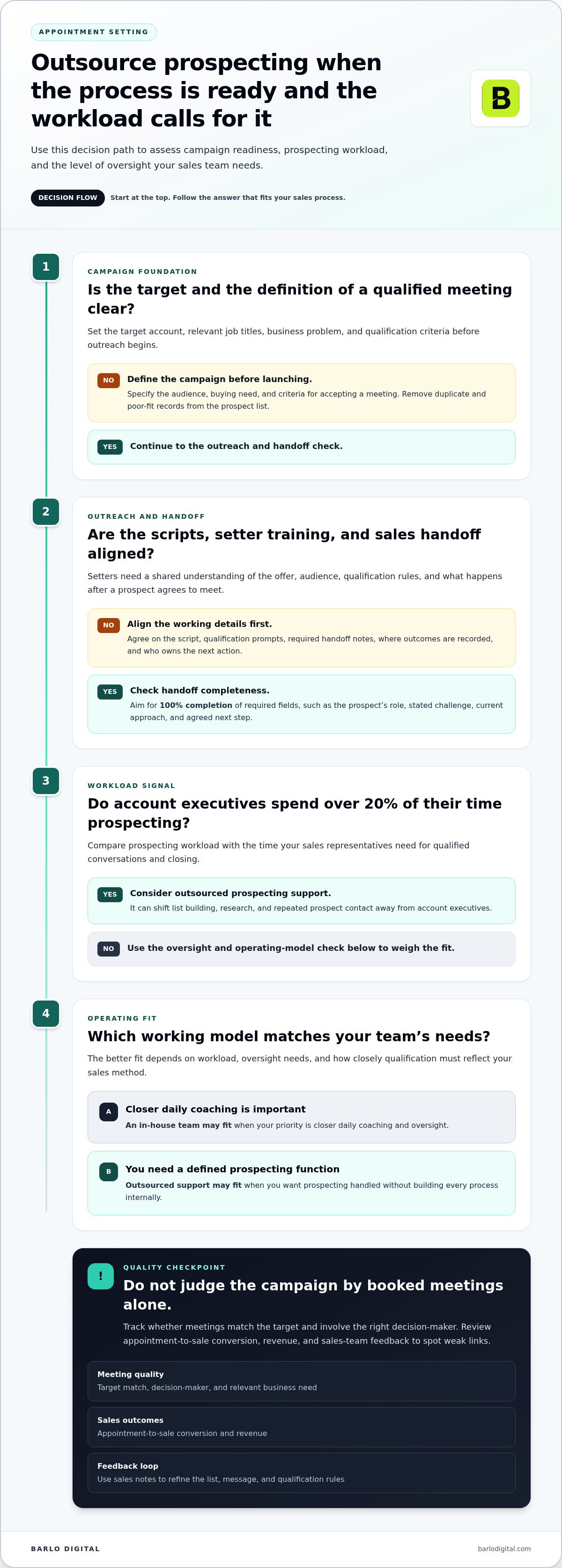
- Align prospect lists, scripts, qualification criteria, and handoff notes with your sales process before outreach begins.
- Compare outsourced support with the time your sales representatives spend prospecting and the expertise the work requires.
- Evaluate providers on targeting, training, communication, and how clearly they report campaign activity and meeting quality.
- Track appointments alongside appointment-to-sale conversion, revenue, and sales-team feedback to spot weak links in the process.
Outbound strategy and multichannel outreach
Outsourced setters should work from a defined campaign, not an unfiltered call list. Specify the target account, relevant job titles, business problem, and criteria for a qualified meeting. For example, a manufacturer selling production equipment might target plant managers and operations leaders, excluding companies outside its service range. This focus keeps outreach relevant and gives sales representatives a consistent standard for accepting meetings.
List building determines who enters the campaign. Segment records by industry, company size, role, location, and a clear buying signal, such as hiring for a related position. Remove duplicates and poor-fit records before outreach begins. A broad list can inflate activity while burying unsuitable contacts, lowering conversion and wasting follow-up time.
For outsourced U.S. calling, map applicable federal and state telemarketing and do-not-call rules before launch. Requirements vary by recipient, call type, technology, and location, so distinguish business from consumer records and define how suppression requests will be handled. Document how opt-outs are honored and calling methods reviewed before setters contact prospects.
Cold calling works best as a planned sequence, not as repeated attempts without context. Give setters a call objective, concise opening, qualification prompts, and a clear next step. If a prospect is unavailable, record the outcome and use an approved follow-up channel. Review call notes alongside meeting outcomes: a booked slot alone does not show that the campaign reached a qualified buyer.
- LinkedIn: Use a relevant profile detail to make a connection request or follow-up specific.
- Email: Tie the message to the prospect’s role and one business problem, then ask for a short discussion.
- Phone: Reference the same problem and use the call to clarify fit or schedule the meeting.
For example, an insurance campaign might target finance leaders at businesses with a defined employee profile. A real estate outreach campaign could focus on property management firms and discuss a specific operational need, rather than sending a generic pitch. In both cases, setters need approved audience criteria and language that reflects the actual offer. The B2B appointment setting approach should connect prospect selection, outreach, qualification, and sales handoff.
Set up a feedback loop before launch. Sales representatives should record whether each meeting matched the target, involved the right decision-maker, and addressed a relevant business need. Use their notes to refine the list, message, or qualification rules. That is how a multichannel campaign improves: every contact provides insight, not just activity.
Scripts, prospect databases, training, and lead management
Outsourced appointment setting works when scripts, prospect records, and sales handoffs reflect your actual process. Compare it with hiring in-house by weighing the prospecting workload, training required, and level of control your team needs.
Scripts and Prospect Lists
A useful script gives setters a framework, not a rigid speech. It should identify the target role, business problem, relevant proof point, and a clear meeting request. For example, a software seller contacting operations directors could open with a familiar workflow issue, then ask whether it is a current priority.
Prospect databases should support your targeting. Review how records are selected, organized, and updated, including company, role, industry, and contact details. Set exclusion rules for poor-fit accounts and duplicates. Ask to see a sample list and compare it with your ideal customer profile before the campaign begins.
Lead Research and Qualification
Research gives setters useful context before they make contact. A prospect’s role, company activity, and likely business need can shape a relevant opening. Qualification then tests fit against agreed criteria, such as authority, need, and willingness to discuss a solution. For example, an interested employee may not qualify if your sales team needs to speak with a budget owner.
Define required qualification fields before launch. A handoff can record the prospect’s role, stated challenge, current approach, and agreed next step. Aim for 100% completion of those required fields, so sales representatives don’t enter meetings without usable context.
Training should cover the offer, audience, script, qualification rules, and objection handling. Practise realistic scenarios: one prospect says the problem is already solved, another asks for information by email, and a third is not the decision-maker. Review call notes and sales feedback, then revise language that confuses prospects or attracts poor-fit leads.
Lead management connects a conversation to sales follow-up. Agree where setters record outcomes, how they flag urgent interest, and who owns the next action. For example, a prospect requesting a product demonstration should reach the assigned representative with the request and relevant context, not just a calendar entry.
Outsourcing can shift list building, research, and repeated prospect contact away from account executives. Consider it when account executives spend over 20% of their time prospecting. An in-house team may offer closer daily coaching; outsourced support can provide a defined prospecting function without requiring your sales team to build every process internally. The better fit depends on workload, oversight needs, and how closely qualification must reflect your sales method.
Access to trained sales development representatives
Adding appointment setters changes the handoff between prospecting and sales, not merely the number of calls made. The value depends on whether representatives understand your offer, record useful context, and schedule meetings that fit your sales process.
The Bridge Group study cited in the research reports that the average sales development representative takes 3 months to ramp up to full productivity. That ramp includes learning the market, practicing outreach, handling objections, and applying qualification rules. Outsourcing can provide access to trained representatives without making your internal sales team build every part of that function itself.
Training must connect to your company’s sales cycle. Give setters examples of qualified and unqualified meetings, explain which roles influence a purchase, and show how your representatives handle the first sales conversation. For example, a technical sale may require an operations leader, while an initial conversation with a general contact may not advance the opportunity.
Scheduling is a workflow, not just filling a calendar. Set clear rules for meeting length, attendee roles, time zones, required notes, and rescheduling. If a prospect requests a discussion about implementation, attach that context so the sales representative can prepare rather than repeat discovery questions.
CRM integration protects the pipeline from broken handoffs. Most outsourced appointment-setting services can integrate with popular CRM and scheduling software. Define which fields setters update, how they label outcomes, and who owns follow-up. For instance, a completed meeting could record the prospect’s role, stated need, and agreed next step, while a no-show receives a distinct status for later review.
Keep the sales cycle visible in the same system. When a meeting becomes an opportunity, the sales team should be able to trace its source and review the setter’s notes. When it stalls, feedback should clarify whether the issue was poor fit, timing, missing authority, or an unclear offer. This prevents the pipeline from treating every booked meeting as equal.
- Before launch: Map the handoff from booked meeting to sales follow-up.
- During the campaign: Review CRM records for missing notes and incorrect stages.
- After sales conversations: Return specific feedback to the setter team.
Technology should support your operating model, not disguise its gaps. Setters need access to the agreed CRM, scheduling system, approved messaging, and reporting fields. The internal owner should review records and pipeline movement with the sales team. Aligning prospecting with these steps keeps scheduling, records, and follow-up connected.
Choosing an appointment-setting provider
A provider can create qualified conversations or leave your sales team with more cleanup. Assess its operating process, accountability, and fit with your organization before moving ahead.
Provider Evaluation Criteria
There is no single best appointment-setting company for every U.S. business. The best fit serves your market, understands your sales cycle, and defines a qualified meeting using your criteria. Compare experience with your buyer type, setter training, reporting, and who owns campaign decisions. A 2-3 week shortlist can help your team compare finalists against the same requirements.
Ask each provider to explain its workflow using a sample account: how it prepares setters, reports activity, and returns sales feedback. Confirm who handles strategy and who reviews performance. For a provider focused on B2B prospecting, compare its process with the requirements of B2B appointment setting, rather than relying on broad claims about appointment volume.
Onboarding should turn your requirements into an operating plan. Share your target-account profile, offer details, qualification rules, approved messaging, and sales handoff process. Align CRM fields, scheduling, reporting, and points of contact before outreach begins. An initial review can expose unclear criteria so you can correct them before they affect the wider campaign.
Risks of Provider Selection
A weak provider can book meetings that sales representatives reject, leaving the organization with activity but little pipeline value. Examine team stability: the appointment-setting team’s average tenure is 1.5 years. Ask how the provider handles setter turnover, coaching, and documented campaign processes so your outreach doesn’t depend on one person’s memory.
Outsourced setters work on behalf of the company that hires them, but your direct control over their incentives, quotas, and coaching may be limited. Set review routines, escalation paths, and correction procedures in advance. If feedback shows repeated poor-fit meetings, clarify who can revise targeting and qualification rules.
Provider Pricing Models
Appointment setting services may use a retainer, hourly billing, fixed pricing, or pay-per-performance terms. Each structure allocates risk differently: a retainer supports ongoing work, while performance-based billing ties charges to defined outputs. Read the definition of a billable appointment carefully, including qualification standards, cancellations, and no-shows.
Compare the pricing model with the work performed, not just its headline measure. For example, an appointment-based fee may reward calendar volume unless the agreement also defines fit. Before signing, confirm what reporting, research, campaign management, and revisions each model includes.
Outsourcing Costs
How much outsourced appointment setting costs in the United States depends on scope, targeting, outreach channels, staffing, and qualification requirements. The price depends on the case and is given after a quote request. Compare the full work covered and the meeting definition, not a bare cost-per-appointment figure.
Ask how the proposal connects spending to sales outcomes, including qualified meetings, appointment-to-sale conversion, and revenue contribution. A low-cost meeting that never advances toward a sale can burden your team. A useful estimate should reflect the campaign workload and the standards your organization expects.
Measuring outsourced appointment setting success
Meeting volume measures activity, not sales impact. Track the path from appointments set to sales conversion and revenue, alongside feedback from the representatives handling those conversations.
Start with appointments set, using a shared definition of a completed, qualified meeting. Separate meetings booked from meetings held, and record cancellations, no-shows, and rejected prospects. A calendar booking with the wrong job title, for example, should not count as a qualified sales conversation. Clear categories help pinpoint whether the problem is targeting, confirmation, or qualification.
Next, calculate the appointment-to-sale conversion rate by comparing sales closed from campaign appointments with the appointments included in the analysis. Keep the cohort consistent: meetings booked in one period may close later, so connect each appointment to its eventual sales outcome. Otherwise, an early report can make productive outreach look ineffective.
Track revenue alongside conversion. A campaign can produce fewer meetings but contribute more revenue if it reaches accounts with stronger buying fit. Review closed deals, deal value, and pipeline movement together. The appointment-setting ROI calculator estimates annual leads by multiplying monthly B2B leads by 12 months, then estimates closed deals by multiplying annual leads by the close ratio expressed as a percentage divided by 100.
- Appointments: Count booked, held, and sales-accepted meetings separately.
- Conversion: Connect held meetings to opportunities and closed sales.
- Revenue: Compare campaign-sourced sales and pipeline contribution.
- Feedback: Record sales-team assessments of fit and meeting context.
Sales-team feedback reveals what a dashboard cannot. Ask representatives whether attendees matched the target role, understood the meeting’s purpose, and had a relevant need. If the same objection or mismatch keeps appearing, use that evidence to refine targeting, scripts, or qualification. Keep feedback specific: “wrong department” is actionable; “poor quality” is not.
Use a consistent reporting period and source labels across your CRM. Distinguish outsourced efforts from other lead-generation sources, and define attribution for shared accounts. Review results with the sales team and setting service, then document one adjustment at a time. You can change the campaign’s audience or message while preserving the original measures to see whether the change improved results.
The key takeaway: judge performance by the journey from qualified appointment to revenue, not calendar volume alone. Use that measure to identify which part of the process needs attention before changing the campaign.
Barlo Digital: Ecommerce ad management (Meta, Google, TikTok)
Barlo Digital manages ecommerce advertising across Meta, Google, and TikTok for businesses focused on online sales. This is a separate growth need from B2B appointment setting. It fits when an ecommerce business needs paid campaigns and clearer measurement of their contribution.
When tracking gaps make campaign results difficult to interpret, our ecommerce tracking and measurement audit can identify where measurement needs attention. If your priority is qualified B2B meetings, ecommerce advertising is not a substitute for appointment-setting support. Match the service to the sales process you need to improve.
Our ecommerce ad management page describes the campaigns we manage.
Make the next growth decision measurable
Before committing to appointment setting outsourcing, define what a useful first phase needs to prove. Write down the buyer profile, meeting standard, sales handoff, and evidence that would justify continuing. This gives your team a decision framework, not just a calendar target, and helps distinguish a targeting problem from a sales follow-up problem.
Keep the wider acquisition picture in view. Barlo Digital manages ecommerce advertising across Meta, Google, and TikTok, provides ecommerce tracking and measurement audits, and supports local SEO and AI search. These services address different growth needs, so choose the approach that matches the constraint your business needs to solve.
If you’re ready to discuss your priorities and determine the right next step, contact Barlo Digital. A clear starting point helps turn the decision into a practical plan.
Frequently Asked Questions
What Exactly Do Appointment Setters Do?
Appointment setters identify suitable prospects, make initial contact, assess fit against agreed criteria, and arrange sales meetings. They also record useful context, such as a prospect’s current challenge, decision-making role, and preferred next step. For example, if a buyer requests a technical discussion, the setter can note the topic and route it to the right sales representative. The goal is a useful handoff, not a promise of results or a closed deal.
What is appointment setting outsourcing and how does it work?
Appointment setting outsourcing means assigning prospect outreach and meeting coordination to an external team. Your company defines the audience, offer, qualification rules, and sales handoff; the provider conducts the agreed outreach and reports activity. For example, a firm selling cybersecurity services might target IT leaders, then route interested prospects to a representative for technical discovery. The arrangement works best when both teams agree on what qualifies as a meeting and how feedback will shape the campaign.
What industries benefit most from outsourced appointment setting?
Businesses with defined buyers and a clear reason for sales conversations may benefit, including managed IT, manufacturing, staffing, medical practice suppliers, and commercial insurance. A manufacturer might seek conversations with operations leaders, while a staffing firm may target hiring decision-makers. The common factor is a reachable audience with specific business needs, not the industry label alone. Broad consumer offers or purchases that do not involve sales conversations may be a weaker fit.
How do you choose and vet an appointment setting provider?
Evaluate a provider using a real sales scenario, not just a polished presentation. Share a sample buyer profile and ask how the team would approach someone who already uses another solution. Review whether its response stays relevant, captures the prospect’s concern, and records the outcome. Clarify who can access campaign records, how performance updates are shared, and how either side can raise an issue.
What metrics should businesses use to evaluate appointment setting performance?
Track held meetings, sales-accepted opportunities, closed-business conversion, revenue contribution, and feedback from the representatives taking the meetings. When sales rejects a meeting, record a reason such as wrong role, no active need, or poor timing. This helps distinguish a targeting failure from a follow-up delay. Compare results by audience segment and outreach source so a weak segment is not obscured by the campaign-wide average.
What are the risks of outsourcing appointment setting, including data privacy and compliance?
Risks include mishandled prospect information, inconsistent opt-out practices, weak access controls, and outreach that conflicts with applicable requirements. Before launch, document which records the provider may use, which systems it can access, how opt-outs are passed along, and who handles data requests or incidents. Limit access to information needed for the work, use approved systems, and agree how records are returned or removed when the engagement ends.
What U.S. telemarketing and do-not-call rules apply to outsourced appointment setters?
Before launch, map applicable federal and state telemarketing and do-not-call rules based on the recipient, call type, technology, and location. Separate business and consumer records, document how suppression requests and opt-outs are handled, and review calling methods before outreach begins.

Article by
Carlos Benavides
Carlos Benavides founded Barlo Digital and is its Director of Paid Media and Performance. He has fifteen years in direct-response marketing, more than $50M in lifetime ad spend, and a B.S. in Computer Science, which is why tracking at Barlo Digital is built by hand. Barlo Digital is a director-led paid media and search agency serving US ecommerce brands, home-service companies and practices.


