

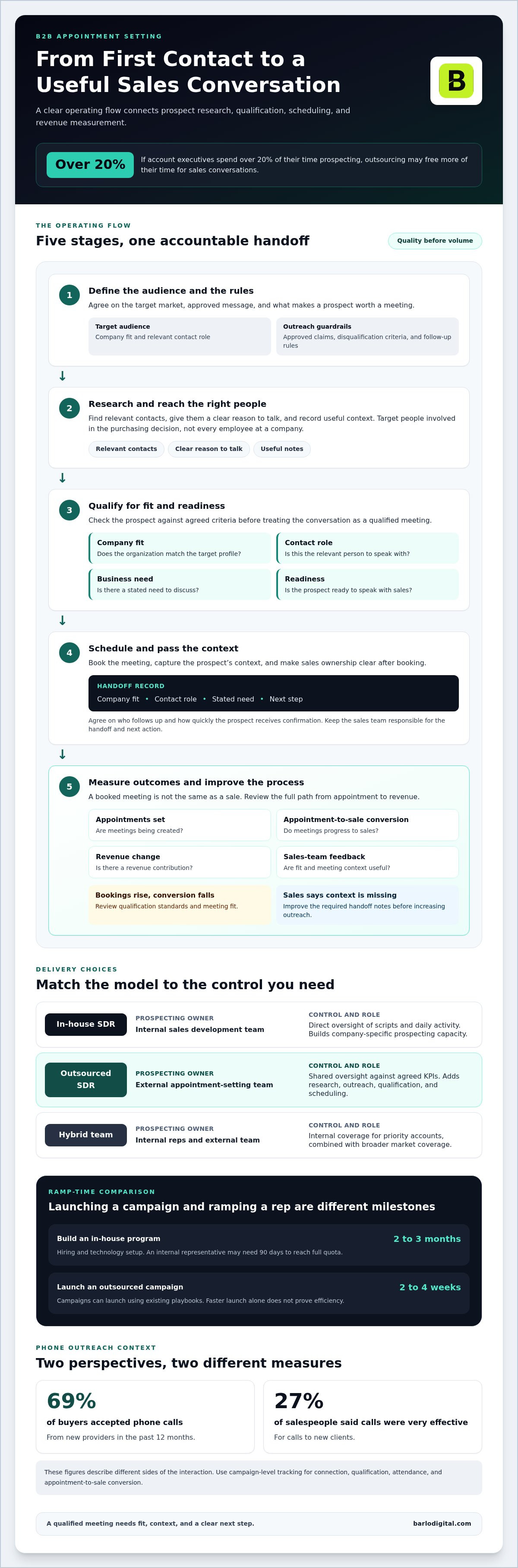
Outsourced appointment setting can make sense when account executives spend over 20% of their time prospecting. It shifts research, outreach, qualification, and scheduling away from sales reps, but it also means sharing control of the process and its daily execution.
That trade-off matters. You may want steadier prospecting and more time for sales conversations, but an external team still needs a clear target market, a workable message, and agreed criteria for a qualified meeting. If your product requires deep technical knowledge to explain, keeping appointment setting in-house may give your team more control.
This comparison will help you assess cost models without treating a low fee as proof of value. You’ll see how outsourced, in-house, and hybrid approaches differ in management demands, control, and fit, and how to judge results using appointments, sales conversion, revenue, and feedback from your sales team. The key question is whether external capacity can create useful opportunities without compromising the quality of the conversations needed to close them.
Key Takeaways
- Compare outsourced, in-house, and hybrid models by who controls outreach, qualification, and scheduling, not by headline cost alone.
- Match the approach to your sales process: complex products may need closer internal involvement, while broader prospecting can be easier to delegate.
- Before launch, define the target audience, what qualifies as a meeting, and how appointment quality will be judged.
- Assess pricing models against the work included and the sales outcomes you need, since a booked meeting is not the same as a sale.
- Use appointment setting to create focused sales conversations, then track whether those conversations lead to revenue and useful feedback from your sales team.
Outsourced SDR teams and sales development
An outsourced sales development representative (SDR) team handles prospecting before an account executive takes over. Appointment setters research target companies, contact potential buyers, assess initial interest, and schedule meetings. The work calls for specific skills: finding relevant contacts, giving them a clear reason to talk, and recording useful context for the sales team.
That separation can protect sales productivity. If account executives spend over 20% of their time prospecting, an external team can take on that activity and leave more time for sales conversations. The aim isn’t simply to fill calendars. A meeting should match the target profile, address a real business need, and include enough context for the sales representative to continue the discussion.
Outreach carries reputational risk. A poorly targeted call can waste a prospect’s time and undermine trust before a sales conversation begins. For example, a manufacturer should target people involved in the relevant purchasing decision, not call every employee at a company. Set approved claims, disqualification criteria, and follow-up rules before outreach begins.
Alignment between sales and marketing makes those rules practical. Marketing can define the audience and campaign message, while sales specifies what makes a prospect worth meeting. Agree on handoff details such as company fit, contact role, stated need, and next step. A shared definition prevents appointment volume from disguising weak qualification.
Outreach remains a viable channel, but the numbers need context: 69% of buyers accepted phone calls from new providers in the past 12 months, while 27% of salespeople said calls to new clients were very effective. Those figures describe different sides of the interaction. Track connection, qualification, attendance, and appointment-to-sale conversion to identify where the pipeline is leaking.
| Model | Prospecting owner | Control | Pipeline role |
|---|---|---|---|
| In-house SDR | Internal sales development team | Direct oversight of scripts and daily activity | Builds company-specific prospecting capacity |
| Outsourced SDR | External appointment-setting team | Shared oversight against agreed KPIs | Adds prospect research, outreach, qualification, and scheduling |
| Hybrid team | Internal reps and external team | Internal coverage for priority accounts | Combines key-account focus with broader market coverage |
Choose the model that matches your target market, sales team capacity, and required control; a focused B2B appointment-setting process also needs clear qualification and handoff rules.
Is outsourcing appointment setting the right move for your company?
The decision comes down to ramp time, control, and whether your sales process can support a clear handoff. Compare the operating models before choosing how to build your pipeline.
Outsourced Versus In-House Setters
Hiring in-house gives your company direct oversight of daily activity and scripts, while an external team works against agreed performance measures. Building an internal program takes 2 to 3 months for hiring and technology setup, and an internal representative may need 90 days to reach full quota. Outsourced campaigns can launch in 2 to 4 weeks using existing playbooks. That speed matters when losing time to hiring blocks market entry.
Cold Calling and Outreach Campaigns
Campaigns turn a target list into sales conversations through contact research, outreach, qualification, and calendar scheduling. Setters assess leads against criteria such as company fit, contact role, business need, and readiness to speak with sales. They then schedule a meeting and record the prospect’s context. Businesses with defined buyers, including manufacturers and suppliers selling to medical practices, can use this process to connect sales teams with relevant decision-makers.
U.S. cold calling and telemarketing are subject to federal and state requirements. Which rules apply depends on the call method, audience, technology, and location, so campaign procedures should account for these factors before outreach begins.
Start with a documented handoff. Agree on the target audience, qualification criteria, approved message, meeting calendar, and process for handling replies. Specify who follows up after a booking and how quickly the prospect receives confirmation. These steps reduce confusion between the setter and sales representative.
Set clear ownership and access terms for lead records and campaign data. Define who can view, export, update, and retain contact records, call notes, and campaign history. The external setter works for the company that hired them, not directly for that company’s customers. Keep your sales team responsible for the handoff and next action.
Measure more than meetings booked. Track appointments set, conversion from appointment to sale, revenue change, and sales-team feedback. If bookings rise while conversion falls, review qualification standards and meeting fit. If sales representatives say context is missing, improve the required notes before increasing outreach.
Outsourced campaigns may shorten launch compared with building a new team, but speed alone doesn’t prove efficiency. Test whether the process produces qualified meetings, useful feedback, and revenue contribution. For companies selling to manufacturers or medical practices, a focused B2B appointment-setting campaign can align prospecting with a defined sales handoff.
Communication, control, and service-quality limitations
External setters work from the company’s target criteria, scripts, and agreed performance measures. That creates shared oversight rather than direct control of every call and daily action. In-house representatives, by contrast, focus 100% on their company’s specific products. The difference matters when a prospect asks a technical question that requires detailed product knowledge or an immediate answer from sales.
Begin lead qualification with a focused target-account profile. Define the industries, company characteristics, contact roles, and business needs that indicate a fit. For example, a manufacturer might prioritize operations leaders at companies using a relevant production process. Research should confirm each contact’s role and company context before outreach, rather than treating every name on a list as equally valuable.
Set clear boundaries for qualification. Setters can verify basic fit, identify a stated need, and record the prospect’s preferred next step. They shouldn’t improvise technical claims or make commitments on behalf of sales. For complex products, define an escalation path: capture the question, route it to a subject-matter expert, and schedule a follow-up only with the prospect’s agreement.
Some appointments should stay in-house. The U.S. Government Accountability Office reported that some specialty and primary care appointments were considered too complex to outsource and were to be scheduled only by clinic staff. The same principle applies elsewhere: when booking requires sensitive judgment or specialized knowledge, leave the decision to trained internal staff.
Quality assurance should assess the work, not just count meetings. Review call recordings or notes against specific standards, then coach on any gaps. A practical review can check whether the setter:
- Reached the right contact at a target account.
- Recorded the business need in the prospect’s own terms.
- Used approved language and avoided unsupported claims.
- Set a meeting with a clear purpose and next step.
Use feedback from sales partners to identify communication breakdowns. Ask representatives to flag meetings with missing context, the wrong contacts, or no relevant need. Compare those examples with qualification notes and call reviews. If poor-fit meetings keep reaching closing conversations, refine the target profile or the questions asked before booking.
Document ownership of scripts, account exclusions, call notes, and changes to qualification rules. A shared scorecard should track meeting quality as well as volume, with a named owner responsible for reviewing recurring issues. This keeps external partners accountable while preserving your company’s control over positioning, prospect experience, and the standards that protect its reputation.
Appointment-setting pricing models and costs
The billing model determines what you pay for and how much risk you carry. Compare the work included, cost structure, and pipeline outcome each model rewards.
Appointment-Setting Cost Estimates
A price estimate is useful only when it defines the campaign being priced. Appointment-setting services may bill by the hour, charge a monthly retainer or per appointment, or tie payment to performance. Those structures aren’t directly comparable unless each estimate specifies the target audience, outreach channels, qualification standard, scheduling work, and reporting. Campaign costs depend on scope, including target-market size, research depth, outreach volume, qualification requirements, and reporting.
Compare estimates by scope, not just the initial figure. One proposal may include research and follow-up, while another covers appointment booking alone. Ask what counts as a qualified meeting and how cancellations, rescheduling, and campaign changes affect billing. A clear estimate connects each charge to defined work and an agreed measure of results.
Outsourcing Costs and Training
Outsourcing shifts the cost of recruiting and training setters into a contracted campaign. A retainer can make ongoing spending predictable, while hourly billing ties charges to time worked. Per-appointment and performance-based models link payment more closely to output, but make the definition of a valid appointment especially important. A meeting that misses the target profile can generate activity without creating useful pipeline.
Training still matters. External setters need product context, approved claims, qualification rules, and a reliable escalation path. Account for the effort required to prepare those materials and refine them using campaign feedback. Compare that setup work with the internal time needed to recruit, coach, manage, and assess setters.
Hidden In-House SDR Costs
Hiring an in-house SDR costs more than the salary. Your company also takes on recruiting, benefits, management time, tools, and the opportunity cost of ramping up a new employee. Technology setup and ongoing coaching add operational work, while a hiring shortfall can leave account executives prospecting as well as closing. Include all these costs when comparing internal capacity with an external team.
Internal hiring can still make sense when product knowledge and direct oversight outweigh the added operating burden. For a complex sales process, an internal setter can learn from product specialists and adjust messaging quickly. Weigh that control against the full employment cost and the number of qualified meetings the role needs to support.
Upfront and Ongoing Costs
Separate launch expenses from recurring campaign charges. Upfront work may include audience research, list preparation, messaging, qualification criteria, and workflow setup. Ongoing charges may cover setter time, outreach, appointment management, and reporting. A setup fee or initial project charge should correspond to specific launch work, not appear unexplained alongside a monthly retainer.
Before signing, connect each charge to a deliverable and review point. Confirm how the agreement handles campaign pauses, revised targeting, and disputes about meeting quality. Then compare ongoing costs with conversion, revenue contribution, and sales-team feedback. The cheapest structure can become costly if it rewards booked meetings that never advance the sales process.
Appointment setting as a lead generation strategy
Lead generation creates potential demand; appointment setting moves selected prospects into scheduled sales conversations. The practical distinction is that a lead may be a contact or inquiry, while a booked meeting gives sales a defined next step.
Appointment setters can make lead generation more actionable by connecting outreach to the sales team’s calendar. But not every booking is a qualified opportunity. A meeting is valuable when the prospect fits the target market, has a relevant business need, and can take part in a useful sales discussion.
Consider a manufacturer targeting industrial suppliers. A broad lead-generation campaign might gather contacts across the market. An appointment-setting campaign then researches relevant companies, contacts the right roles, confirms fit, and schedules conversations with sales. Each stage has a different purpose, so reporting should show where prospects stop progressing.
Use a simple pipeline to diagnose the process:
- Define the target. Specify company type, relevant roles, and the problem your solution addresses.
- Generate and research leads. Identify prospects and add enough company context to make outreach relevant.
- Make contact. Use the campaign’s approved message to explain why a conversation may matter.
- Qualify interest. Confirm the prospect fits the criteria and understands the meeting’s purpose.
- Schedule and hand off. Book the meeting, record context, and give sales a clear next action.
This sequence reveals failures that a single “leads generated” total can hide. If contacts are plentiful but few fit the target, review research and targeting. If qualified prospects decline meetings, examine the message and timing. If meetings happen but don’t progress, sales feedback may reveal weak qualification or a mismatch between campaign expectations and the sales conversation.
There is evidence that outreach can open doors: 82% of buyers accept meetings with sellers who reach out to them. Treat that figure as a reason to test relevant outreach, not as a forecast for your campaign. Measure appointments set, attendance, conversion to sale, revenue contribution, and feedback from sales. Those measures connect activity to business outcomes.
Appointment-setting services work best as one part of a lead-generation strategy, not a substitute for it. Marketing defines the audience and message, setters create conversations, and sales advances qualified prospects. Align those responsibilities, then review pipeline movement to find where momentum drops.
For a structured approach to B2B appointment-setting campaigns, tie targeting and qualification to the sales team’s actual pipeline needs.
Barlo Digital: Ecommerce ad management (Meta, Google, TikTok)
For companies that need qualified B2B sales conversations, Barlo Digital provides B2B appointment setting tailored to their target market and sales process. A director runs every account, and senior-level staff handle the work directly. Nothing is handed to a junior, and there’s no account-manager layer.
Choose the next growth constraint to solve
The right next step depends on what’s constraining your growth system. If qualified sales conversations are the bottleneck, assess whether outsourced appointment setting fits your target market and sales process. If the broader challenge is customer acquisition, distinguish that need from appointment booking before allocating budget or changing your team structure.
Barlo Digital supports other acquisition needs with ecommerce ad management across Meta, Google, and TikTok, ecommerce tracking and measurement audits, and local SEO and AI search. These services address distinct channels and measurement challenges, rather than the appointment-setting decision itself.
Bring your sales goals and the constraint you’re trying to remove into the conversation. Explore B2B appointment setting as a practical next step for your growth plan.
Frequently Asked Questions
What Exactly Do Appointment Setters Do?
Appointment setters create a qualified next step between prospecting and a sales conversation. For example, a setter contacting a software company might identify the operations leader, confirm the company’s relevant need, and arrange a discussion with an account executive. They also record useful context, such as the prospect’s stated challenge and preferred follow-up. Their role is to open and organize the conversation, not close the sale.
What is outsourced appointment setting and how does it work?
Outsourced appointment setting means an external team prospects and schedules sales meetings for a company. The company defines its target audience, offer, and meeting criteria; the team researches prospects, conducts outreach, and coordinates bookings. For example, a staffing firm might target organizations with hiring needs, then pass relevant conversations to its sales representatives. The company remains responsible for sales discussions and follow-through.
How much does outsourced appointment setting cost in the United States?
There’s no single U.S. price because costs depend on the scope and billing model. A campaign requiring detailed account research, specialized industry knowledge, and multiple outreach channels differs from one with a narrower audience and simpler qualification. Compare proposals by included work, billing basis, meeting criteria, and reporting. Then weigh total campaign costs against qualified opportunities and sales outcomes, not just booked meetings.
What pricing models do appointment-setting companies use?
Common pricing structures include hourly billing, monthly retainers, fixed campaign fees, per-appointment charges, and performance-based arrangements. Hourly and retainer models charge for time or ongoing campaign work; appointment-based models tie billing to bookings. Performance models link payment to agreed outcomes. Each structure creates different incentives, so define what counts as a completed appointment, how cancellations are handled, and which campaign work each charge covers.
How do I choose an outsourced appointment-setting provider?
Choose based on fit with your sales process, not headline volume. Check whether the team can work with your target industries, explain your offer accurately, and document prospect context in a useful format. For a technical product, assess how questions are escalated rather than improvised. Compare proposed qualification rules and reporting with your sales team’s needs. A good fit makes ownership, handoffs, and performance measures clear.
What questions should I ask before hiring an appointment-setting company?
Include operational questions in the campaign scope: Which accounts and roles are targeted? What makes a meeting qualified? Which research and outreach activities are included? Who owns contact records, notes, and campaign data? How are cancellations, exclusions, and changes handled? What reporting will sales receive, and how will feedback shape the campaign? Clear answers prevent disagreements over deliverables and reveal gaps before they disrupt the sales process.
What metrics should businesses use to evaluate appointment-setting services?
Track the journey from booked meeting to business result. Compare meetings held with meetings booked, then examine appointment-to-sale conversion and revenue contribution. Segment results by target industry, campaign message, or lead source to see where quality changes. Include sales-team feedback about fit and meeting preparation. A rising booking count can conceal weak opportunity quality, so assess the full journey instead of treating calendar activity as the final measure.
What are the risks and drawbacks of outsourcing appointment setting?
Outsourcing can weaken the prospect experience if setters misunderstand the offer, target the wrong roles, or book meetings without a meaningful fit. Your company also has less direct control over daily call execution than with an internal team. Reduce risk with approved messaging, account exclusions, call reviews, and escalation rules. Keep highly technical explanations or sensitive scheduling decisions with internal specialists when external setters lack the context to handle them accurately.

Article by
Carlos Benavides
Carlos Benavides founded Barlo Digital and is its Director of Paid Media and Performance. He has fifteen years in direct-response marketing, more than $50M in lifetime ad spend, and a B.S. in Computer Science, which is why tracking at Barlo Digital is built by hand. Barlo Digital is a director-led paid media and search agency serving US ecommerce brands, home-service companies and practices.


