

An appointment is not valuable just because it lands on a calendar. The cost of B2B appointment setting services depends on the pricing model, target-account complexity, qualification depth, channels, and campaign scope. A specific quote depends on the case and is provided after a quote request, with those factors shaping the work included.
That makes a headline rate a poor basis for comparison. A lower fee may exclude essential work, while a higher one may cover deeper prospect qualification or broader campaign execution. Compare how each service creates qualified meetings and how clearly it reports the work.
This article explains common pricing models, what affects campaign launch timing, and how to assess a partner’s targeting, qualification, and reporting. It also covers outreach strategy, helping you judge whether an approach fits your buyers instead of simply counting meetings.
Key Takeaways
- Compare pricing by the work included, qualification depth, and campaign scope, not by the headline fee alone.
- Assess how a partner engages prospects, books meetings, and follows up when a prospect misses one.
- Use targeting, messaging, and sales-team readiness to identify what may affect campaign launch timing.
- Judge performance through clear activity and campaign reporting, then connect those measures to meeting quality.
- Choose an outreach strategy that fits your buyers and gives you a practical way to evaluate its value.
So What Makes a Great Appointment Setting Partner?
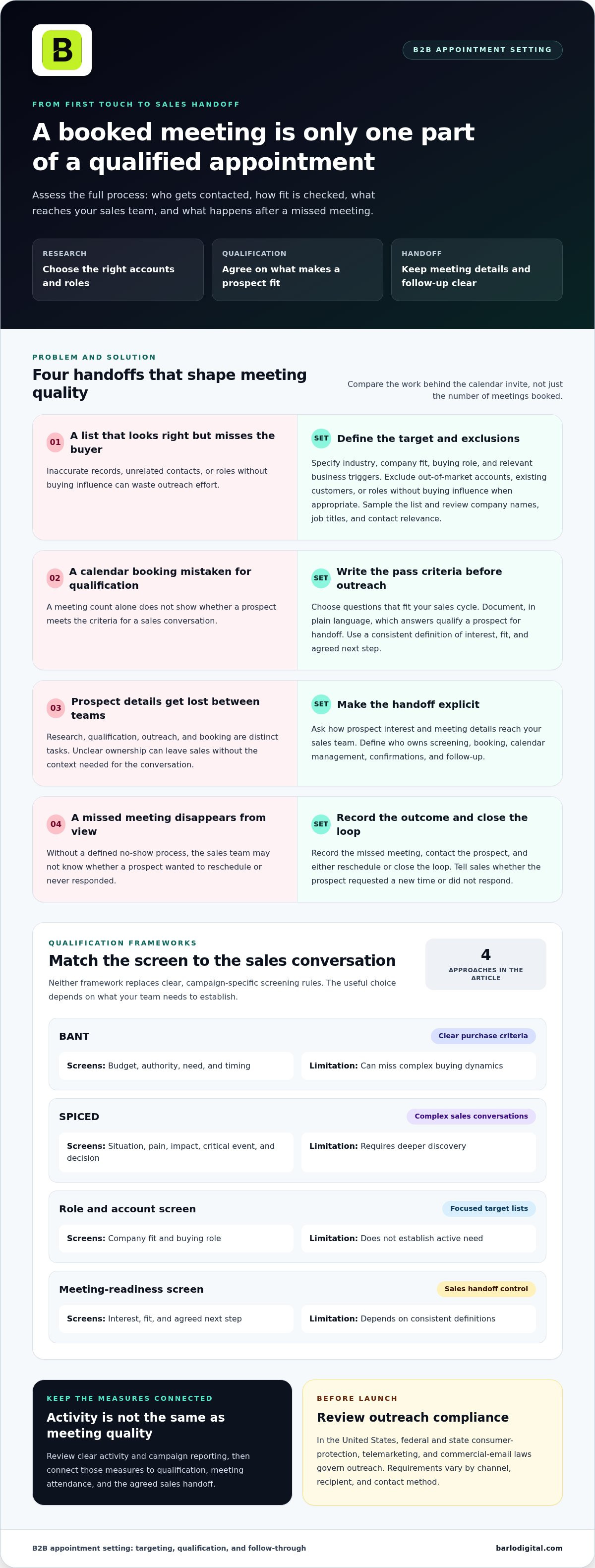
A strong partner connects prospect research, qualification, outreach, booking, and follow-up in one accountable process. Assess the handoffs, not just the number of meetings scheduled.
In the United States, federal and state consumer-protection, telemarketing, and commercial-email laws govern outreach. Requirements vary by channel, recipient, and contact method, so review campaign compliance before launch.
B2B appointment-setting companies may research target accounts, contact prospects, screen leads against agreed criteria, book meetings, and report activity. Some also manage calendars, send confirmations, and follow up after missed meetings.
Lead Engagement and Meeting Booking
Engagement covers the path from first outreach to a confirmed meeting. A partner may call or email prospects, answer questions, and offer available calendar times. This differs from research, which identifies whom to contact, and qualification, which assesses fit. Ask how prospect interest and meeting details reach your sales team.
No-show follow-up is a separate operational step. A sound process records the missed meeting, contacts the prospect, and either reschedules or closes the loop. For example, the sales team should know whether the prospect requested a new time or did not respond. This prevents a calendar booking from being mistaken for a qualified appointment.
Prospect Research and Targeting
Research defines which accounts and roles belong on the target list. Criteria may include industry, company fit, buying role, and a relevant business trigger. For example, a campaign aimed at manufacturers should distinguish plant-level decision-makers from unrelated contacts. Research determines who receives outreach before a conversation begins.
Good targeting also sets exclusions. Depending on the campaign, remove accounts outside the target market, existing customers, or roles without buying influence. Sample the list before launching outreach. Review company names, job titles, and contact relevance together. Inaccurate records waste effort and undermine qualification results.
Qualification assesses whether a prospect is ready for a sales conversation. BANT checks budget, authority, need, and timing. SPICED examines Situation, Pain, Impact, Critical Event, and Decision. Neither framework replaces clear, campaign-specific screening rules. Set those rules before outreach and specify which answers qualify a prospect for handoff.
| Approach | Best for | What it screens | Main limitation |
|---|---|---|---|
| BANT | Clear purchase criteria | Budget, authority, need, timing | Can miss complex buying dynamics |
| SPICED | Complex sales conversations | Situation, pain, impact, event, decision | Requires deeper discovery |
| Role and account screen | Focused target lists | Company fit and buying role | Does not establish active need |
| Meeting-readiness screen | Sales handoff control | Interest, fit, and agreed next step | Depends on consistent definitions |
Choose the framework whose questions match your sales cycle, then document the pass criteria in plain language. For a practical scope comparison, review B2B appointment setting against these handoffs before comparing qualified appointment totals.
What are the benefits of hiring a professional appointment-setting or Appointment Outsourcing service?
Outsourcing can add prospecting capacity without requiring you to build every sales development role internally. Common risks include poor targeting, weak qualification, and meetings that never enter the pipeline. Define handoff rules and review meeting quality to manage those risks.
Outsourced Appointment Setting Benefits
An outsourced team handles repeatable prospecting work, giving internal salespeople more time for active opportunities and buyer conversations. The market comparison reports outsourced SDR programs deliver a pipeline 60% faster than internal setups. That speed matters when internal hiring, training, and management would delay outreach.
Capacity is another distinction. An external team can focus on outreach volume and calendar activity, while in-house representatives often split time across prospecting and other sales tasks. The market comparison also reports a 20-30% lower fully burdened cost per appointment than in-house operations. Compare that measure alongside qualification and meeting attendance, not volume alone.
Outsourced SDR Services
Appointment setting is one function within outsourced sales development representative services. An SDR program may cover prospect research, outreach, qualification, and handoff; a narrower appointment-setting scope may focus on booking qualified meetings. Define the boundary in writing so neither team assumes the other owns follow-up or screening.
For example, an outsourced SDR can identify a target account, contact decision-makers, confirm fit, and book a sales conversation. The internal account executive then owns the opportunity after the agreed handoff. An internal SDR, by contrast, works within your sales processes and relies on your managers to set daily priorities.
The trade-off is control. An in-house team offers direct oversight, product immersion, and daily access to sales leadership. An agency can add execution capacity, but it still needs accurate positioning, timely feedback, and current qualification criteria. If sales managers cannot review calls or correct messaging, outsourcing may repeat errors at greater volume.
Assess fit by mapping the work before engaging an agency. Identify target accounts, define qualification criteria, assign follow-up ownership, and set a review schedule. A company with a proven sales process but limited prospecting capacity may outsource execution. If the buyer profile is still changing, clarify targeting first.
Measure delivered work beyond appointments booked. Track qualified meetings, attendance, accepted handoffs, and resulting pipeline. HubSpot data cited for specialized outbound partners suggests an average ROI of $6.30 for every $1 spent. Treat that figure as context, then compare your own campaign results against the same sales stages and time period.
Appointment-setting budgets and pricing models
Budget comparisons are misleading when providers define a meeting differently. Compare scope, qualification standards, and what happens after booking.
Appointment-Setting Budgets
A budget sets resources for a defined campaign, not just a meeting target. Specify the target market, prospect research, outreach channels, qualification, scheduling, and reporting before comparing proposals. Reaching senior buyers across several industries, for example, requires different research and messaging than contacting one defined account segment.
Price depends on the campaign. Target market, account research, channel mix, qualification depth, and scope all affect cost. Match the scope to your sales team’s capacity. If salespeople cannot handle the meetings generated, more outreach may create calendar pressure rather than revenue.
Pricing Models and Packages
Common pricing structures include a fixed retainer, payment per qualified meeting, or a hybrid combining a base fee with meeting-based charges. A retainer covers agreed campaign work; per-meeting pricing depends on the definition of a qualifying output. A hybrid can tie payment to both execution and booked meetings.
Packages may combine research, outreach, screening, scheduling, and reporting, while custom proposals may price those tasks separately. Compare qualification criteria, cancellation rules, and whether follow-up is included. A booked calendar slot and an attended meeting, for example, are different deliverables.
Cost-Per-Meeting Estimates
Calculate cost per meeting by dividing campaign spend by the meetings counted under the agreement. The result depends on how that denominator is defined. If one proposal counts every booking and another counts only attended, qualified meetings, the estimates are not comparable.
Use cost per meeting alongside lead quality and conversion through your sales process. A lower cost can still burden the team if prospects lack authority or a relevant need. Define qualification, attendance, rescheduling, and duplicate-contact rules in writing before comparing estimates.
Agency Engagement Costs
An engagement may cover setup, ongoing campaign execution, or both. Separate initial research and messaging development from recurring outreach, screening, calendar coordination, and performance reporting. The proposal should identify each workstream and its owner, making the deliverables clear to your team.
Check commercial terms against your sales process. Confirm campaign scope, billing basis, meeting definition, reporting schedule, and how target accounts can be changed. Put edge cases in writing: if a prospect books, cancels, and later attends, specify which event counts and how it appears in reporting.
Choose a model by matching payment to the work you need and the outcome your team can use. A retainer suits a defined ongoing scope; per-meeting pricing puts more weight on the appointment definition; a hybrid combines both. Compare B2B appointment-setting scope against these terms before assessing proposals.
Appointment-setting campaign launch timeline
A launch depends on decisions made before the first call or email. Treat setup, testing, outreach, and reporting as connected stages, not as a promised start date.
During setup, align the agency and internal sales team on target accounts, buyer roles, qualification criteria, the offer, and handoff. Provide current sales materials and examples of strong opportunities. If the target changes after list building, research and messaging may need revision before outreach starts.
Next, prepare the campaign process. Organize account and contact records, ensure calling and email workflows follow the approved plan, and decide how meetings enter the sales calendar. A clear handoff identifies the meeting owner, prospect context, qualification notes, and next action.
Use a first-month plan to sequence launch work without treating the calendar as a guarantee. Begin with a focused segment, review early responses, and adjust messaging if prospects misunderstand the offer. Expand only when the team can distinguish useful objections from poor-fit accounts.
- Prepare: approve the target profile, message, qualification rules, and internal handoff.
- Test: review sample accounts and early outreach for data and message errors.
- Run: coordinate calling, email, and LinkedIn activity against prospect responses.
- Improve: use meeting outcomes and sales feedback to refine targeting and follow-up.
Coordinate multichannel outreach. If a prospect receives an email and a call, both should give a clear, consistent reason to engage. Record replies and objections by channel, then use them to refine the next touch. Disconnected scripts create noise, not more opportunities.
Reporting should show activity and campaign performance, not just booked meetings. Review contacts reached, responses, qualified appointments, attendance, and sales-team feedback together. More bookings mean little if sales rejects the prospects or meetings repeatedly do not happen.
Set the reporting rhythm before launch. Regular reviews should explain what changed, the evidence behind the change, and who owns the next action. Track revisions to target lists, messaging, and qualification rules so results can be linked to campaign decisions.
Campaign launch timing depends on how quickly the business approves targeting, messaging, data, and sales handoffs. A B2B appointment-setting campaign is easier to manage when those owners and checkpoints are agreed before outreach starts.
Market analysis and appointment-setting strategy
Appointment generation fails when teams mistake outreach volume for market demand. Start with buyer behavior, then plan channels around how prospects evaluate new providers. General market patterns are not a forecast for an individual campaign.
One market figure states that 82% of buyers accept meetings with sellers who reach out. Another says 69% accepted calls from new providers in the past 12 months. These figures support testing direct outreach, but they don’t prove every prospect is ready to engage. A useful strategy identifies the buyer, the problem, and the reason to talk now.
Calling still has a role, but it shouldn’t carry the entire plan. The market analysis states that 27% of salespeople say calls to new clients are very effective. That is a reason to test the call’s place in the sequence, not to discard it. For example, an email can introduce a relevant business issue before a call asks whether it deserves discussion.
Multichannel campaigns combining email, phone, and LinkedIn reportedly deliver roughly 40% higher response rates than single-channel efforts, alongside 31% lower cost per lead. Treat those figures as directional market comparisons, not guaranteed outcomes. The practical question is whether each channel adds a distinct reason to respond. Repeating the same pitch across three channels adds activity, not meaningful context.
Before launch, map the target market against four decisions:
- Account fit: Which industries and company conditions signal a credible opportunity?
- Buyer role: Who owns the problem, influences the decision, or controls the budget?
- Message: What business issue gives that person a clear reason to engage?
- Next step: What meeting outcome should move the opportunity toward closing?
Compare performance by segment and channel. If one industry responds but rarely advances, examine fit and qualification. If calls start conversations but email drives bookings, adjust timing and attribution. Track responses, qualified meetings, attendance, and sales acceptance separately so high reply volume does not hide weak pipeline quality.
Success depends on the connection between market selection and sales follow-through. Review objections, meeting outcomes, and accepted opportunities with the sales team, then change one campaign variable at a time. Give each messaging, targeting, or channel adjustment a clear reason and measurable purpose.
A strong strategy ties every campaign decision to buyer evidence. This gives the team a clear basis for refining outreach while keeping prospect fit and sales relevance ahead of raw activity.
Barlo Digital: Ecommerce ad management (Meta, Google, TikTok)
Barlo Digital is a practical next step for businesses that need qualified sales conversations with defined buyer groups. Our B2B appointment setting supports companies selling to MSPs and IT services, manufacturers, staffing agencies, medical practices, and commercial insurance buyers.
This service fits when your target market and sales handoff are clear, but prospect outreach needs dedicated execution. A director runs every account, and all work is senior-level, never handed to junior staff. That keeps targeting, outreach, and meeting criteria aligned with the decisions your sales team needs to make.
For ecommerce businesses, our ad management covers Meta, Google, and TikTok. The right channel depends on your business model and campaign goals.
These are distinct services for different acquisition needs. Choose the one that addresses the work your business needs.
Choose the next growth constraint to solve
The next move should address the point where your acquisition process loses momentum. If qualified sales conversations are the constraint, B2B appointment setting services may fit. If the issue sits elsewhere, prioritize that bottleneck instead of adding activity without a clear purpose.
Separate the problem from the tactic. Identify the outcome your team needs, who owns it, and what evidence would show progress. This keeps decisions grounded in operational needs rather than assumptions about which channel or service should come next.
Use that priority to shape your next step. Explore Barlo Digital’s services and identify the area that best matches your current business need.
Frequently Asked Questions
How much do appointment setters cost?
Appointment-setting costs depend on campaign scope, target-account difficulty, qualification requirements, outreach channels, and reporting. Price depends on the campaign and is provided after a quote request. Compare the included work and define what counts as a qualified, attended meeting. A campaign targeting senior decision-makers across several industries, for example, may require more research than outreach to a narrow, established account list.
How Do You Maintain High-Quality Leads Even with a High Volume of Meetings?
Protect lead quality by keeping qualification standards consistent as outreach volume changes. Give the team a written checklist covering account fit, buyer role, need, and the agreed next step. Sample meeting records and have salespeople mark each accepted or rejected, with a reason. If rejections often cite the wrong job titles, revise targeting before increasing activity.
How much do B2B appointment setting services cost in the United States?
There is no single price for every United States campaign. Scope and execution requirements shape the quote, including target-market complexity, research, channels, qualification depth, scheduling, and reporting. Compare proposals against the same written scope. Booking meetings alone is a different engagement from researching, screening, and following up with prospects.
What pricing models do appointment setting agencies use?
Agencies commonly use a retainer, a fee per qualified meeting, or a hybrid. A retainer covers defined ongoing work, while per-meeting pricing depends on the contract’s criteria. A hybrid combines a base scope with an output component. Before comparing offers, define whether a meeting must be attended, what qualifies, and how cancellations and rescheduling count.
How do outsourced B2B appointment setting services compare with in-house teams?
Outsourcing assigns prospecting execution to an external team; an in-house team works under your company’s direct management. Internal representatives may have closer product access, while an external program can add capacity without requiring your team to manage every outreach task. Outsourcing may suit a sales team with clear positioning but limited prospecting time. Internal hiring may better fit a company still changing its market or sales process.
How do you choose a reliable B2B appointment setting provider?
Choose a provider by assessing how clearly it defines deliverables, meeting qualification, campaign ownership, and reporting. Request a sample meeting record showing the prospect’s role, account context, stated need, and agreed next action. Confirm that sales can reject a meeting and record why. A sound process makes these records useful for coaching and campaign decisions, rather than leaving your team with calendar entries alone.
What results and appointment rates should businesses expect?
Results depend on the target market, offer relevance, contact data, channel mix, and sales follow-through. Rather than treating an appointment rate as a promise, define the stages to measure: prospects contacted, replies, qualified meetings, attendance, and sales acceptance. Compare results by account segment so strong responses from poor-fit prospects do not disguise weak pipeline contribution.
How do B2B appointment setters qualify leads and book meetings?
B2B appointment setters qualify leads by applying agreed account and buyer criteria during outreach conversations. They can ask about the prospect’s role, business need, current approach, and readiness for a sales discussion. When a prospect fits, the setter offers a meeting time, records the context, and routes the details to the assigned salesperson. Clear criteria help prevent a polite response from being mistaken for genuine buying interest.

Article by
Carlos Benavides
Carlos Benavides founded Barlo Digital and is its Director of Paid Media and Performance. He has fifteen years in direct-response marketing, more than $50M in lifetime ad spend, and a B.S. in Computer Science, which is why tracking at Barlo Digital is built by hand. Barlo Digital is a director-led paid media and search agency serving US ecommerce brands, home-service companies and practices.


