

A click is not a customer. PPC advertising services manage paid campaigns in which businesses bid to show ads to selected audiences, then measure what happens after someone clicks. With Google Ads, advertisers generally pay when someone clicks an ad and visits their site.
The basic model is simple, but costs and results are not. A campaign can attract traffic and still waste budget if targeting, the landing page, or conversion tracking is wrong. Clicks alone do not necessarily show whether a campaign is producing valuable inquiries or sales.
This guide explains how PPC works and what agency costs depend on, while distinguishing ad spend from management fees. You’ll also learn what account management, reporting, and conversion tracking should cover, and how Google Ads, Microsoft Advertising, and Local Services Ads differ. The aim is to help you judge whether a campaign is generating measurable business outcomes or simply more clicks.
Key Takeaways
- Separate ad spend from agency fees so you can see the full cost of running a campaign.
- Assess what setup, ongoing management, and optimization actually cover before comparing proposals.
- Look for clear account ownership and reporting tied to business outcomes, not just clicks.
- Track calls, forms, and sales accurately to understand which campaigns produce valuable leads or revenue.
- Choose platforms based on your audience and goals, since Google Ads, Microsoft Advertising, and Local Services Ads serve different needs.
How much do PPC agencies charge for their services?
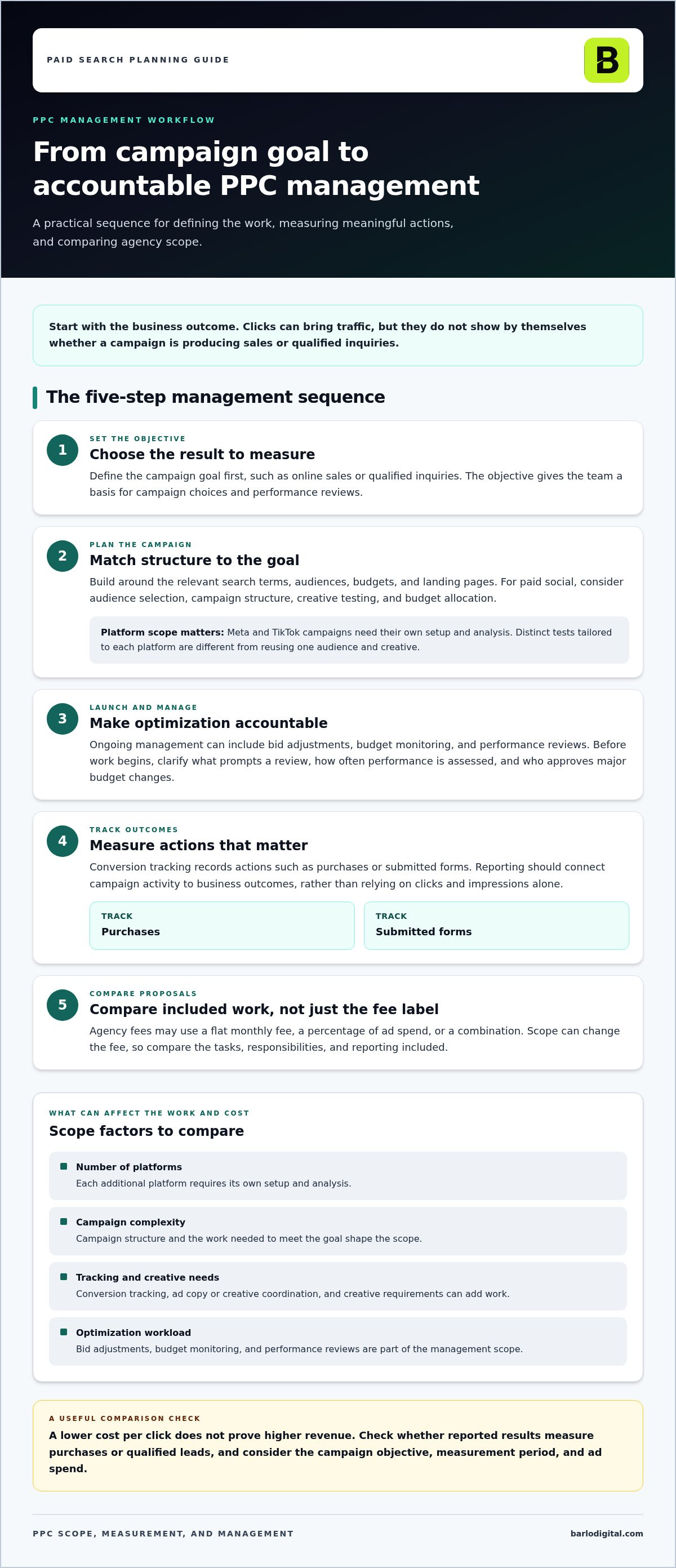
PPC agency fees depend on campaign scope, platforms, and the work involved. Management typically covers setup, bid optimization, reporting, and conversion tracking. The right scope depends on your goals and the campaigns needed to meet them.
Campaign Setup and Optimization
Start by defining the goal, such as online sales or qualified inquiries. The agency can then structure campaigns around search terms, audiences, budgets, and landing pages. After launch, bid optimization adjusts how campaigns compete in search results. Ask what prompts a review, how often performance is assessed, and who approves major budget changes. These details reveal whether management is active and accountable.
Paid Social Campaign Management
Paid social campaigns use platforms such as Meta and TikTok to reach people beyond search results. Management may include audience selection, campaign structure, creative testing, budget allocation, and performance reviews. Each additional platform requires its own setup and analysis. Compare the proposed work: one shared audience and creative is different from distinct tests tailored to each platform.
Included PPC Management Services
Management should connect each task to a business outcome. Common tasks include keyword and audience research, campaign setup, coordinating ad copy or creative, bid adjustments, budget monitoring, and reporting. Conversion tracking records actions such as purchases or submitted forms. A United States District Court for the District of New Jersey agreement described campaign management aimed at improving click-through rate and reducing price per click.
Agency fee structures commonly use a flat monthly fee, a percentage of ad spend, or a combination. Each model can change as campaign scope changes, so compare the tasks included rather than the fee label alone. The price depends on the case and is given after a quote request. Key cost factors include platform count, campaign complexity, tracking needs, creative requirements, and optimization workload.
Use case studies to assess how an agency defines results. Look at the starting performance, campaign objective, measurement period, and reported outcome. A sales increase means little without context about attribution and ad spend, and a lower cost per click does not prove higher revenue. Ask whether the case tracks purchases or qualified leads and whether it covers search, social media, or both.
For marketplace advertising, separate campaign scope from general search and social work. Amazon PPC management focuses on campaigns within Amazon, so its setup and reporting differ from website-focused search ads. Compare platform-specific tasks, reporting definitions, and optimization responsibilities before judging an agency proposal.
Is Hiring a PPC Agency Worth the Cost?
An agency can be a fit when paid search needs consistent specialist attention. Common risks include unclear account ownership, click-focused reporting, and promises without a defined measurement plan. These gaps can waste budget or obscure whether campaigns contribute to revenue.
Agency Selection Criteria
Compare agencies against the same goal, such as online sales or qualified leads. Ask who will manage the account, what work they will do, and how they will report progress. A proposal should connect campaign changes to measurable outcomes, not vague claims about traffic or returns. Before work begins, clarify account access and who makes decisions.
An agency’s location can affect communication, but geography alone does not demonstrate competence. A US business may prefer a team in its time zone, while remote account management can work with agreed meeting times and written updates. Look for relevant industry and platform experience, as well as the people assigned to your account. A polished profile is not evidence of performance.
Use these questions to make proposals comparable:
- Which person will manage the account, and who makes campaign decisions?
- What does the reporting measure beyond clicks and impressions?
- How will the agency connect paid search activity to revenue or qualified leads?
- What account access will the business retain?
- Which campaign changes require approval before implementation?
Experience and Qualifications
Ask for examples that match your sales model, audience, and campaign objective. An ecommerce business should examine purchase-focused work, while a service company should look for lead-quality measures. Google Premier Partner status is reserved for the top 3% of Google partners, but status alone doesn’t establish fit. Evaluate the proposed team’s direct platform experience and ability to explain its decisions.
Experience should be specific enough to evaluate. Ask how the agency handled campaigns involving similar products, sales cycles, or geographic targeting. Review the starting point, work performed, and reported outcome. A case study showing more traffic has limited value if it says nothing about lead quality or revenue. Ask who did the work rather than assuming the person presenting it managed the account.
Hiring internally is another point of comparison. That figure helps frame the staffing decision, not the agency fee you should expect. Compare the internal role’s full responsibilities with the agency’s stated scope, including campaign oversight and reporting.
Choose an agency when its working model fills a genuine capability gap. If your team already manages paid search effectively, additional management may add little. If campaign decisions, measurement, or optimization lack clear ownership, an agency can bring structure. Set the business objective first, then compare experience, account access, reporting, and responsibilities against it.
Agency reporting and account management
Reports should show what the agency changed, what the campaigns produced, and how the results relate to your investment. Click counts alone cannot explain whether Google Ads is contributing to sales.
Bid and Budget Management
Bid management controls how campaigns compete for search traffic, while budget management sets spending limits across campaigns. Ask which signals guide bid changes and how the agency avoids letting one campaign consume funds needed elsewhere. For example, a product campaign with clicks but few conversions may need a budget review, not an automatic increase.
Google Ads Management
Google Ads management includes reviewing search terms, ad relevance, campaign settings, and landing-page alignment. Google Ads recommends evaluating how many people see ads, how many click, and how much sales revenue follows. Ask the agency to present these stages together and explain how it uses return on investment to refine the account.
Account management should make responsibilities visible. Establish who changes bids, reviews search terms, and approves budget adjustments. A clear process records each change, the reason for it, and the result, creating an audit trail. Without that record, an account can change direction while the business sees only a monthly total.
Reporting should separate activity from outcomes. Impressions and clicks describe exposure and traffic. Conversions record completed actions, such as purchases or submitted forms, while revenue connects those actions to business value. Ask for paid search to be reported separately from organic results, so each channel’s contribution is clear.
Useful reporting explains what happened and why. If conversions fall, the report should identify whether fewer people clicked, landing pages became less effective, or targeting changed. If revenue rises, it should show which campaigns contributed and what adjustments came before the change. A graph without explanation leaves you to diagnose the account yourself.
Agree on reporting expectations before management begins. Set the metrics, account access, reporting format, and process for documenting decisions. This avoids surprises and gives internal teams a consistent record. It also makes comparisons across product categories easier, without confusing higher spend with better efficiency.
For ecommerce teams coordinating search with paid social, ecommerce ad management across Google, Meta, and TikTok can connect platform oversight with campaign reporting. Keep the review focused on decisions: what changed, why it changed, and whether conversions and revenue moved with it.
Conversion tracking and performance reporting
A campaign report is only as reliable as the actions it records. Track the path from ad exposure to purchase or qualified lead, then use that evidence to assess each strategy.
Conversion Tracking
Conversion tracking records actions after an ad interaction, such as an ecommerce purchase or submitted lead form. Define each valuable action before launching campaigns, then test that the tracking records it once and assigns it to the correct source. For Shopify stores, an ecommerce tracking and measurement audit can help identify gaps across advertising and analytics.
Lead and Sales Performance
Lead volume alone does not show whether a campaign attracts the right audience. It also reported a threefold increase in qualified leads. For your account, compare lead quality and completed sales alongside acquisition cost.
Ad Performance Measurement
Google Ads recommends reviewing how many people see an ad, how many click, and how much sales revenue follows. Consider the stages together. If impressions rise but clicks stay flat, inspect the ad and its relevance. If clicks rise but purchases do not, investigate the landing page, checkout, and tracking. Each step helps isolate a different problem.
PPC Performance Metrics
Use metrics that connect campaign activity to business outcomes. Click-through rate shows how often impressions lead to clicks. Conversion rate shows how often interactions produce a tracked action. Cost per acquisition measures advertising cost for each recorded conversion. Return on ad spend compares attributed revenue with ad spend, helping ecommerce teams assess whether campaigns generate revenue efficiently.
Compare platform totals with business records before calling a campaign successful. For example, check reported purchases against completed orders, and form conversions against qualified leads in the sales system. Differences can reveal duplicate events, missed conversions, or attribution gaps. Use a consistent reporting period and conversion definition to make comparisons across campaigns and audience segments meaningful.
Google Ads recommends tracking return on investment and continually refining ads. Make one evidence-based adjustment at a time, such as refining targeting after reviewing search terms. Record the change and its effect on conversions. This links campaign decisions to results instead of treating higher traffic as proof of better performance.
Google Ads, Microsoft Advertising, and Local Services Ads
Google Ads and Microsoft Advertising reach people through search, while paid social targets audiences on social platforms. Local Services Ads reach people searching for local services. Choose a campaign based on whether you sell products, generate leads, or need local visibility.
Google states that Search ads can appear at the top of the search results page, above organic search results. Advertisers pay when someone clicks and reaches their site, while keyword competition affects auction prices. Google receives more than 167 billion monthly searches, so the platform can offer broad search visibility. That scale still makes account structure and search-term relevance central to efficient spending.
Microsoft Advertising is another paid search platform, reaching people using Microsoft search properties. Campaigns organize keywords and ads around the products or services you offer. Consider it if your audience uses those search environments or you want to test reach beyond Google. Compare platforms using the same conversion definitions, campaign goals, and reporting period.
Paid social works differently. Google Ads and Microsoft Advertising respond to active search intent, while social campaigns can reach people based on audience selection and platform activity. A shopper searching for a specific product may see a search ad; a social campaign can introduce the product before they search. Creative, audience selection, and conversion measurement therefore need platform-specific optimization.
Local Services Ads are designed for local service businesses rather than ecommerce product campaigns. They can appear in local search results and connect consumers with service providers. A reported contractor campaign generated a 9:1 return on investment, but that example is not a forecast for another business. The relevant decision is whether local inquiries, rather than online product orders, define campaign success.
Choose based on intent and the path to purchase. For an online store, start with Google or Microsoft search campaigns targeting product keywords, then compare clicks, purchases, and revenue. For a local contractor, evaluate Local Services Ads against the need for calls and estimates. To reach people beyond search, test paid social separately. Do not combine results without accounting for different audiences and conversion paths.
Use a controlled comparison: define the target action, set a consistent reporting window, and assess conversion quality alongside visibility. For search platforms, review keyword relevance and click costs. For social, examine audience and creative response. For local service ads, evaluate whether contacts become viable jobs. Businesses combining Google, Meta, and TikTok can review ecommerce campaign management across platforms as they plan that mix.
Barlo Digital: Ecommerce ad management (Meta, Google, TikTok)
Barlo Digital manages ecommerce campaigns across Meta, Google, and TikTok. Work with us when search and paid social need coordinated management, or when campaign performance is difficult to connect to store sales.
A director runs every account, and senior-level work stays with the people responsible for decisions. There is no junior handoff or account-manager layer. We also audit ecommerce tracking and measurement when purchase data and platform reporting do not align.
If you’re ready to review campaign management for your store, visit our ecommerce ad management page.
Make the next campaign decision measurable
Start by defining the business outcome your advertising must support. Choose a metric that reflects it, identify who owns campaign decisions, and set a review process before changing budgets. This gives your team a practical basis for assessing ppc advertising services beyond platform activity.
Barlo Digital manages ecommerce advertising across Meta, Google, and TikTok, and audits ecommerce tracking and measurement to address campaign data gaps. For local businesses, we also provide Local SEO and AI search. The right starting point depends on whether your priority is paid campaign management, measurement, or local search visibility.
Bring a clear objective and the questions your current reporting cannot answer. We can discuss the advertising or measurement work that fits your needs.
Contact Barlo Digital to discuss your PPC needs.
Frequently Asked Questions
What Is Pay Per Click Advertising and How Does It Work?
Pay-per-click advertising is a model in which advertisers pay for each ad click, not simply for showing the ad. A click may still have little value if a shopper lands on an unavailable product or abandons checkout. For an online store, review product availability, pricing, shipping details, and checkout usability alongside campaign activity. These factors affect whether a paid visit can become an order.
Should You Hire a PPC Agency?
Consider hiring an agency when a particular workload exceeds your team’s capacity, such as launching a large seasonal catalog or expanding to another ad platform. Before committing, map who handles product data, creative approvals, landing pages, and campaign decisions. The relationship works best when internal owners can provide those inputs promptly. If no one can approve changes or provide accurate product information, clarify responsibilities first.
What Is PPC Marketing?
PPC marketing is paid promotion that uses click-based ad placements to attract potential customers. For an ecommerce business, this can mean promoting a product category, seasonal offer, or specific item. The practical distinction is the objective: a product launch may prioritize visibility and initial sales data, while an established product may focus on consistent order volume. Set the objective before deciding what campaign activity means.
Do PPC Services Work to Increase Leads and Sales?
Paid campaigns can help when the advertised offer matches what the business can deliver and the customer journey works. An online retailer may attract shoppers with a promotion but fail to generate orders if an item is out of stock or shipping terms are unclear. Review inventory, checkout completion, and product-page accuracy during campaign reviews. Operational details can explain weak sales even when ads reach interested shoppers.
How PPC Marketing Services Benefit Businesses?
Paid campaigns can help test demand for a product or offer before broader merchandising decisions. A retailer, for example, can compare interest in two product categories, then use sales and customer questions to inform its next promotion. This gives marketing and ecommerce teams evidence to prioritize offers. The benefit is better decision-making, not simply adding another advertising channel.
Struggling With PPC Campaigns That Aren’t Delivering Results?
Review account changes before rebuilding a campaign. Check change history, ad approvals, product availability, and whether advertised prices match the landing pages. A recent catalog or promotion change may have broken the connection between an ad and the offer shoppers see. Isolate affected campaigns first to find a correctable operational issue before making wider structural changes.
How much do PPC advertising services cost in the United States?
Costs depend on management scope and advertising budget, so proposals should separate those amounts clearly. Compare what each quote includes, such as account setup, creative work, campaign management, and measurement support. Identify separately billed work and how changes in scope are handled. This makes it easier to compare proposals without treating different service packages as equivalent.
What are typical PPC agency management fees and ad spend requirements?
There is no single management fee or ad budget that suits every business. Start with the maximum acquisition cost your margins can support, then consider whether the campaign can generate enough useful sales data. Factor in product margin, average order value, repeat purchases, and fulfillment costs. A budget that ignores these economics can create activity without a viable route to profit.

Article by
Carlos Benavides
Carlos Benavides founded Barlo Digital and is its Director of Paid Media and Performance. He has fifteen years in direct-response marketing, more than $50M in lifetime ad spend, and a B.S. in Computer Science, which is why tracking at Barlo Digital is built by hand. Barlo Digital is a director-led paid media and search agency serving US ecommerce brands, home-service companies and practices.


