

Effective business to business appointment setting does more than put a meeting on the calendar. It identifies prospects with a relevant need, qualifies their fit, and schedules a conversation with the right sales representative. A well-run operation typically aims to have 70-85% of its meetings held, not merely booked.
A full calendar can still conceal a broken process. If prospects lack authority, urgency, or a clear reason to talk, sales teams waste time on meetings that go nowhere. Business to business appointment setting works best as a repeatable system: define the right buyer, research accounts, qualify prospects before scheduling, and track whether meetings become opportunities. This guide explains those steps and how to assess a program as it scales, so you can judge results by meeting quality and follow-through, not booking volume.
Key Takeaways
- Define what makes a prospect worth a meeting before outreach begins, so booking activity reflects real sales potential.
- Use calls, email, and scheduling tools as a coordinated process, with each touchpoint moving the prospect toward a clear next step.
- Launch in stages: establish the target profile, test the process, then use meeting quality and opportunity creation to guide adjustments.
- Research each account and qualify need, decision-making authority, and readiness before putting time on a sales representative’s calendar.
- Scale only after you understand which audience, messages, and follow-up practices produce meetings that are held and advance sales conversations.
What is appointment setting in sales?
- Define the outcome before making contact. Business to business appointment setting turns a prospect’s interest into a scheduled conversation with a sales representative. The setter researches the account, starts a relevant conversation, checks for a genuine fit, and agrees on a specific meeting time. The calendar entry is the output, not proof of value.
- Qualify readiness before booking. Confirm the prospect has a need your sales team can address, a role in the decision, and a reason to discuss a next step. Record the business problem, relevant context, and agreed meeting purpose. A dedicated setter should pass that information to the representative so the conversation starts with useful context instead of repeating discovery.
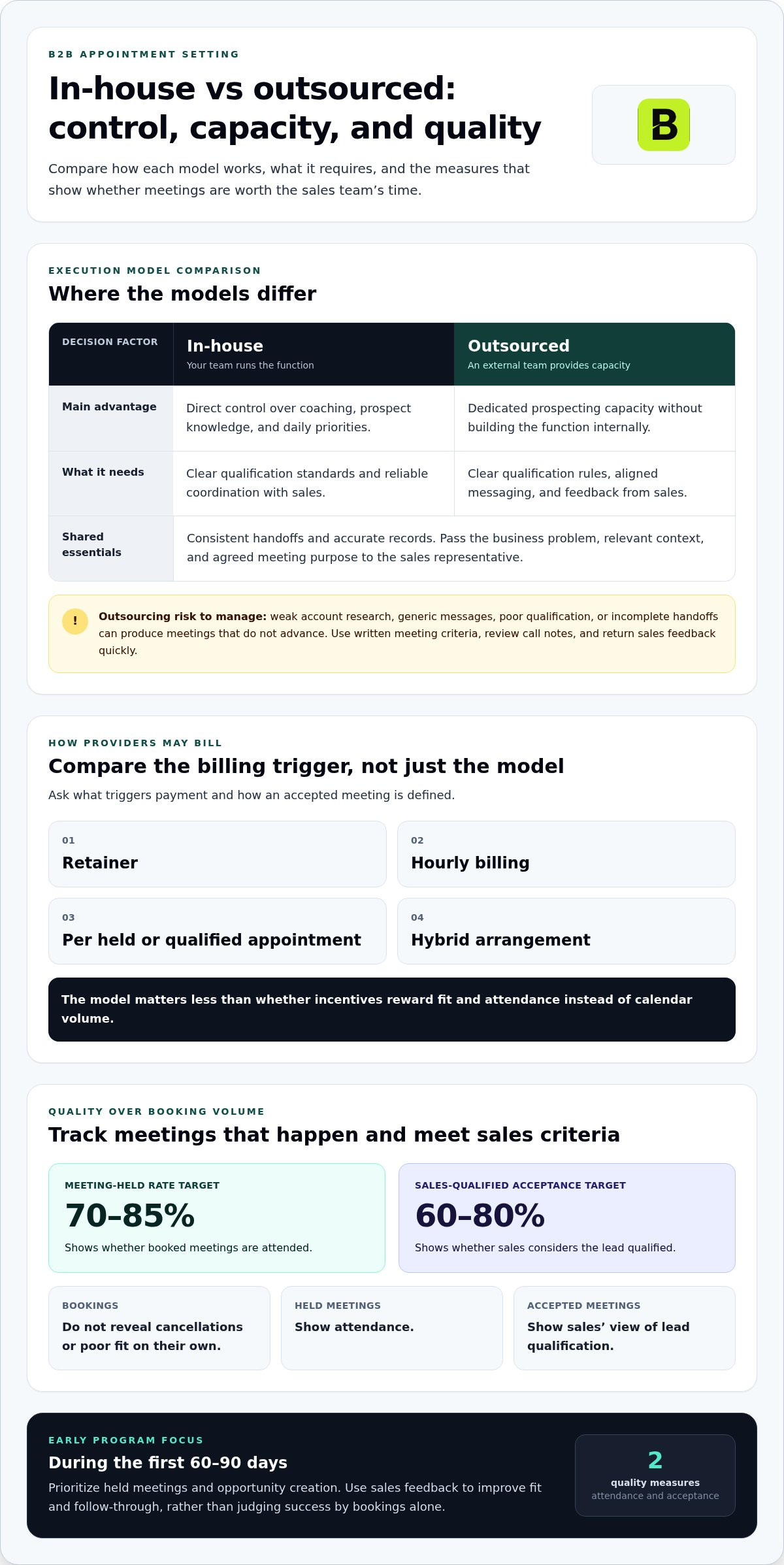
- Measure meetings that happen and meet sales criteria. Effective programs commonly target meeting-held rates of 70-85%, while sales-qualified acceptance targets often fall between 60-80%. Track both: held meetings reveal attendance, while acceptance shows whether sales considers the lead qualified. Raw bookings hide cancellations, poor fit, and wasted closing time. Also watch whether accepted meetings create opportunities and contribute to revenue.
- Plan field activity around territory density. For residential canvassing, a productive field canvasser may target 50-70 doors per day, with experienced canvassers in dense territories aiming for 3-6 booked meetings daily. These are field canvassing benchmarks, not universal B2B quotas. Group nearby prospects, leave time for follow-up, and schedule meetings around representatives’ routes. A sparse territory changes the travel burden and the number of useful contacts per day.
- Choose in-house or outsourced execution based on control and capacity. In-house appointment setting gives the sales organization direct control over coaching, prospect knowledge, and daily priorities. Outsourcing can add dedicated prospecting capacity without building the function internally, but it requires clear qualification rules, aligned messaging, and feedback from sales. Both models depend on consistent handoffs and accurate records.
- Understand pricing before comparing providers. Common models include a retainer, hourly billing, payment per held or qualified appointment, and a hybrid arrangement. Compare what triggers billing and how an accepted meeting is defined. The model matters less than whether incentives reward fit and attendance rather than calendar volume.
- Control the risks of outsourced work. Poor account research, generic messages, weak qualification, and incomplete handoffs can produce meetings that never advance. Set written criteria for a qualified meeting, review call notes, and return sales feedback quickly. Appointment-setting programs should prioritize held meetings and opportunity creation during their first 60-90 days, rather than judging success by bookings alone.
- Use the process that fits your sales motion. For teams selling to businesses, B2B appointment setting should connect prospect qualification, scheduling, and sales feedback. Without that loop, meeting volume can rise while closing performance stays flat.
AI, scheduling software, and multichannel outreach
Coordinate calls, email, LinkedIn, and scheduling around a single prospect record. For US campaigns, treat calls, email, and texts as separate channels. Requirements can vary, so build channel-specific legal review, consent records, and opt-out handling into the process before launch.
Use the steps below to make each touchpoint relevant and keep the internal handoff accurate.
Personalize Outreach and Value Propositions
- Research the account before writing. Identify the prospect’s role, business model, and a relevant issue your offer addresses. RAIN Group reports that 82% of buyers review a seller’s LinkedIn profile before responding or connecting. Keep your profile consistent with the message, so the prospect can understand who is reaching out and why.
- Connect the value proposition to a specific business situation. For example, a message to an operations leader might refer to a documented process bottleneck and offer a meeting to discuss a relevant solution. Avoid generic claims that could go to every company in the pipeline.
- Plan follow-up without treating silence as consent. RAIN Group reports that 43% of buyers who accept meetings at least sometimes consider five or more contact attempts acceptable before a seller reaches them. Use varied, respectful follow-ups, record responses, and stop outreach when someone opts out.
Coordinate Outreach With Scheduling Software
- Set a sequence across channels before launching. For example, start with a tailored email, follow with a call, then use LinkedIn to reinforce the same business reason. RAIN Group’s prospecting research evaluated 15 outreach methods, and three of its five most effective methods were phone calls. Use calling as a deliberate channel, not an isolated task.
- Configure scheduling software to show accurate availability and meeting details. Include the meeting purpose, expected attendees, and the prospect’s time zone. Confirm calendar invitations reach the right internal participants, and that rescheduling updates the same record.
- Use AI to assist with research, message drafts, and call summaries, then have a person verify important details. Check names, company facts, and claims before sending. Automation can speed up preparation, but it cannot determine whether a prospect’s response signals genuine interest or a request to stop.
- Track channel performance by meaningful outcomes. Compare replies, qualified conversations, scheduled meetings, and attendance across calls, email, and LinkedIn. RAIN Group ranks calls to new contacts fifth among prospecting methods, so assess calling alongside other channels rather than assuming one channel will carry the entire pipeline.
Appointment-setting campaign launch timeline
Build the process in sequence: define the audience, prepare outreach, launch controlled campaigns, then optimize against qualified appointments. Use the first 60-90 days to assess meetings held and opportunities created, not calendar volume alone.
- Set the campaign target. Define the ideal account, buyer role, business problem, and reason to meet. Distinguish decision-makers from people who influence the purchase. For example, a workflow software campaign could target operations leaders at companies with a clear process bottleneck. Give sales and outreach teams the same qualification rules before collecting prospects.
- Prepare account data and email setup. Check each contact’s name, role, company, and business email before adding them to a campaign. Use the company’s email systems and follow its established domain authentication and sending practices. Review bounce notices, replies, and spam complaints during launch. Incorrect records and poor delivery can undermine a test before the message gets a fair evaluation.
- Write and review the script. Build a short opening around the account’s business context, then explain why the conversation may be relevant. Give callers a few discovery prompts and concise responses to likely objections. Include a direct meeting request and a clear way to end the conversation if the prospect declines. Test the script with sales representatives before using it across a full campaign.
- Launch with a controlled audience. Start with one defined segment so the team can identify whether issues come from targeting, messaging, or channel choice. Coordinate calls and email around the same value proposition. Record each attempt, response, and next action in one prospect record. A consistent sequence makes results easier to interpret than disconnected outreach.
- Connect bookings to the sales calendar. Make the meeting purpose, attendees, and prospect context visible in the invitation. Confirm the assigned representative can attend and that the calendar entry reflects the prospect’s agreed time. Add call notes and qualification details to the handoff. This keeps a booked meeting from reaching sales without the information needed to continue the conversation.
- Review performance and optimize. Compare target segments, messages, channels, held meetings, and sales acceptance. If meetings are booked but sales rejects them, tighten qualification before increasing outreach. If qualified appointments are accepted but fail to create opportunities, review the meeting purpose and sales follow-up. During the first 60-90 days, use those patterns to adjust campaigns and improve the process.
Prospect research and qualification
- Define the account you want before lead generation begins. Specify the industry, business model, and operating conditions that make a prospect relevant. For example, a supplier targeting manufacturers might prioritize facilities facing a documented production constraint. Clear criteria keep list building focused on fit, not just volume. They also give researchers and sales representatives a shared basis for accepting or rejecting an account.
- Research the company before choosing a contact. Review its website, public announcements, product lines, and hiring activity for evidence of a business need. Five minutes of focused B2B research before a visit can be more useful than 20 minutes of aimless conversation at the front desk. Record the specific evidence and its source, so an opener can refer to facts rather than assumptions.
- Identify the prospect’s role in the decision. Check whether the contact owns the problem, influences a purchase, or can connect you with the decision-maker. A department title alone doesn’t prove authority. In your notes, distinguish the person’s stated role from what remains to be learned. This keeps the first conversation direct without treating a senior title as automatic qualification.
- Test need, authority, and intent in conversation. A qualified B2B lead has a real need, decision-making authority, and intent to move forward. Ask what is happening now, what consequence the issue creates, and whether the contact is considering a change. A prospect who describes a current bottleneck gives the sales team a stronger reason to discuss solutions than someone who only agrees to receive information.
- Separate interest from readiness. A prospect may welcome a conversation without having a project or a next step. Ask what would make a meeting useful and who should attend. If the contact cannot name a relevant issue, decision participants, or a reasonable discussion goal, continue useful follow-up rather than labeling the lead sales-ready.
- Book only after confirming the meeting’s purpose. Explain why the conversation is relevant, identify the attendees, and agree on the scheduling details. Add the prospect’s need, role, and stated intent to the booking record. An invitation without context forces the representative to restart discovery and gives the buyer no clear reason to attend.
- Use sales feedback to refine the qualification standard. Compare accepted meetings with rejected leads and resulting opportunities. If sales repeatedly rejects one source or account type, review the research criteria and outreach notes. If qualified prospects attend but reveal a different need, revise the questions. This closes the loop between market research, lead generation, qualification, and booking.
Appointment-setting services and scaling
Scale only after your sales team accepts and can advance the meetings. More outreach amplifies both effective qualification and weak targeting.
- Set the scale criteria before expanding. Review held meetings, sales acceptance, and opportunity creation by audience and message. A high booking count without sales acceptance signals a quality problem, not a need for more volume. Record why sales accepts or rejects each meeting, then use those patterns to decide whether the campaign is ready to grow.
- Run a focused pilot. Start with one or two ideal customer profile segments instead of targeting every possible buyer. For example, a company selling to healthcare organizations could test separate messages for practice administrators and clinical operations leaders. This makes it easier to see which audience responds, qualifies, and advances to a sales opportunity.
- Confirm the provider’s actual process. Ask how prospects are researched, how qualification is defined, and what information reaches sales after booking. Request one to three past projects as evidence of relevant execution. A useful example should explain the target, outreach approach, meeting criteria, and how results were assessed, not simply show a calendar full of bookings.
- Check alignment with your sales team. Give the provider your buyer criteria, approved claims, and meeting handoff requirements. Have sales leaders review sample messages and qualification notes before outreach begins. If sales rejects meetings for reasons the provider was never told about, the process is misaligned. Fix the shared standard before expanding the audience.
- Choose a pricing model by its billing trigger. Providers may charge by retainer, time, appointment, or a hybrid structure. B2B appointment-setting cost in the United States depends on the campaign scope, target audience, channels, qualification requirements, and reporting needs; the price is provided after a quote request. Compare what counts as a billable appointment and whether cancellations or unqualified meetings count.
- Expand in controlled stages. Add a segment or channel only when current results show where capacity is being lost. If one audience generates accepted opportunities, broaden it carefully. If new segments book meetings that fail sales review, tighten targeting before increasing volume. Scale based on evidence, not a larger contact list.
- Keep sales feedback inside the operating loop. Review outcomes with the provider and sales leaders regularly. Record reasons for rejection, attendance, and opportunity progression. Use these findings to revise account selection, scripts, and follow-up. Shared feedback keeps the campaign connected to the sales process as it grows.
- Set clear expectations before committing. A reliable provider can explain its workflow, reporting, qualification rules, and responsibilities in plain terms. Check that the service fits your sales capacity and that representatives can follow up promptly. To assess a structured appointment-setting process, compare its qualification and reporting against these criteria.
Barlo Digital: Ecommerce ad management (Meta, Google, TikTok)
Barlo Digital manages ecommerce advertising across Meta, Google, and TikTok. A director runs every account, with senior-level work handled directly. Nothing is handed to junior staff, and there’s no account-manager layer.
If paid campaigns are part of your growth plan, assess whether they attract customers and produce useful business outcomes, not just clicks. Barlo Digital’s ecommerce tracking and measurement audit examines how campaign activity is recorded, helping identify gaps between advertising data and reported results.
If you’re reviewing paid acquisition for an ecommerce business, explore our ecommerce ad management service.
Put the qualification standard into practice
A meeting process earns its place only when sales uses the information it produces. Before expanding outreach, align sales leaders on the buyer profile, the evidence that qualifies a prospect, and what happens after a meeting is booked. That agreement makes business to business appointment setting a working part of the sales operation, not just a calendar task.
Barlo Digital provides appointment setting alongside broader growth services. Its work also includes ecommerce advertising on Meta, Google, and TikTok, ecommerce tracking and measurement audits, and local SEO and AI search. The right next step depends on your business’s actual bottleneck. If qualified sales conversations are the priority, share your target buyers, sales process, and current constraints to discuss the fit.
Explore B2B appointment setting. A clear starting point makes it easier to determine what should happen next.
Frequently Asked Questions
What’s a good appointment-to-close rate?
There isn’t one close rate that fits every sales cycle, contract size, or buying committee. A field sales team consistently below a 20% appointment-to-close rate may have a qualification problem. Review which meetings become proposals and which prospects actually buy. If qualified meetings rarely close, inspect sales conversations, offer fit, and follow-up as well as appointment quality.
What’s the difference between an appointment setter and an SDR?
An appointment setter focuses on engaging prospects and scheduling sales conversations. An SDR, or sales development representative, may also research accounts, qualify leads, and create opportunities for account executives. Titles vary by company, so assess the role by its assigned tasks and handoff. For example, ask whether the person only books meetings or also handles prospecting and early-stage qualification.
What is B2B appointment setting and how does it work?
Business to business appointment setting connects a prospective business buyer with a sales representative for a relevant conversation. A setter identifies a target account, contacts an appropriate person, and arranges a meeting when there’s a reason to talk. For example, a software company might connect a prospect interested in reducing manual reporting with a representative who handles that product area.
What services do B2B appointment-setting companies provide?
Services can include account research, contact identification, outbound calls and email, early qualification, meeting scheduling, and reporting. Some providers also prepare messaging or manage follow-up sequences. Scope varies: one service may supply appointments, while another supports a broader prospecting process. Before comparing proposals, map each task to an owner, including responsibility for sales handoff and feedback.
Which tools and technologies are used for B2B appointment setting?
Teams commonly combine a contact database, calling tools, email platforms, calendar scheduling, and a system for recording prospect activity. LinkedIn can support account and role research, while AI tools may assist with drafting or summarizing. Choose tools that connect contact history, meeting details, and sales outcomes. For example, a representative should see the prospect’s last reply before making a follow-up call.
What metrics measure B2B appointment-setting performance?
Track the full path from outreach to revenue: response rate, qualified-meeting rate, attendance, sales acceptance, opportunity creation, and closed deals. Define each metric consistently. For example, calculate attendance as held meetings divided by scheduled meetings, and acceptance as meetings sales agrees meet its criteria. Comparing these stages by audience and channel shows where qualified prospects drop out.
What U.S. rules apply to B2B cold calling, email, and texting?
Requirements can vary by channel. Before launch, conduct channel-specific legal review, keep consent records, and provide opt-out handling for calls, email, and texts.
How much does B2B appointment setting cost in the United States?
Common billing models include retainers, hourly billing, payment per held or qualified appointment, and hybrid arrangements.

Article by
Carlos Benavides
Carlos Benavides founded Barlo Digital and is its Director of Paid Media and Performance. He has fifteen years in direct-response marketing, more than $50M in lifetime ad spend, and a B.S. in Computer Science, which is why tracking at Barlo Digital is built by hand. Barlo Digital is a director-led paid media and search agency serving US ecommerce brands, home-service companies and practices.


