

Poor marketing data does more than make reports untidy. Common marketing data quality issues include inconsistent formatting, poor targeting, missing or invalid fields, stale records, and broken data integrity. Each can distort campaign audiences, measurement, and budget decisions.
Customer records and campaign reports should be usable when they enter your systems, but small failures can compound. A mismatched date format can break a report, an incomplete profile can weaken segmentation, and outdated information can put an offer in front of the wrong person.
This article explains how these issues arise and what they affect. You’ll learn to recognize problems with formatting, targeting, completeness, validity, freshness, and integrity, and understand how they can mislead marketing decisions. The aim is a clear diagnosis, not vague advice to “clean your data.”
Key Takeaways
- Duplicate records can trigger repeated marketing messages and distort audience counts. Learn how to spot where duplicate entries create campaign waste.
- Inconsistent date, number, and address formats can disrupt reporting and prevent systems from matching records correctly.
- Inaccurate or outdated audience data can misdirect targeting and weaken the signals used by machine-learning systems.
- Assess data completeness, validity, freshness, and integrity separately. Each reveals a different failure that can undermine marketing decisions.
- Different teams may define the same customer or metric differently. Clear shared definitions make campaign reporting more useful.
1. What are the most common data quality issues?
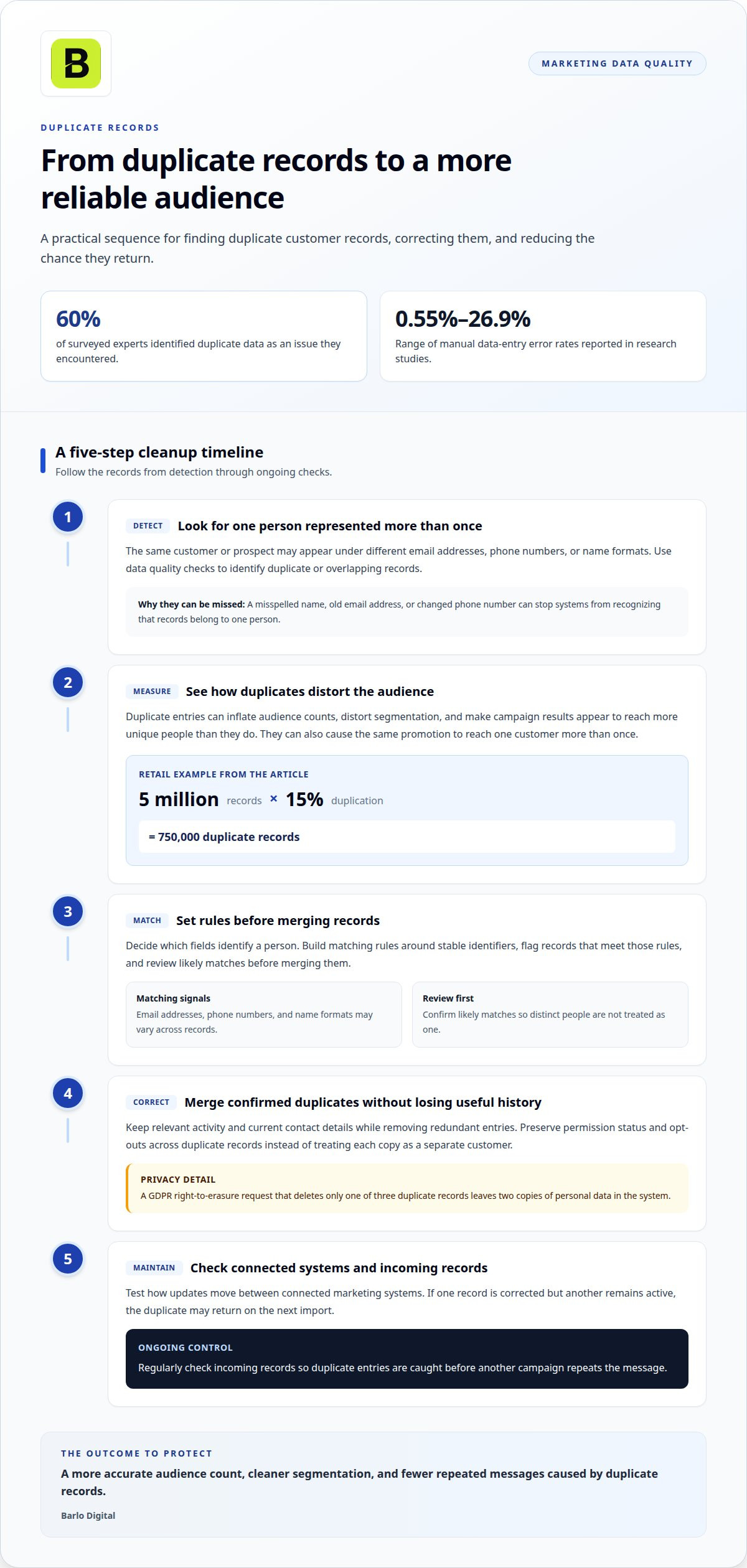
Duplicate customer and prospect records are a common marketing data quality issue. One person may appear under different email addresses, phone numbers, or name formats. Data quality checks test uniqueness by identifying duplicate or overlapping records. In one survey, 60% of experts identified duplicate data as an issue they encountered.
In the United States, applicable federal and state privacy laws and channel-specific consent rules affect how personal data is collected and used. For reliable records, preserve permission status and opt-outs across duplicate entries instead of treating each copy as a separate customer.
Poor database quality often starts during collection and entry. Human error, inconsistent processes, system limitations, and changes to customer information can all create errors. Manual data-entry error rates in research studies have ranged from 0.55% to 26.9%. In a survey, 60% of experts identified human error as a data quality issue they encountered.
The scale becomes clear in a retail example: a database contains 5 million customer records, with a 15% duplication rate. That leaves 750,000 duplicate records. The extra entries inflate audience counts, distort segmentation, and can make campaign results appear to reach more unique people than they do.
Duplicates also waste communications. A customer may receive the same promotion more than once when separate records share an email address or phone number. That repeat contact uses campaign spend without reaching an additional person.
Inaccurate details make duplicates harder to spot. A misspelled name, old email address, or changed phone number can stop systems from recognizing that two records belong to one person. The result is an inaccurate customer profile and an inflated prospect list. Set matching rules around stable identifiers, then review likely matches before merging records.
Good cleanup preserves useful history while removing redundant entries. Define which fields identify a person, flag records that match those rules, and merge confirmed duplicates while retaining relevant activity and current contact details. Test how updates move between connected marketing systems. If one record is corrected but another remains active, the duplicate may return on the next import. Regularly check incoming records to catch the problem before another campaign repeats the message.
A GDPR right-to-erasure request that deletes only one of three duplicate records leaves two copies of personal data in the system.
2. Inconsistent dates, numbers, and address formatting
Marketing reports can split one result into several rows when systems store the same value in different formats. A date such as 04/05/2026 could mean April 5 or May 4, depending on the system. If one platform records a state as “CA” and another uses “California,” a report may fail to match the records. About 55% of surveyed experts said they struggled with inconsistent data formats.
Inconsistent labels can change what a dashboard counts. A report might group “Paid Social,” “paid-social,” and “Meta prospecting” as separate channels, even when they represent the same activity. This fragments spend and conversion totals. Define shared formats and labels before combining sources, then map older values to the agreed standard.
Measurement units create a more serious failure when teams exchange data. NASA lost the Mars Climate Orbiter, worth $125 million, after its Jet Propulsion Laboratory used metric measures while contractor Lockheed Martin Astronautics used the English system of feet and pounds. The operational lesson is direct: label units, define expected formats, and flag values that fall outside plausible ranges before they reach reports or automated decisions.
Definitions can conflict even when fields match exactly. Marketing might count a customer as active after a purchase within 90 days, while finance uses a 180-day window. Both systems may report accurate dates, yet their active-customer totals differ because the rule differs. Put each metric’s definition beside its name, including the time window and qualifying action. Otherwise, teams compare incompatible numbers as if they measured the same thing.
Inconsistent and incomplete records also weaken comparisons across sources. A lead file may include a full state and postal code, while a platform import contains only the city. One source then appears to have fewer qualified records, not because demand changed, but because its fields are missing or its location rules differ. Standardize required fields and retain the source label for each imported record.
Irrelevant data adds noise, not insight. Mixing test campaigns with live campaigns, or old product categories with current ones, can obscure the result that matters. Clearly mark test records and define which campaign statuses and categories belong in each report. Consistency means applying the same rules across the data, not forcing every field into one format.
A practical correction sequence is straightforward: identify mismatched fields, choose a canonical format, map existing values, and test the result against each source. Check dates, currency, units, locations, channel names, and metric definitions. Repeat these checks after imports or schema changes. Without this control, a clean-looking dashboard can still combine incompatible totals.
3. Inaccurate data in machine-learning training sets and ad targeting
Duplicate, incomplete, and inaccurate records distort how marketing systems represent customers. A person’s purchase history may be split across profiles, while a missing industry or purchase date can weaken audience selection. Models trained on those records may learn inconsistent patterns, causing campaigns to exclude valuable prospects or include people outside the intended segment.
Customer information also decays after collection. Gartner estimates that around 3% of data decays globally every month. People change jobs, email addresses, and preferences, so an old record can point a campaign toward the wrong contact. A stale title, for example, can make a business prospect appear to hold a role they left. Regular data management and refresh rules help limit that drift.
Missing fields can skew a model even when every available value is accurate. In a customer lifetime value model, excluding the 20% of records missing tenure data can systematically underestimate lifetime value for a customer segment. The model sees only customers with complete histories. Its output then reflects the missing-data pattern, not necessarily the segment’s actual value.
Invalid values create another failure. An age of 150 years is an example of a value automated profiling can flag as an inaccurate candidate. Without validation, that entry may remain in a customer file and contaminate age-based analysis or audience rules. A useful check compares each field against its permitted range and flags outliers for review instead of treating every entered value as true.
Bad attribution or tracking data also misstates campaign results. If a conversion event is missing, assigned to the wrong source, or recorded inconsistently, a report can credit the wrong campaign or omit a conversion altogether. The resulting performance comparison is unreliable. A tracking and measurement review can identify breaks between marketing activity, recorded events, and reported outcomes.
Collection gaps often begin before data reaches a model or dashboard. A form may make a field optional even though a segmentation rule later treats it as essential. A campaign may also collect a value without recording when or where it originated. Define required fields, allowed values, and intended uses before data enters a reporting or training workflow.
Validation needs to test both values and relationships. Check whether an event has a valid timestamp, whether a customer record has the fields needed for its assigned segment, and whether the reported source matches the recorded campaign. Gartner predicts that organizations will abandon 60% of AI projects unsupported by AI-ready data through 2026. Consistent inputs are not a cosmetic standard. They determine whether a model or campaign report has a usable foundation.
4. Data completeness, validity, freshness, and integrity
A database can look complete and still contain unusable values. Completeness checks count required fields with missing or null entries, but a filled field may hold a placeholder such as “999” or “N/A.” About 32% of surveyed experts said they dealt with incomplete fields. A completeness report should therefore distinguish populated fields from fields containing meaningful information.
Form design is the first control. Make a field required when its value is essential to routing, segmentation, or reporting. Restrict numeric fields to digits, and use date or currency fields for those formats. Free-form fields invite inconsistent entries, while validation rules can stop malformed data before it reaches the database.
Validity checks test whether values fall within acceptable ranges or match defined rules. If an age field permits values from 0 to 125, an entry of 200 should be flagged for review. Automated profiling can identify outliers, while attribute-level checks make it easier to isolate the field causing failure. Data validation tools can enforce formats, required values, and permitted ranges during imports and routine checks.
Freshness measures how recently a record was updated. One study found that 85% of companies blamed stale data for poor decision-making and lost revenue. An inventory pipeline that refreshes at 2 AM can leave afternoon users with data up to 23 hours old. The right threshold depends on use: an example maximum age is 15 minutes for inventory used in fulfillment, compared with 24 hours for a customer segmentation dataset used for weekly campaigns.
Integrity checks test whether data remains coherent across rows, columns, and values. A default date of January 1, 1900, inserted when the actual date is unavailable, may make a record appear complete while conveying no useful date. Checks should flag defaults, unexpected value relationships, and broken conformity with the field’s rules.
To measure marketing data quality, track the share of records that pass completeness, validity, freshness, and integrity checks. Establish a baseline from the current database, set acceptable thresholds based on each field’s intended use, and compare later results with that baseline. Keep definitions stable so changes in the score reflect changes in the data, not the measurement rule.
A practical audit profiles key fields, measures missing and invalid values, and traces each failure to its source. Clean records using documented rules, then rerun the same tests. Check new imports and review thresholds when forms, campaigns, or systems change. This cycle shows whether fixes hold, rather than producing a one-time cleanup.
5. Common data quality issue types
Organizations often reduce data quality to a single score, which hides the cause of a problem. A campaign list can be accurate but irrelevant, complete but outdated, or consistent but based on a flawed definition. Classifying each failure by its mechanism makes the fix clearer. Ask not just whether data is “good,” but which decision it can safely support.
Semantic issues arise when teams assign different meanings to the same field. Sales might label a lead “qualified” after a conversation, while marketing uses form completion. Both entries may be correct by their own rules, yet a combined report misstates funnel performance. Set one definition for shared terms, document its owner, and record exceptions instead of blending incompatible labels.
Representation issues appear when systems describe the same concept differently. About 22% of surveyed experts said they faced issues with different languages and measurements. A multilingual organization might store a product category under translated labels, while regional teams use different measurement conventions. Map equivalent terms to a shared value and preserve the original wording when it carries useful context.
Context failures occur when a valid record is used for the wrong purpose. A contact collected for a product inquiry may not be a current buyer for a separate campaign. Likewise, a historical transaction describes past behavior, not necessarily present intent. Attach purpose and collection context to records, then make campaign rules use those fields rather than assuming every available value applies.
Process failures have a different pattern. If a data-entry workflow makes it easy to skip a field, the resulting pattern points to a form or training problem, not isolated carelessness. If an automated import repeatedly overwrites a preferred value, the integration rule is a likely cause. Trace errors back to the step that introduced them before applying a bulk correction.
Ownership failures allow known defects to persist. One team may flag a field as unreliable, while another continues using it in reports because there is no organization-wide rule. Assign an owner to each critical dataset, define who approves changes, and log corrections with their reasons. This records what changed and helps prevent later processes from restoring the same defect.
Classify each issue by type, impact, and origin. Separate meaning, representation, context, process, and ownership failures. Then prioritize defects that affect a live decision, such as audience eligibility or campaign reporting. A documented classification turns “bad data” into a specific problem, a responsible process, and a correction you can test.
Barlo Digital
Barlo Digital helps businesses trace marketing data problems to the measurement or campaign process causing them. When unreliable events, attribution, or audience inputs distort decisions, our ecommerce tracking and measurement work can assess how data moves from marketing activity into reported results. We also manage paid campaigns, where dependable measurement helps teams judge performance using consistent signals rather than misleading totals.
This work is especially useful when tracking gaps or inaccurate campaign data make it difficult to decide where advertising should go next. A clearer view of the measurement chain gives those decisions a more reliable operational basis.
Make data quality an operating discipline
Data quality needs an owner, a correction path, and regular checks. A one-time cleanup won’t prevent failures from returning through new forms, imports, or campaign changes. Treat common marketing data quality issues as operational risks, and connect each defect to the decision it could distort.
Barlo Digital can help when unreliable measurement makes marketing decisions harder to trust. Our ecommerce tracking and measurement work addresses gaps between campaign activity and reported results. Start with the data affecting your decisions, then identify the next practical step.
Frequently Asked Questions
What are the most common data quality issues?
Common issues include duplicate records, inconsistent definitions, missing values, invalid entries, stale information, and broken relationships between fields. Their effects depend on where they enter the workflow. For example, a product category entered differently in sales and analytics systems can split one segment into separate groups. Classify the defect, then trace which reports, audiences, or decisions rely on the affected field.
How to Deal with this Duplicate Data?
Start by identifying fields that reliably identify a person or company, such as a normalized email address or account identifier. Separate clear matches from possible matches, since people can share a name or organization. Merge confirmed duplicates using a defined rule, preserve relevant activity history, and document which record remains authoritative. Then review imports and synchronization processes so the same duplicate pattern does not return.
What are the most common marketing data quality issues?
Marketing teams often face unreliable campaign attribution, inconsistent channel labels, incomplete audience fields, outdated contact details, and conflicting conversion definitions. For example, analytics may record a form submission without connecting it to a campaign identifier. The conversion exists, but its source is unclear. Diagnose collection, identity, and reporting defects separately: each needs a different correction and can distort a different marketing decision.
What are common data quality issues in CRM and marketing automation platforms?
CRM and marketing automation records can contain conflicting lifecycle stages, missing ownership, invalid contact fields, and rules that act on outdated values. For example, a workflow may continue nurturing a contact after sales has marked the opportunity closed. Review field mappings and trigger conditions together. Even an accurate record can prompt the wrong action if an automation reads an outdated status or unintended field.
What are the business costs and risks of poor marketing data quality?
Poor data quality can waste campaign delivery, misdirect sales follow-up, distort performance comparisons, and drive decisions based on false patterns. It can also frustrate customers, such as when someone already purchasing receives an introductory offer. The cost goes beyond media spend: teams may spend time reconciling conflicting reports instead of acting on them. Identify which operational decision depends on each unreliable field.
Which marketing data quality tools and practices are most effective?
Effective controls combine field validation, duplicate detection, data profiling, and recurring tests across system handoffs. Choose checks based on how each field is used: a campaign-source field needs permitted values, while a transaction date needs a valid format and a clear relationship to the event. Document each rule and its owner. Review failures over time, since recurring errors often point to a form, import, or workflow that needs fixing.

Article by
Carlos Benavides
Carlos Benavides founded Barlo Digital and is its Director of Paid Media and Performance. He has fifteen years in direct-response marketing, more than $50M in lifetime ad spend, and a B.S. in Computer Science, which is why tracking at Barlo Digital is built by hand. Barlo Digital is a director-led paid media and search agency serving US ecommerce brands, home-service companies and practices.


