

A dashboard can be precise and still be wrong. Marketing data accuracy problems arise when tracking misses conversions, duplicates records, or advertising platforms claim credit for the same result. The outcome is distorted performance reporting and budget decisions based on unreliable signals.
It’s reasonable to expect campaign metrics to agree, but each system may count and attribute outcomes differently. Adding platform-reported conversions together can produce a total that exceeds the number of customers or sales in your business records.
This article explains how to spot tracking, record, and reporting errors, identify attribution overlap, and strengthen campaign measurement. It also covers how to monitor discrepancies and maintain data quality over time, so campaign decisions rest on evidence that holds up across your systems.
Key Takeaways
- Validate records and connect data sources so duplicates and inconsistent fields don’t distort campaign reporting.
- Separate overlapping platform claims from actual customer outcomes by comparing ad reports with CRM and accounting records.
- Use complete, reliable conversion data before trusting campaign optimization or predictive analytics.
- Pair data-quality checks with business performance indicators to spot tracking failures that surface as unexpected metric changes.
- Set recurring reviews for discrepancies, stale records, and tracking changes so data problems are caught before they compound.
Insufficient validation and poor data integration
Marketing data accuracy problems often begin when records enter systems without validation or remain isolated across platforms. A 45% share of marketing data used for business decisions was incomplete, inaccurate, or out of date in one survey.
There is no single percentage for inaccurate or outdated marketing databases. The survey’s 45% figure covered data with at least one of those problems, making routine quality checks essential.
Start data cleanup by checking required fields, standardizing formats, identifying duplicates, and comparing records across systems. These controls catch errors before they distort reports or audience decisions.
Standardized Identifiers Across Data Sources
A standardized identifier is a consistent value, such as an email address or customer ID, used to match records across systems. It helps connect one person’s activity without counting every channel entry as a separate contact.
Without consistent identifiers, one person may appear as multiple leads in an advertising platform, analytics system, and CRM. Duplicate records can inflate marketing metrics by 10-30%. In one example, 15,000 of 50,000 leads generated in a quarter were duplicates.
Centralized reporting can reveal conflicts. Map each source’s field names to shared definitions, then apply the same matching rules. For example, standardize email casing and phone formatting before comparing records. Preserve original source values so every match remains traceable to its channel.
Connecting Offline and Online Data
Offline and online integration connects digital interactions with outcomes recorded outside digital platforms. A web inquiry, phone call, appointment, and completed sale can each represent a touchpoint in one customer journey.
When these events remain separate, online reports may count a lead while another system records the resulting sale. Shared identifiers can link an inquiry to the customer record created after a call. Distinguish a submitted form from a qualified lead, and a booked appointment from a completed sale. Each is a different outcome.
Integrating offline and online data can give you more accurate customer insights and audience profiles. It can also reveal opportunities a single channel’s report misses.
Data Quality Audits and Validation
A data quality audit checks whether records are complete, consistent, unique, and usable for reporting. It helps identify defects before they distort campaign decisions.
Compare advertising platform conversion reports with CRM and accounting data for the same 30-day period. Trace sample records from their original source through each system. A gap may come from a missing field, failed integration, or inconsistent event definition. Correct the cause, document the matching rules, and compare the results again.
These marketing data accuracy problems require recurring controls, not a one-time cleanup. A 32% share of survey respondents rated their data infrastructure fair or poor, reinforcing the need to treat validation and integration as ongoing operating controls.
Attribution overlap across advertising platforms
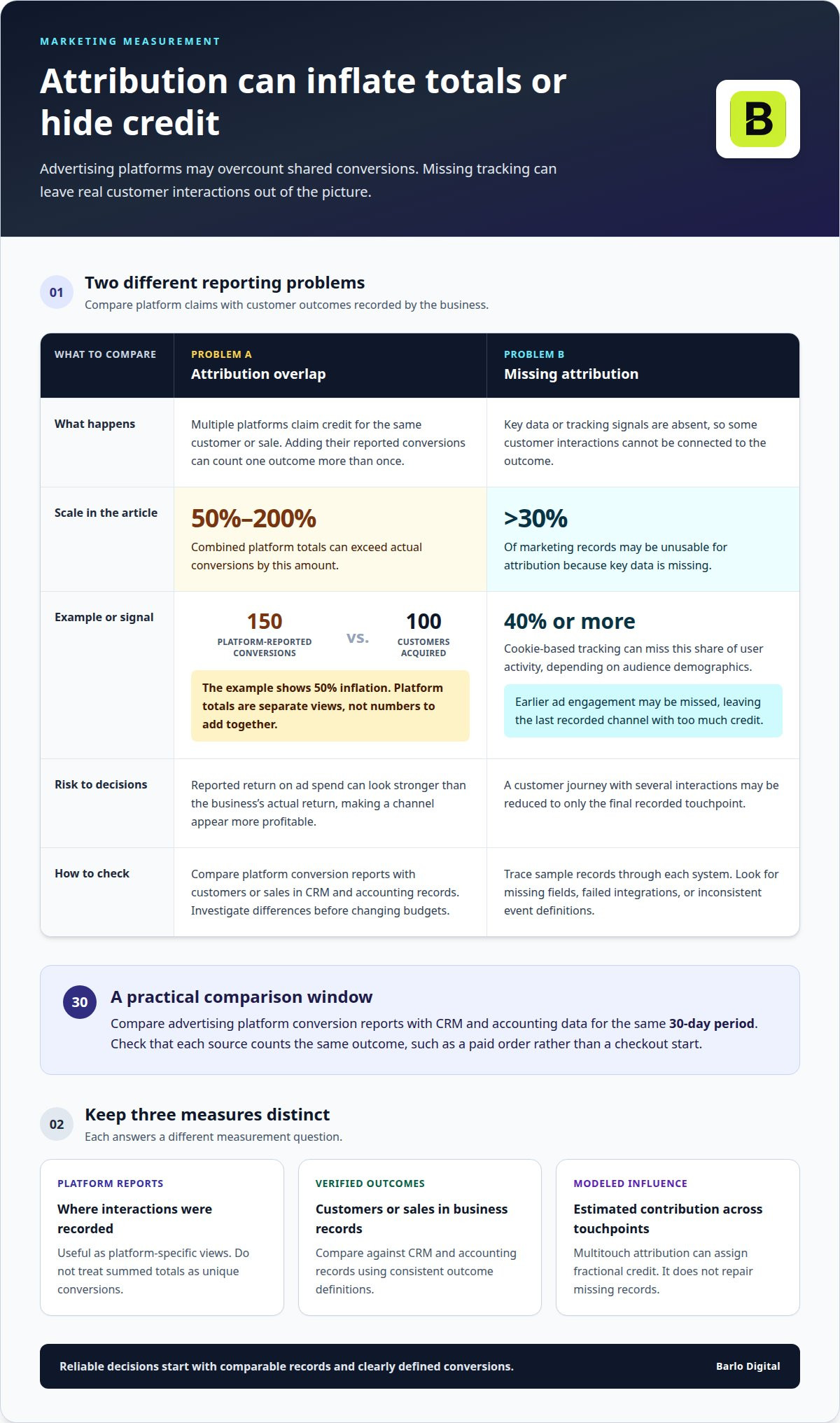
Each advertising platform applies its own attribution rules. When platforms claim credit for the same customer, their combined conversion totals can exceed actual conversions by 50% to 200%. This overlap is one source of marketing data accuracy problems: the reports look precise, but they count some outcomes more than once.
For example, platforms may collectively report 150 conversions while the business acquired 100 customers. That is a 50% inflation problem. Platform reports still show where interactions occurred, but they don’t prove each platform caused a separate conversion. Treat their totals as separate views, not numbers to add together.
Missing attribution creates the opposite problem. More than 30% of marketing records may be unusable for attribution because key data is missing. Cookie-based tracking can also miss 40% or more of user activity, depending on audience demographics. A customer journey may include an ad impression, a later search, and a direct visit, while the recorded conversion retains only the final touchpoint.
That gap affects ROI measurement. If reports omit earlier engagement, the last recorded channel can receive too much credit. If platforms claim the same sale, reported return on ad spend can look stronger than the business’s actual return. Compare attributed conversions with customers or sales recorded in operational systems. Investigate discrepancies before shifting budget or calling a channel profitable.
Multitouch attribution assigns fractional credit across customer touchpoints rather than giving all credit to one interaction. It can show how several interactions contributed to a conversion. A practical starting model gives equal credit to each recorded interaction. Organizations can later test weighted credit based on investment, product, timing, and marketing tactic. Choose a model that supports the decision, not one that favors a preferred channel.
Attribution modeling can’t repair missing records or make platform reports directly comparable. Define each conversion consistently, such as a paid order rather than a checkout start. Then align reporting windows and compare outcomes across platforms, analytics, and business records. If one source counts leads and another counts completed sales, the difference may reflect event definitions, not campaign performance.
Marketing data accuracy problems become harder to diagnose when platform-reported conversions, verified business outcomes, and modeled channel influence are blended together. Keep those measures distinct. That gives decision-makers a clear foundation for interpreting reports instead of treating attribution estimates as confirmed sales. When tracking rules or conversion signals conflict, an ecommerce tracking and measurement review can help isolate where the counts diverge.
Campaign measurement and predictive analytics
Predictive analytics uses historical campaign data to estimate likely outcomes and guide future decisions. Its output is only as dependable as its inputs. If conversion events are incomplete, duplicated, or defined differently across systems, a model can mistake measurement defects for meaningful patterns. The result isn’t foresight. It’s a flawed forecast with a polished interface.
Start by defining the business outcome each campaign should measure. A product view, purchase, qualified lead, and completed sale are different events. Keep their definitions consistent across analytics and advertising systems. Then check whether each event is recorded reliably before using it to forecast demand, allocate budget, or build audience segments. Data integration matters because fragmented records can hide how a campaign performed across the full customer journey.
Google Analytics data sampling can affect how reports represent large datasets. A sampled report estimates results from a subset of available data, which can obscure small differences between campaigns or audience groups. Check whether a report is sampled before treating a narrow change as a decision signal. Keep date ranges and filters consistent when comparing reports, and distinguish an estimate from a complete event count.
Analytics literacy matters just as much as the tool. Gartner surveyed 377 users of marketing analytics in 2022, and analytics influenced 53% of marketing decisions in that survey. Yet about a third of respondents said decision-makers cherry-pick data that supports an existing view. A practical control is to record the decision question, the metric used, and the evidence that would challenge the conclusion. That makes the reasoning visible, not just the dashboard.
Test predictive models against outcomes they didn’t use to make the forecast. For example, compare predicted lead volume with actual qualified leads from a later campaign period. If the model repeatedly overestimates one channel, inspect its conversion definitions, missing events, and audience composition. Update the model only after identifying the measurement cause. Otherwise, repeated campaign adjustments can reinforce the same faulty assumption.
US marketers need to assess data quality through accuracy, completeness, consistency, and appropriate handling of customer information. California’s CCPA gives consumers rights to direct how their personal data is collected and shared, request deletion, and exercise those rights without business penalties. Privacy obligations depend on applicable law and data use, so analytics access and campaign activation should follow the organization’s privacy controls.
Forecasts are useful only when teams can explain their inputs, limitations, and the decisions they inform. Pair each prediction with a defined outcome, a review date, and a comparison against actual results. If actual campaign performance diverges, investigate tracking and integration before changing strategy. This keeps analytics accountable to business evidence rather than confidence in a model.
Pairing data validation metrics with performance indicators
Data validation shows whether marketing records are trustworthy; performance indicators show whether campaigns produce business results. Read them together, or flawed inputs can make weak performance look healthy.
Data Quality and Marketing Performance
Data quality measures whether records are accurate, complete, consistent, and usable for decisions. Pair each quality measure with an outcome it could distort. For example, compare lead-field completeness with the share of leads that become qualified opportunities. If missing source data rises while qualification falls, the campaign report may be hiding a tracking failure or a change in lead behavior.
In the survey, 30% of CMOs identified improving data quality as the change most likely to improve marketing performance. That finding points to a practical discipline: connect validation checks to campaign outcomes, not just database cleanliness. For B2B organizations that need senior leadership to bridge data integrity with revenue goals, fractional CMO guidance from monkeybox.media can help steer go-to-market planning. Review match rates alongside qualified leads, or duplicate rates alongside completed purchases. Those pairings show whether data defects are affecting real actions and results.
ROI and Operational Performance
ROI indicators connect marketing activity to revenue or customer value, while operational indicators track steps that precede revenue. Useful measures include Marketing Influenced Revenue, customer lifetime value, lead-to-customer conversion rate, and return on marketing investment or ad spend.
Choose a measure that matches the decision. For a lead-generation campaign, compare valid lead counts with qualified leads and closed sales. For ecommerce retailers like Beauty Supplements, connect tracked purchases with accounting records. A high click-through rate can’t establish profitable growth if purchase records are incomplete. Use one definition for each stage, so teams don’t mistake a form submission for revenue.
Use a compact scorecard instead of a dashboard full of disconnected metrics. Select and consistently track the top three KPIs, then pair each with a data quality check. For example, track qualified leads, lead-to-customer conversion, and return on ad spend. Add checks for source-field completeness, duplicate records, and event consistency. This helps separate a campaign shift from a measurement defect.
Real-time monitoring catches breaks before they distort a full reporting period. Set tracking-anomaly alerts to notify the team when key metrics move outside expected ranges. A sudden 50% drop in daily conversions is an example that warrants immediate attention. Compare the conversion event with a second source, then inspect recent campaign or site changes. The alert identifies a symptom, not its cause.
After an alert, trace the metric through the sequence of recorded actions: ad interaction, site event, lead or order record, and final business outcome. If analytics shows fewer conversions but the order system remains steady, investigate event collection first. If both decline, examine campaign delivery and customer behavior. This distinction ties corrective action to evidence instead of guesswork.
Review the scorecard on a fixed schedule and record what changed, what the data shows, and what action follows. When a KPI moves, check its paired validation measure before changing budgets. This simple control makes performance decisions more defensible and keeps unreliable data from directing the next campaign.
Proactive marketing data quality management
Data quality suffers when nobody owns routine maintenance. A proactive strategy assigns responsibility, sets review intervals, and records how errors are corrected. This turns measurement from periodic cleanup into an operating control.
Useful tools include a CRM, analytics platform, advertising platforms, centralized reporting, duplicate-detection rules, and anomaly alerts. Each has a distinct role: the CRM holds customer records, analytics captures behavior, and reporting connects figures across sources. Validation rules can flag missing fields or inconsistent formats before records affect audience lists or conversion reports.
Freshness matters. B2B contact data degrades by about 30% annually. Flag B2B records for verification after 12 months without updates or verification, and exclude flagged records from active campaigns. Flag B2C records after 6 months without updates or verification. Stale details can misrepresent someone’s role, location, or interests, making targeting and campaign decisions less reliable.
Set a maintenance schedule around system changes and time. Audit marketing tracking after every major release and at least quarterly otherwise. Investigate discrepancies between marketing systems weekly. A website update, checkout change, or new form field can break data collection without changing the campaign itself. Regular reviews help distinguish a measurement fault from a real shift in customer behavior.
Automation can reduce repetitive handling errors, but it doesn’t eliminate the need for oversight. Automate checks for duplicate records, required fields, and unexpected value formats. Route exceptions for review rather than silently deleting or merging records. Keep a change log with the affected source, correction, and date. This preserves a record when reported conversion numbers change after cleanup.
Make data quality visible in your operating strategy. Track match rates, accuracy scores, and validation results alongside campaign performance. If the numbers shift, identify whether the cause was a source update, a tracking change, or a real change in customer behavior. A clean record count alone proves little if records don’t connect to valid actions and outcomes.
Assign a clear owner to each source and document its fields, refresh process, and failure signals. For example, the team responsible for website analytics can own event checks, while CRM operations can manage stale contact records. When an issue crosses systems, assign one person to track it through resolution. This prevents recurring defects from falling between teams.
Automation, validation rules, and recurring audits work best as one system. After a tracking correction, test the affected data flow and record the result. Review the process again after the next system release or scheduled audit. This creates a repeatable control instead of relying on one-time cleanup to keep marketing data dependable.
Barlo Digital
Barlo Digital helps businesses address measurement gaps when campaign reports don’t match recorded leads, sales, or other outcomes. We audit ecommerce tracking and measurement to diagnose data gaps and attribution issues, then identify discrepancies and the corrections needed for more dependable decisions.
Our ecommerce tracking and measurement audit is useful when store events, advertising platforms, and business records tell conflicting stories. Measurement Rescue addresses tracking fixes. The right support depends on where the error enters the measurement process and which campaign decisions it affects.
Clear measurement gives teams a stronger basis for deciding what to adjust, what to keep, and what needs further investigation. The work should connect tracking evidence to meaningful business outcomes, not just produce another report.
Make the next decision answerable
Before changing a budget or campaign, decide which business outcome must be trustworthy. Assign an owner to that metric and make sure the reporting path supports the decision. This keeps unresolved marketing data accuracy problems from becoming routine operating assumptions.
Barlo Digital connects measurement with the work it informs, including ecommerce ad management across Meta, Google, and TikTok, as well as local SEO and AI search. The right support depends on whether the issue lies in tracking, campaign execution, or interpreting results. The aim is to make the evidence behind your next marketing decision easier to examine.
Bring the discrepancy, the systems involved, and the decision it’s blocking. Contact Barlo Digital to discuss the next step, and move forward with a clearer basis for action.
Frequently Asked Questions
What are the most common causes of inaccurate marketing data?
Inaccurate data often starts with inconsistent tracking tags, missing fields, duplicate entries, or unclear event definitions. A campaign might label the same source “paid social” in one system and “social” in another. That split makes channel reporting unreliable. Changes to forms, checkout flows, or analytics settings can also interrupt data collection, leaving reports incomplete even when customer activity continues.
How does inaccurate marketing data affect campaign performance and ROI?
Inaccurate inputs can direct campaign budgets toward the wrong audiences or conversion actions. For example, an ad system optimized for form submissions may prioritize low-quality inquiries over customers who complete a purchase. Reported performance may look strong while business outcomes weaken. The cost isn’t only wasted spend: teams may also delay useful changes because faulty metrics conceal what’s working.
How can marketers measure data accuracy and identify errors?
Measure accuracy by testing whether recorded values match underlying customer or transaction records. For example, select a small sample of purchases and compare order IDs, timestamps, and recorded campaign sources across systems. Track missing-field rates, invalid values, duplicate matches, and differences between event counts. Break results down by source and event type so a failure in one form or integration doesn’t disappear in an overall average.
How often should marketing databases be audited and updated?
Set review timing according to how often records change and how quickly new data enters the database. Review imported lists when they arrive, and investigate unusual changes in key fields before activating a campaign. A database with frequent lead intake needs closer monitoring than a stable, low-volume file. Trigger an extra review after migrations, form changes, or a sudden increase in rejected or unreachable contacts.
How can businesses prevent inaccurate data from entering marketing systems?
Put controls at the point of entry. Require essential fields, use consistent dropdown choices for categories, and reject malformed values before they reach reporting systems. For example, prevent a campaign form from accepting an invalid email format, and store the original source with each new record. Route exceptions to a review queue rather than silently changing or discarding them. Clear ownership helps ensure each error is corrected upstream.

Article by
Carlos Benavides
Carlos Benavides founded Barlo Digital and is its Director of Paid Media and Performance. He has fifteen years in direct-response marketing, more than $50M in lifetime ad spend, and a B.S. in Computer Science, which is why tracking at Barlo Digital is built by hand. Barlo Digital is a director-led paid media and search agency serving US ecommerce brands, home-service companies and practices.


