

Facebook ad tracking didn’t stop with iOS 14. It became less complete: Apple’s App Tracking Transparency prompt let users choose whether apps could track their activity across other companies’ apps and websites, reducing the signals Facebook could use for attribution and retargeting. That’s the core iOS 14 impact on Facebook ads tracking.
If reported conversions or retargeting audiences look thinner, changes to measurement may be part of the problem. Aggregated Event Measurement limits which website events Meta can use for optimization, while reporting may rely on modeled results when direct tracking signals are missing.
This article explains what changed, how Aggregated Event Measurement affects conversion reporting, and what campaign adjustments, retargeting, and server-side tracking can and cannot do. You’ll get a clearer basis for interpreting Facebook results and deciding which measurement fixes matter, without assuming every reporting gap means lost sales.
Key Takeaways
- Aggregated Event Measurement changes which conversion events can be reported, so event priorities affect what Facebook can use for optimization.
- Separate delayed or modeled reporting from actual sales performance before making campaign decisions.
- Adjust campaign optimization to account for weaker tracking signals, and assess whether relying on one advertising channel leaves measurement gaps.
- Pixel retargeting audiences may be smaller when Facebook receives less activity data. Audience size and available first-party signals shape the options.
- Server-side tracking can supplement browser-based signals, but it does not restore data a user has chosen not to share.
1. Aggregated Event Measurement
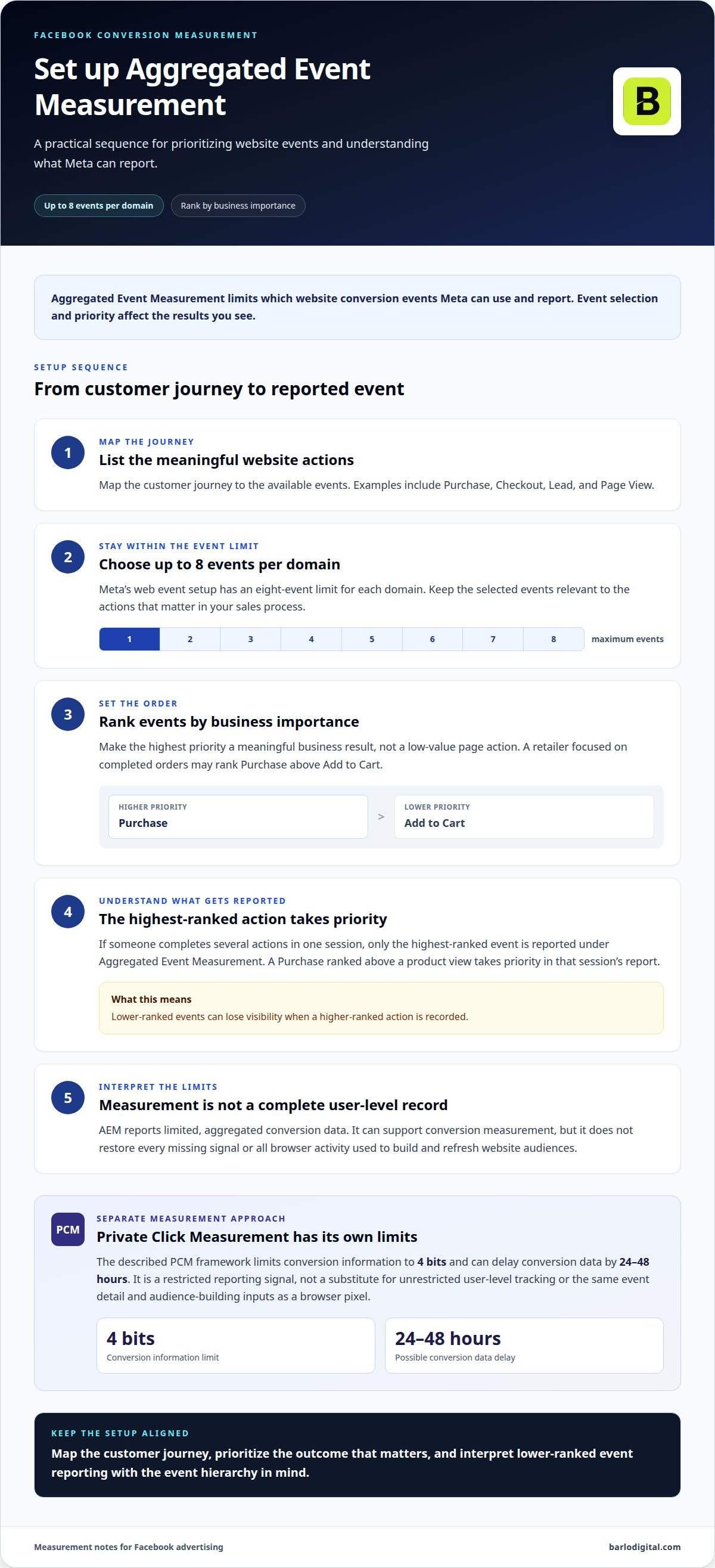
Aggregated Event Measurement, or AEM, changes how Meta processes website conversions from people using Apple devices. Rather than treating every browser signal as a complete record, the platform reports limited, aggregated conversion data. This affects attribution, optimization, and the activity available for ad targeting.
Meta’s web event setup has an eight-event limit per domain. Advertisers prioritize events such as a purchase, checkout, lead, or page view, then rank them by business importance. If someone completes several actions in one session, only the highest-ranked event is reported under Aggregated Event Measurement. For example, a purchase ranked above a product view takes priority in that session’s report.
That hierarchy makes event selection an operational decision, not just a settings detail. A retailer focused on completed orders may rank Purchase above Add to Cart, while a business seeking qualified inquiries may prioritize its lead event. Lower-ranked events can lose visibility when the system records a higher-ranked action, so an event list that does not reflect the sales process can distort measurement.
The iOS 14 changes also affect Facebook ad targeting. When less browser activity is available, Meta has fewer signals for building or refreshing website-based audiences. AEM can still support conversion measurement, but it does not restore every missing user-level signal. Retargeting people who viewed a product may therefore rely on less complete activity than before.
Apple’s Private Click Measurement, or PCM, is a separate approach to measuring ad-driven conversions. The described PCM framework limits conversion information to 4 bits and can delay conversion data for 24–48 hours. That is a restricted reporting signal, not a substitute for unrestricted user-level tracking. Advertisers should not assume PCM will provide the same event detail or audience-building inputs as a browser pixel.
For practical measurement, map the customer journey to the available events, then rank the outcomes that matter most. Confirm that the highest-priority event represents a meaningful business result, rather than a low-value page action. A clear conversion measurement setup helps connect event configuration with the outcomes used to assess campaign performance.
2. What's the Facebook iOS 14 change?
Apple’s App Tracking Transparency prompt changed whether apps could track activity across other companies’ apps and websites. Apple made the prompt mandatory for apps in April 2021. When users declined tracking, Facebook received fewer signals for connecting ad views or clicks with later conversions.
Apple’s SKAdNetwork is a framework for attributing app installs and conversion activity while limiting access to user-level identifiers. It gives advertising platforms restricted conversion signals instead of the detailed user-level paths Facebook previously used. As a result, it can be harder to connect an individual ad interaction with a later app action.
Facebook’s attribution reporting changed too. Before iOS 14, its default attribution window was 28-day click and 1-day view. The current default described here is 7-day click and 1-day view. A purchase after the earlier click window might have appeared in Facebook’s report, while the shorter window can leave it unattributed there.
That does not prove the sale never happened. It means Ads Manager may report fewer conversions than a store or analytics platform records. Facebook also uses models to estimate conversions from iOS 14 users. Modeled reporting can help describe performance, but it is not a direct record of every user’s path.
Timing adds another source of discrepancy. iOS conversion reporting may be delayed by as much as 48 hours, while Facebook ad data may arrive after a three-day period rather than in real time. A campaign viewed immediately after a sale can therefore appear weaker than its later report. Compare reporting periods only after delayed results have had time to arrive.
UTM codes offer a separate way to label ad traffic for analytics tools. Add consistent source, medium, and campaign identifiers to destination links, such as “facebook,” “paid-social,” and a campaign name. These tags help an analytics platform group visits by campaign, but they do not restore missing user-level attribution or tell Facebook which person converted.
For a cleaner comparison, use consistent measurement windows and review three records: Facebook Ads Manager, website analytics, and completed orders. Check that each system uses the same dates, conversion definition, and campaign identifiers. Differences may reflect distinct attribution rules, delayed data, or missing signals, not necessarily a change in demand.
3. Campaign optimization and advertising diversification
Apple’s iOS privacy changes reduced the user-level signals available to Facebook advertising. The practical response is not to chase every reported fluctuation. Separate changes in measurement from changes in business outcomes, then optimize campaigns around the strongest available conversion signals.
A historical comparison shows why platform reports need context. Facebook’s reported return on ad spend was 3.13 from February through April 2021, then 1.93 from July through September 2021. The reported figures indicate a decline between those periods, but do not establish its cause. It describes those periods, not a universal outcome or proof that privacy changes alone caused the difference.
Use a small set of business measures alongside Ads Manager. For ecommerce, compare reported purchases with completed orders and revenue. For lead generation, compare platform conversions with qualified inquiries and booked appointments. If Facebook reports fewer conversions but completed orders remain steady, investigate attribution and signal loss before cutting campaign budgets.
Then align optimization with the action closest to business value. A campaign optimized for a low-intent event may generate activity without sales. Review the optimization event, the quality of resulting customers, and the time it takes them to convert. Change one major campaign variable at a time so you can interpret the results.
Conversational advertising and SMS can offer another path to conversion. For example, a retailer might invite shoppers to ask product questions through messaging, then track resulting orders separately. Treat messages, opt-ins, and purchases as distinct points in the customer journey. A conversation is not a sale.
A survey cited in the available market facts found 70% of marketers dissatisfied with ad performance. Dissatisfaction alone does not diagnose the cause. Segment results by campaign objective, audience, placement, and conversion quality, then identify where the decline appears. This prevents a reporting gap from being mistaken for a demand problem.
For roofers, diversification may also include a dedicated storm response campaign when severe weather creates local demand. Give the campaign its own targeting and message, then review lead quality. Across Facebook and other channels, ask which campaigns produce verified business outcomes and which only appear efficient within one platform.
4. Effects on Facebook pixel retargeting audiences
iOS 14 reduced the user data Meta can receive when people decline tracking, affecting pixel-based targeting and retargeting. Website visitor audiences can be smaller or less complete, which can also limit the signals available for lookalike audiences. The change affects the data Facebook can use, not whether a business can run retargeting campaigns.
A custom audience based on site activity depends on the Pixel receiving that activity. For example, a visitor who views a product and leaves may not be added consistently to a website retargeting audience. That makes the pool less reliable for reaching every eligible visitor with a follow-up ad. A missing Pixel event does not prove that the person never visited.
Lookalike audiences rely on a source audience, such as purchasers or qualified leads. If fewer source records match, Meta has less input for finding similar users. The effect depends on source quality and how you define a valuable customer. A list of completed purchasers may be more useful than a broad list of page visitors.
Audience size matters for delivery and campaign learning. Before iOS 14 changes, campaigns could be successful with audiences of 50,000 to 200,000 users. Advertisers are advised to aim for an audience of at least 500,000 users to help offset lost iOS user data. These figures are guidance, not a guarantee that a larger audience will perform better.
Broader targeting gives Meta more room to find likely converters, but it changes the campaign’s purpose. A prospecting campaign can use wider audience settings and let its conversion objective guide delivery. Retargeting has a narrower role: reaching people with prior activity, such as product views, cart starts, or past purchases.
Keep these objectives separate rather than asking one audience to serve every purpose. For example, distinguish past purchasers from recent product viewers when repeat and first purchases need different messages. Review audience overlap, event quality, and actual conversion outcomes before shifting budget. A larger audience is not helpful if it weakens relevance or attracts low-intent traffic.
Use customer records and website activity where people have provided them appropriately. Refresh source audiences as customer data changes, and do not treat Pixel counts as a complete census of site visitors. If a retargeting pool shrinks, test broader time windows or campaign audiences where available, then assess results against completed sales or qualified leads.
The goal is not the biggest possible audience. It is enough usable signal for Meta to deliver ads while maintaining a clear connection to the intended action. Consider audience size, campaign objective, and conversion quality together to distinguish a targeting problem from incomplete tracking or a weak offer.
5. Facebook Conversion API server-side tracking
The Meta Pixel sends website activity through a browser. The Facebook Conversion API, or CAPI, sends conversion events from a business’s server to Meta. This second route can provide another signal when browser tracking is incomplete, but it cannot restore user data that iOS users decline to share.
For example, a store can send a confirmed purchase event from its order system. A lead-generation business can send a recorded inquiry after form submission. The event should represent a real action, not a button click that may never lead to a completed order or qualified inquiry.
The Pixel and CAPI may report the same customer action. If both send a purchase, the setup needs a way to identify duplicate events; otherwise, one order could be counted twice. Test the event flow from the original action through Meta’s event diagnostics, then compare reported purchases with the order system.
Server-side tracking improves the route by which events are transmitted. It does not bypass Apple’s privacy choices, guarantee complete attribution, or make every conversion visible. Private Click Measurement information is limited to 4 bits, so it cannot provide the detailed user-level record some advertisers expect. Treat CAPI as an additional measurement signal, not a way to reverse privacy restrictions.
Domain verification is another configuration step. Advertisers using a Facebook Pixel should verify their domain to demonstrate ownership. This connects the website’s domain to the business’s Meta account and supports control of its conversion-event setup. Verification alone does not create missing events or correct inaccurate purchase data.
Event prioritization still matters. The setup allows up to eight events per domain, so rank actions by business value. An ecommerce business might place Purchase above Add to Cart, while a lead-generation business might prioritize a submitted inquiry over a page view. Selected events should match the outcome the campaign is meant to produce.
Check the entire event chain, not just whether CAPI is switched on. Confirm that the server receives the action, sends the correct event name, and avoids duplicate reporting with the browser Pixel. Then compare Meta’s reported conversions with completed orders or recorded leads over matching date ranges. A working connection can still transmit the wrong event.
Accurate tracking depends on which event is sent, where it comes from, and whether duplicate signals are handled correctly. The goal is a reliable flow of events, not a higher conversion count inflated by duplicates or low-value activity.
Barlo Digital
Barlo Digital helps businesses distinguish tracking gaps from campaign problems. We examine how conversion events, reported results, and actual business outcomes fit together, then identify where measurement or campaign structure needs attention.
Our services include ecommerce tracking and measurement audits, as well as paid campaign management across Meta, Google, and TikTok. The right next step depends on whether the issue lies in event data, reporting, or campaign performance. If Facebook results no longer align with orders or qualified leads, we can trace the gap and identify what needs attention.
Talk with Barlo Digital about your tracking and campaign results.
Make your next decision from cleaner evidence
The iOS 14 impact on Facebook ads tracking makes measurement discipline part of campaign management. The next step is not to force every report into agreement. It is to decide which business outcomes matter, identify where their records diverge, and use that evidence before changing spend or targeting.
Barlo Digital connects tracking quality with paid campaign decisions through ecommerce tracking and measurement audits, tracking fixes, and ecommerce ad management across Meta, Google, and TikTok. This combination helps when reporting differences make it difficult to tell whether campaigns are underperforming or measurement is incomplete. We also offer Local SEO and AI search for businesses seeking visibility beyond paid ads.
Bring us the gap you need to resolve, whether ad reports do not match recorded outcomes or you are unsure which campaign decision the data supports. We can discuss the issue and the appropriate next step without treating a platform’s reported numbers as the whole business picture.
Contact Barlo Digital to discuss your ads. Start with the measurement question that is affecting your next decision.
Frequently Asked Questions
What's the Facebook iOS 14 change?
It changed how advertisers can interpret some campaign results, particularly when user-level signals are unavailable. For practical diagnosis, separate app promotion from website sales: an app-install campaign and a product-purchase campaign rely on different conversion paths. Review the action each campaign is designed to drive, then assess the outcome in the system where it is recorded, such as an app store or order platform.
At what rate are iOS14 users opting out of IDFA tracking?
In US markets, Facebook tracking opt-out rates can exceed 80–90%. The figure is a broad market estimate, not a measurement for a specific advertiser’s account. It does not tell you how many customers your own campaigns reached or converted. For a business review, use your actual order or lead records to assess results instead of applying that market rate to campaign forecasts.
How Will iOS 14 Affect Your Facebook Ads?
It can make some campaign results harder to attribute and some Pixel audiences less complete. The practical effect varies by campaign objective and conversion path. A retailer measuring website purchases, for example, faces a different reporting issue from an app developer measuring installs. Identify the conversion action first, then decide which business record provides the clearest evidence of the outcome.
What was not affected by the iOS 14 update?
Apple’s tracking changes did not focus on Facebook’s ad creation tools or advertisers’ control over creative decisions. Businesses can still develop different images, messages, and offers, then assess which attracts the intended response. Keep creative testing separate from tracking diagnosis: record changes to an ad’s message so they are not confused with shifts in measurement.
Why does this matter for Facebook Ads?
It matters because campaign decisions can be distorted when one reporting view is treated as the complete record. A useful review asks three questions: did the ad reach the intended audience, did people take the desired action, and did that action create business value? For a lead campaign, distinguish an inquiry from a qualified opportunity instead of treating every submission as equal.
IOS 14 Ad Tracking: What Does it Mean for Your Facebook Ads Strategy?
Understanding the iOS 14 impact on Facebook ads tracking starts with defining a decision rule before reviewing results. For example, decide whether campaign changes depend on purchases, qualified leads, or another business outcome. Keep that measure stable while assessing creative or audience changes. This makes the next strategic choice clearer, even when Facebook’s reporting does not capture every customer interaction.
What changed for Facebook ads tracking with Apple iOS 14 App Tracking Transparency?
App Tracking Transparency made tracking permission a user choice for apps. For advertisers, that means available campaign signals can vary depending on whether people grant permission. When reviewing an app campaign, distinguish the permission prompt from the ad itself: the prompt governs tracking access, while creative, audience settings, and the offer remain separate campaign decisions to evaluate.
When did iOS 14.5 require apps to ask permission to track users?
Apple made App Tracking Transparency mandatory for apps in April 2021. If you are comparing campaign performance across that period, annotate the change in your internal reporting timeline. Also record any simultaneous changes to budgets, creative, or conversion goals. That context helps analysts avoid assigning every difference between periods to one cause when several campaign conditions may have shifted together.

Article by
Carlos Benavides
Carlos Benavides founded Barlo Digital and is its Director of Paid Media and Performance. He has fifteen years in direct-response marketing, more than $50M in lifetime ad spend, and a B.S. in Computer Science, which is why tracking at Barlo Digital is built by hand. Barlo Digital is a director-led paid media and search agency serving US ecommerce brands, home-service companies and practices.


