

Referral-driven growth isn’t a client pipeline. If new business depends on who happens to know you, prospecting will stay inconsistent. Learning how to get clients for a staffing agency starts with a harder question: which employers have a hiring problem your agency can solve better than a generalist?
Personal networks and referrals can open doors, but they don’t give you a reliable way to prioritize prospects or explain why a buyer should choose your staffing expertise. More outreach won’t fix that. Without a defined niche, a clear reason to engage, and consistent follow-up, prospecting can consume time without producing enough qualified employer conversations.
This guide shows you how to define an ideal employer profile, choose acquisition channels that fit your resources and sales cycle, and build a measurable process for outreach, follow-up, and client development. We’ll also explain how targeted appointment setting can support business development without confusing a high volume of unqualified leads with sales progress. The goal is a repeatable pipeline, not another burst of activity that fades when referrals slow down.
Key Takeaways
- How to get clients for a staffing agency starts with defining the employers your niche can serve and the hiring problems you solve.
- Choose acquisition channels based on your target buyer, available sales capacity, and how quickly you need feedback.
- Compare referrals, outbound, content, events, paid promotion, and account expansion by targeting control, effort, and follow-up demands.
- Use a five-step process to turn target selection, prospecting, contact, qualification, and follow-up into measurable outputs.
- When outreach capacity is the constraint, staffing agency lead generation and appointment setting can support business development while your team handles closing and staffing delivery.
How to Get Clients for a Staffing Agency Starts with a Clear Market Position
Client acquisition and candidate recruiting are separate jobs. Recruiting fills an employer’s open roles. Client acquisition wins the employer relationship that creates those openings in the first place. A large prospect list won’t solve the second problem if buyers can’t tell what your agency handles or why it fits their needs.
That distinction is central to how to get clients for a staffing agency. Buyers need a specific reason to start a conversation. “We recruit talent” describes a category. “We supply contract maintenance technicians for manufacturers facing recurring shift coverage gaps” names a buyer, a hiring problem, and a capability. Use a position like this only if your recruiting operation can support it.
Choose a staffing niche buyers can recognize
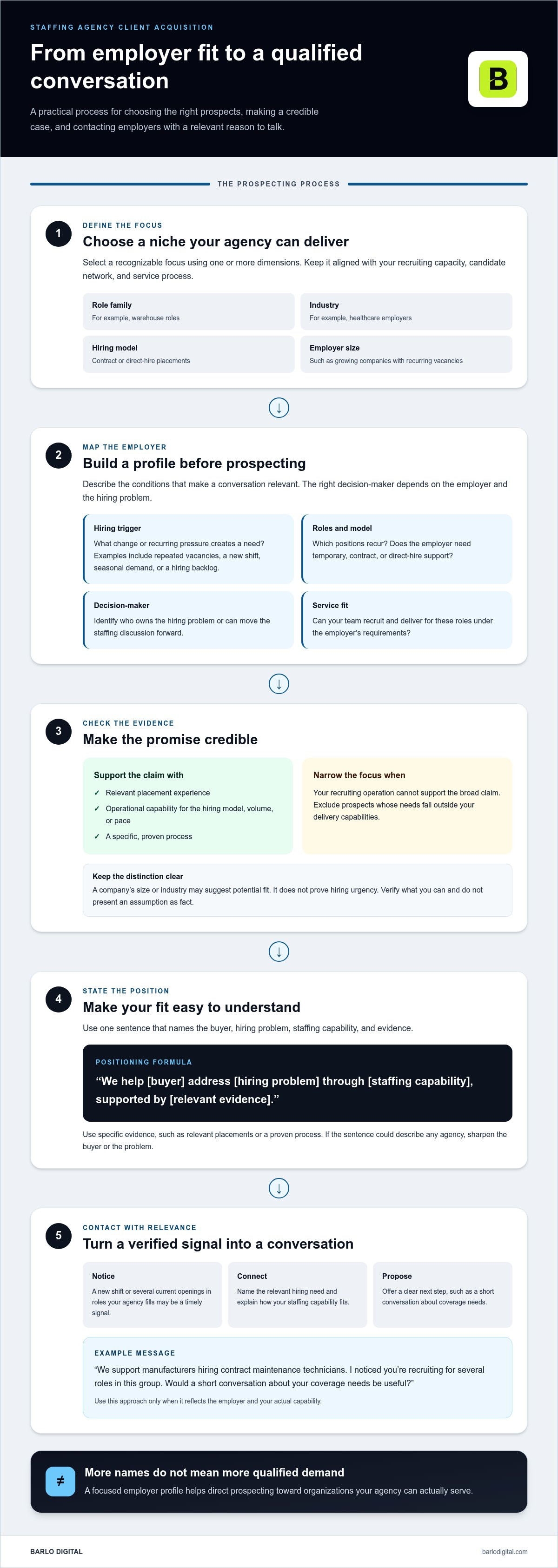
Define your focus through one or more useful dimensions: role family, industry, hiring model, or employer size. For example, an agency might focus on warehouse roles, healthcare employers, contract placements, or growing companies with recurring technical vacancies. These are different positioning choices, not proof of expertise. Choose a focus your recruiting capacity, candidate network, and service process can support.
Make your claim verifiable. Relevant placement experience can show familiarity with a role or industry. Operational capability can show that your team can handle the hiring model, volume, or pace you describe. If neither supports a broad claim, narrow it. A precise, credible specialty gives buyers more reason to engage than an expansive promise that raises questions about delivery.
Build an employer profile before prospecting
Describe the employer conditions that make a conversation relevant. Note likely hiring triggers, recurring roles, the decision-maker, and the staffing service that fits. Triggers might include repeated vacancies, a new shift, seasonal demand, or a hiring backlog. Identify whether the relevant contact is an owner, HR leader, talent acquisition manager, or operations leader. The right title depends on the employer and the hiring problem.
- Hiring trigger: What change or recurring pressure creates a need?
- Roles and model: Which positions recur, and does the employer need temporary, contract, or direct-hire support?
- Decision-maker: Who owns the hiring problem or can move a staffing discussion forward?
- Service fit: Can your team recruit and deliver for these roles under the employer’s requirements?
Exclude prospects whose needs fall outside your delivery capabilities. More names do not mean more qualified demand. A focused profile helps you spend prospecting time on employers your agency can serve and makes channel choices more disciplined. Our staffing agency lead generation service supports targeted employer conversations rather than raw lead volume.
Put your position into one sentence: “We help [buyer] address [hiring problem] through [staffing capability], supported by [relevant evidence].” Keep the evidence specific, such as relevant placements or a proven process. If the sentence could describe any agency, sharpen the buyer or problem before starting outreach.
Staffing Agency Lead Generation Channels: How to Create Qualified Conversations
A channel is not a strategy by itself. Choose it based on the employers you want to reach, the staffing offer that fits their needs, and the sales capacity available to follow up. A channel that produces names your team can’t qualify or contact consistently adds volume, not pipeline.
Give each channel a distinct purpose. Referrals can provide a trusted introduction. Targeted outbound can reach employers that match your focus. Expertise-led content can answer buyer questions before a sales discussion. Events can create direct conversations, while paid promotion can extend the reach of a relevant offer. The American Staffing Association’s staffing industry statistics offer context on the broader market, but market data alone doesn’t show whether a specific employer is ready to buy.
Use referrals and targeted outbound with a clear reason to contact
Ask a business contact for a specific introduction, not a vague promise to “keep you in mind.” Explain the role types and employer situations your agency serves, then ask whether they know an operations leader dealing with a related hiring challenge. A focused request is easier to pass along and makes it clearer whether the introduction is relevant.
For outbound, distinguish a buying signal from a generic company attribute. A new shift or several current openings in roles your agency fills may justify timely research and a tailored message. A company’s size or industry may suggest potential fit, but it doesn’t prove hiring urgency. Verify what you can, state what you observed accurately, and don’t present an assumption as fact.
Keep the message compact: identify the relevant hiring need, explain your staffing fit, and propose a next step. For example: “We support manufacturers hiring contract maintenance technicians. I noticed you’re recruiting for several roles in this group. Would a short conversation about your coverage needs be useful?” Use this approach only when it reflects the employer and your actual capability.
Make expertise visible before the sales conversation
Publish practical material for a defined employer problem: a checklist for planning seasonal staffing, guidance on structuring a role intake, or common causes of delays in filling a particular job family. Specific content gives prospects a reason to engage and helps your team identify recurring questions. Use documented case evidence only when you can accurately describe the work and its results. Don’t imply that one placement proves broad performance across roles or industries.
Paid promotion can put a useful resource or clear staffing offer in front of a defined audience. It can’t correct an unclear offer or establish that an inquiry is a qualified employer opportunity. Assess the channel by the conversations that fit your staffing capability, not just clicks, form submissions, or contact volume.
Judge every channel by whether it creates relevant employer conversations. Track whether prospects match your target, have a real hiring need, and agree to discuss it. That keeps staffing agency lead generation tied to business development instead of an inflated list of names.
Compare Staffing Client Acquisition Methods by Effort, Control, and Fit
No channel wins on every measure. Referrals may bring context but depend on relationships. Outbound gives you more control over whom you contact, but requires research and consistent follow-up. Compare each method against your team’s capacity and the quality of employer opportunities it produces. Don’t assume one channel is universally the fastest or cheapest.
| Channel | Setup effort | Control over targeting | Feedback speed | Follow-up demands |
|---|---|---|---|---|
| Referrals | Low to moderate. Requires relationship-building and clear introduction requests. | Low to moderate. Depends on who your network knows. | Often direct, but timing varies. | Moderate. Follow up with the introducer and employer. |
| Outbound | Moderate to high. Requires prospect research, message development, and a contact process. | High. You select employers and roles to pursue. | Replies can provide early feedback, not proof of buying readiness. | High. Plan for consistent, relevant contact and clear next steps. |
| Content | Moderate to high. Useful material takes subject knowledge and production time. | Moderate. Topic choice shapes who it attracts, but readership varies. | Usually slower. Engagement can build over time. | Moderate. Respond to inquiries and keep useful material current. |
| Events | Moderate to high. Attendance, preparation, and follow-up take time. | Moderate. Audience fit depends on the event. | Direct conversations can provide immediate reactions. | High. Follow-up is needed to move conversations forward. |
| Paid promotion | Moderate to high. Requires a defined offer, targeting, creative, and measurement. | Moderate to high. Depends on platform and campaign settings. | Early response data may arrive before sales quality is clear. | High. Inquiries need qualification and sales follow-through. |
| Account expansion | Low to moderate. Starts with existing relationships and delivery knowledge. | High within current accounts. | Direct discussions can reveal additional needs. | Moderate. Requires regular account review and relevant proposals. |
Which channel fits a new or established staffing agency?
A new agency can test referrals if its relationships reach suitable employers and its team can support the offer with relevant capability. An established agency can assess repeatable prospecting and expansion within current accounts. Match the workload to available time and sales skills. Don’t launch more channels than the team can follow through on.
Start with one primary channel and one supporting channel. For example, pair outbound with useful content that helps explain the offer. Set a review point, then assess whether the combination produces qualified employer conversations. Change the mix based on evidence, not activity alone.
Measure channel quality beyond response volume
Track progression from qualified conversations to sales meetings, proposals, and signed client relationships. Record each opportunity’s source, staffing need, decision-maker, next step, and disposition. A high reply count can hide poor fit. A smaller number of relevant conversations may provide better evidence about whether your targeting and offer are working.
For paid campaigns, connect lead tracking to sales outcomes so inquiries can be distinguished from viable opportunities. Evaluate staffing agency lead generation by relevant employer conversations and downstream progress, not simply by the number of responses recorded.
Build a Repeatable Staffing Client Acquisition Process in Five Steps
A pipeline becomes manageable when each prospect moves through the same visible stages. Use five steps: define the target, build a prospect list, contact, qualify, and follow up. Give each step a recorded output. That lets you find where progress stalls instead of adding more outreach or another channel by default.
-
Define the target. Turn your employer profile into rules the team can apply. Specify the roles, hiring model, employer conditions, and staffing needs that fit your delivery. Also name exclusion criteria, such as a role type your recruiting operation can’t support.
Output: A short target definition and clear fit criteria.
-
Build a prospect list. Identify employers that meet those criteria. Record the source of each prospect and the evidence for including them. A company’s industry may suggest potential fit, but it does not confirm an active hiring need. Keep verified signals separate from assumptions.
Output: A prioritized list with a reason for contacting each employer.
-
Contact the employer. Use a concise message tied to a relevant staffing need or observable business change. State why your agency’s capability may fit, then propose a clear next step. Track the date, channel, message angle, and response so you can compare outreach on more than activity volume.
Output: A contact record and a scheduled next action.
-
Qualify the opportunity. Confirm that the employer has a relevant hiring need and that your agency can deliver the staffing service required. Identify who owns the decision and understand the business reason behind the need, such as recurring vacancies or a change in staffing demand. Record facts, open questions, and whether the opportunity merits further sales time.
Output: A qualification note with fit, decision-maker, need, and disposition.
-
Follow up and review. After every interaction, set the next action and its owner. Follow up with useful context, such as a relevant answer or a clear recap, rather than repeating the same pitch. Pause or stop when the employer declines or the fit disappears.
Output: A dated next step, or a documented reason to close the prospect.
Keep the process consistent, not mechanical
Use a cadence your team can maintain, then adjust it based on buyer responses and sales capacity. There is no universal number of touches that suits every employer or staffing need. Review the funnel regularly: which target profiles advance to qualified conversations, which messages earn relevant replies, and where prospects drop out. If the fit is weak, revise targeting. If the need is real but the message misses, revise the message. Test those changes before adding channels.
Record source, hiring need, decision-maker, next step, and outcome in a CRM or another consistent tracking system. This creates a usable pipeline record and makes handoffs less dependent on memory. A disciplined process is the operational foundation of how to get clients for a staffing agency. Targeted employer conversations can support the outreach stage of that process.
When to Add Staffing Agency Lead Generation Support
Outside support makes sense when your target employers and staffing offer are clear, but your team can’t consistently make the outreach happen. If you’re still changing the niche, message, or qualification rules, adding outreach capacity won’t fix the underlying problem. It will simply put more activity through an unclear process.
Start with a capacity check. Who owns prospecting now? How much time can they protect for research, outreach, and follow-up? Are employer conversations being missed because sales staff are also handling recruiting, account service, or daily operations? If the target is defined but outreach keeps slipping, dedicated appointment setting can support the business development process.
Decide whether to keep prospecting in-house or add support
Keep prospecting in-house when an accountable team member has time to execute and can maintain useful contact with prospects. Consider external support when the profile is specific, qualification criteria are documented, and outreach consistency is the constraint. In either model, your team should retain ownership of the staffing offer, employer fit, and sales conversations that determine whether a relationship moves forward.
Appointment setting is not client closing. It does not replace your team’s responsibility to evaluate an employer’s needs, discuss terms, and win the relationship. It is also separate from candidate sourcing and staffing delivery. Those functions remain tied to fulfilling the employer’s roles after business development creates an opportunity. Confusing these responsibilities leads to mismatched expectations and poor handoffs.
Set expectations for an appointment-setting engagement
Before outreach begins, define the employer profile, the staffing offer being presented, and what qualifies as a useful meeting. Specify which hiring needs fit, which decision-makers matter, and what information should be captured before a conversation is booked. Clear criteria prevent a calendar full of meetings that don’t match your agency’s capabilities.
Agree on how outreach activity, employer responses, meeting details, and prospect dispositions will be documented. Decide who reviews those records and who takes the next sales action. A useful feedback loop is direct: your team reports which conversations were relevant, what objections surfaced, and where qualification missed. That information can refine targeting and messaging without treating every response as a successful outcome.
At Barlo Digital, we provide targeted appointment setting for staffing agencies. A director runs every account, and the work is handled at senior level without an account-manager layer. Our role is to support employer outreach and qualified conversations, not to claim control over whether a prospect signs, whether candidates are placed, or how staffing delivery performs. Those outcomes depend on the sales process and fulfillment that follow.
If your employer profile is clear and outreach capacity is the bottleneck, our staffing agency lead generation service can support your client acquisition process.
Turn Your Pipeline into a Consistent Business Development Habit
Client acquisition becomes more dependable when it runs as a business process, not a scramble triggered by a quiet month. Put your target, outreach activity, qualification notes, and follow-up into a routine your team can maintain. Review the evidence regularly. If the right employers aren’t responding, adjust the targeting or message before increasing activity.
That’s the practical answer to how to get clients for a staffing agency: make the process specific enough to repeat, then improve it based on the conversations and opportunities it produces. You don’t need to pursue every channel at once. You need a clear starting point and consistent execution.
Barlo Digital provides staffing agency lead generation and appointment setting, with director-led account delivery and senior-level work. To build a more consistent employer pipeline, explore our staffing agency lead generation service.
Frequently Asked Questions
How does a new staffing agency get its first client?
A new staffing agency can pursue its first client by focusing on a role group it can credibly fill and approaching employers already connected to its team. Start with former colleagues, vendors, and business contacts who understand the agency’s capabilities. Ask for a relevant introduction, then use the first discussion to clarify hiring volume, timing, and required qualifications. This helps establish whether there’s a workable fit before committing recruiting resources.
What is the best way to get clients for a staffing agency?
The best approach depends on the agency’s specialty, sales capacity, and access to employers. To work out how to get clients for a staffing agency, start with a channel you can run consistently and judge it by the opportunities it creates, not just replies or names collected. For example, an agency with strong industry relationships might test referral outreach, while one with a defined employer list might test targeted outbound.
How can a staffing agency find companies that need workers?
Look for observable hiring activity, then verify the need directly. Employer career pages, public job postings, and announcements about new operations can point to a possible staffing requirement. Treat each as a research lead, not confirmation that the employer needs an agency. Check whether the roles match your recruiting capability, then ask an appropriate contact whether the hiring challenge is ongoing, time-sensitive, or already being handled.
Do referrals work for staffing agencies?
Yes, referrals can introduce an agency to employers through an existing relationship, but they don’t guarantee a contract or an active hiring need. Make the request easy to pass along: describe the role types you support and the kind of employer that may benefit. After an introduction, respond promptly, thank the person who connected you, and keep them updated without sharing confidential details.
How should staffing agencies approach potential clients?
Approach a potential client with a brief, relevant message that shows why you chose that employer. Refer to a specific hiring signal, explain the staffing capability that may fit, and ask for a practical next step. Avoid broad claims about filling any role. If the signal is uncertain, frame it as a question rather than a fact. A respectful, accurate message gives the buyer room to clarify the need.
How can a staffing agency measure client acquisition?
Track prospects from first contact through signed agreement, and record where each opportunity came from. Separate qualified conversations from unqualified replies, then monitor how often conversations become meetings, proposals, and client relationships. Review results by channel and target profile, not only as a combined total. If a source creates activity but few viable opportunities, inspect the fit and qualification notes before investing more time in it.
Should a staffing agency outsource lead generation?
Outsourcing may make sense when the agency knows which employers it serves but lacks consistent time for prospect research and outreach. Keep ownership of the staffing offer, qualification standards, sales conversations, and delivery. Set expectations for which employers to contact, what counts as a relevant meeting, and how outcomes will be recorded. We provide staffing agency lead generation and appointment setting to support employer outreach.

Article by
Carlos Benavides
Carlos Benavides founded Barlo Digital and is its Director of Paid Media and Performance. He has fifteen years in direct-response marketing, more than $50M in lifetime ad spend, and a B.S. in Computer Science, which is why tracking at Barlo Digital is built by hand. Barlo Digital is a director-led paid media and search agency serving US ecommerce brands, home-service companies and practices.


