

A long channel list doesn’t prove a ppc management company can manage your budget responsibly. If you can’t see who makes campaign decisions, how ad data connects to booked jobs, qualified leads, or sales, or what work is actually being done, platform reports can create confidence without showing business performance.
That concern is justified. Clicks and platform-reported conversions are inputs, not proof that advertising is producing revenue or qualified demand. The right partner should make ownership explicit, connect measurement to outcomes your business values, and explain why its channel mix fits your buyers.
This checklist gives you practical criteria to compare providers: who controls the accounts and retains access, how tracking connects campaigns to sales, leads, and bookings, which channels fit your business, and what optimization happens beyond routine reporting. At Barlo Digital, a director runs every account, with campaign work handled at senior level and no account-manager layer. Use the questions ahead to identify a partner whose responsibilities, measurement, and communication are clear before spend is committed.
Key Takeaways
- A ppc management company should own ongoing planning, execution, measurement, and optimization, not just account setup.
- Trace campaign data from ad clicks to tracked actions and business outcomes, and identify where platform and sales records may diverge.
- Compare in-house, freelancer, and agency models by ownership, capacity, and continuity to find a fit for your operation.
- Define scope, account access, decision rights, measurement responsibilities, and review cadence before work begins.
- Barlo Digital assigns a director to every account, with senior-level work and no junior handoff or account-manager layer.
What a PPC Management Company Should Own Beyond Ad Setup
Launching ads is a task. Managing them is an ongoing responsibility. The scope should identify who plans campaigns, oversees budget changes, tests ads, reviews performance, and decides what to adjust. Without those boundaries, a provider can report activity while your business is left guessing who owns the decisions behind it.
Managed PPC is ongoing campaign planning, execution, measurement, and optimization, with clear responsibility for decisions and work tied to business priorities. Account setup, occasional advice, or access to campaign software doesn’t establish that anyone is responsible for what happens after launch. Put the ongoing work and decision owners in writing before the engagement begins.
What responsibilities belong in ongoing PPC management?
Agree on responsibilities before campaigns are active. The provider’s scope may include campaign structure, targeting, bid adjustments, budget oversight within agreed limits, ad testing, and regular performance reviews. The agreement should also state who approves changes outside those limits, who can edit campaigns, and how often the provider shares findings and proposed actions.
Keep platform tasks distinct from business decisions. A provider can review campaign activity, but your team may need to assess whether a lead is qualified, a sale is profitable, or a product should remain a priority. Decide who supplies that information and how it informs campaign choices. For ecommerce brands, ecommerce tracking and measurement supports decisions based on purchase data rather than ad-platform activity alone.
Which paid channels fit different business models?
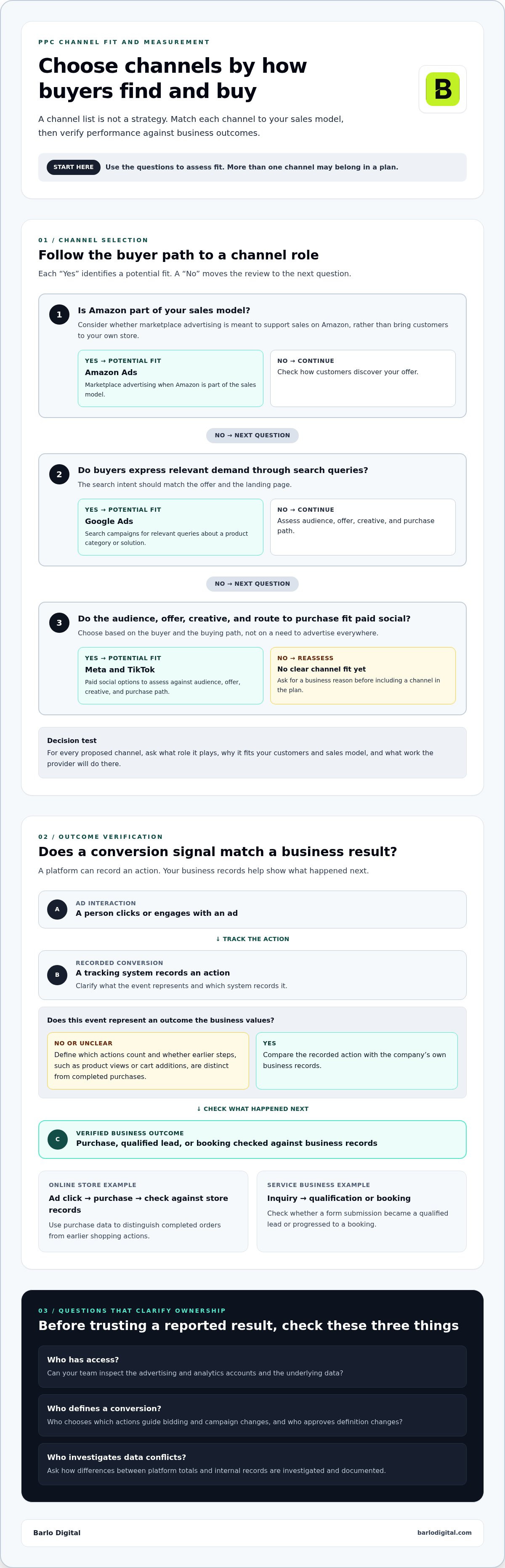
A channel should earn its place in the plan. The right mix depends on how customers discover and buy, the audience the business needs to reach, and the path from ad to conversion. A provider’s ability to manage several platforms doesn’t mean every platform belongs in your campaign. Ask what role each channel is expected to play and why it fits your business.
- Google Ads: Search campaigns may fit when people express relevant demand through queries, such as looking for a product category or a solution. The search intent should match the offer and landing page.
- Meta and TikTok: These are paid social options. Their suitability depends on the audience, offer, creative, and route from ad to purchase, not on a need to advertise everywhere.
- Amazon Ads: Marketplace advertising may fit when Amazon is part of the sales model. Its role differs from campaigns intended to bring customers to a company’s own store.
A ppc management company should explain the business reason for each channel and the work it will perform there. “We manage it” isn’t a rationale. Look for a recommendation grounded in your customers, sales model, and campaign responsibilities.
How a PPC Management Company Should Connect Ads to Measured Outcomes
A conversion number in an ad platform is a recorded signal, not automatically a sale or qualified lead. Measurement should connect an ad interaction to a tracked action, then compare that action with the business record showing what happened next. For an online store, that could mean tracing an ad click to a purchase and checking the order against store records. For a service business, it could mean following an inquiry through qualification or booking.
A platform-reported conversion shows that a tracking system recorded an action; a verified business result is an outcome checked against the company’s own records. That distinction affects which campaigns appear successful and what receives more budget. A useful provider should explain what each conversion represents, what system records it, and how the business evaluates the outcome.
What measurement questions should buyers ask?
Ask which conversion events guide bidding and campaign changes, and why those events matter to the business. If an online store prioritizes completed purchases, clarify how that event is separated from earlier steps such as product views or cart additions. For lead generation, ask whether campaign decisions use only form submissions or also account for lead quality and later sales activity.
- Account access: Who can access the advertising and analytics accounts, and can your team inspect the underlying data?
- Event ownership: Who decides which actions count as conversions, and who approves changes to that definition?
- Data conflicts: Who investigates differences between platform totals and internal records, and how are findings documented?
Platforms and business systems can count or attribute actions differently. A platform may record a conversion that the business later identifies as canceled, duplicated, or unqualified. A provider should explain what each report measures and what limits affect comparisons. Reporting totals without context makes it difficult to tell whether a discrepancy comes from tracking, attribution, or the actual campaign.
How tracking supports better campaign decisions
Campaigns learn from the signals they receive. If low-value actions are treated like completed orders or qualified inquiries, optimization may favor activity that looks strong in a dashboard but doesn’t match the business goal. Ask the provider how it evaluates event quality and incorporates business feedback into campaign decisions. The answer should show how measurement informs action, not just how reports are assembled.
For ecommerce brands, ecommerce tracking and measurement helps connect advertising activity with purchase data used to evaluate campaigns. A practical test is whether the provider can trace a reported conversion to its source, explain what it represents, and describe how the business checks the outcome. If it can’t, campaign decisions may be relying on an unverified signal.
PPC Management Company, Freelancer, or In-House Team: Compare the Operating Model
The right setup depends on the workload and resources your advertising requires. A business running one channel with occasional changes has different staffing needs from one coordinating campaigns across several channels, product, sales, and analytics teams. Compare who executes the work, who makes decisions, and who reviews performance. The label alone tells you little.
The key buyer question is where responsibility sits in practice. An in-house team brings internal context, a freelancer may provide focused execution, and a ppc management company may provide a broader operating structure. Each model still needs clear decision rights and communication. Set those expectations based on the work your business needs, not assumptions about the type of provider.
When an in-house PPC team may be the right fit
Internal hiring can suit a business that needs paid media coordinated daily with merchandising, sales, finance, or customer service. Proximity to internal decisions can help, but it doesn’t guarantee greater control or lower cost. The business still needs to assign time and ownership for campaign changes, channel coverage, measurement, and review. If one employee holds all account knowledge, continuity can depend on that person’s availability.
When external PPC management may fit better
Outside support may address a gap in execution capacity or platform experience, while your team contributes product knowledge, margins, lead quality, and sales context. Define who approves budget shifts, who supplies outcome feedback, what the provider handles, and how reviews happen. For ecommerce teams considering outside campaign execution, our ecommerce ad management covers paid campaigns across Meta, Google, and TikTok.
Check continuity, too. Ask who performs the work, who covers account decisions, and who explains the reasoning behind changes. A freelancer’s responsibilities can be direct, but capacity may be concentrated in one person. A company may offer a team structure, but clarify whether senior practitioners execute or work passes through layers. At Barlo Digital, a director runs each account and work stays at senior level.
Choose the model that matches workload, channel mix, and internal capacity. Put the operating agreement in writing before launch. If no one can name the decision owner and reviewer, the structure is incomplete.
PPC Management Company Checklist: Questions to Ask Before You Choose
A polished proposal can hide an unclear operating agreement. Before choosing a ppc management company, get specific about the work, access, decision rights, and communication. The answers should leave no doubt about who does what, what your team must provide, and how campaign choices connect to business goals.
Checklist for access, ownership, and senior-level delivery
Ask for named responsibilities, not general assurances. A title like “account lead” doesn’t tell you who changes campaigns or reviews performance. Use these questions to expose the actual delivery model:
- Who performs the work? Identify the people handling campaign setup, ongoing changes, and performance review. Ask whether senior specialists execute the work or pass it to other staff.
- Who owns the accounts? Establish that your business retains appropriate access to advertising and analytics accounts, and can view campaign settings and data.
- Who has decision rights? Agree which changes the provider can make independently and which require approval, such as expanding a channel or changing budget limits.
- How are issues escalated? Define who handles tracking failures, urgent campaign concerns, or disagreement about priorities, and how those issues reach your team.
Then ask for the review cadence and format. The purpose isn’t to demand more reports. It’s to know when decisions are reviewed, who attends, and how agreed actions are recorded. A clear cadence prevents campaign changes from becoming a stream of unexplained adjustments.
Checklist for scope, fit, and commercial terms
Scope should describe the actual work, not just the platforms involved. Clarify what campaign responsibilities are included, where your team must contribute, and how channels are selected. Ask the provider to explain what business information shapes its recommendations, such as sales priorities, product availability, lead quality, or the conversion path. A channel recommendation should have a business reason behind it.
- What is included? Specify channels, campaigns, testing responsibilities, measurement support, and work that falls outside the engagement.
- What must we provide? Confirm who supplies product, sales, margin, or lead-quality feedback, and who approves creative and landing page changes.
- How will fit be assessed? Ask what evidence supports a channel recommendation and what business outcome it is intended to serve.
- What are the commercial terms? Review the fee structure, billing terms, termination terms, and any separate audit scope in writing. Don’t rely on verbal summaries.
Our audits are paid and credited in full if the client continues within 60 days. For a measurement-focused engagement, see our ecommerce tracking and measurement services.
Use the answers to build a short written responsibility map before work starts. If you need to define what your ad data can support, review Barlo Digital’s ecommerce tracking and measurement approach.
How Barlo Digital Manages PPC Accounts and Your Next Step
Account structure determines who owns the work after launch. At Barlo Digital, a director runs every account. Campaign work stays at senior level, with no junior handoff and no account-manager layer between the person responsible and the work being done. That makes ownership direct: the person leading the account is responsible for campaign decisions and their execution.
What director-led PPC management means in practice
For a business evaluating a ppc management company, staffing is an operating detail, not a footnote. You should know who reviews the account, who makes changes, and who can explain the reasoning behind those changes. Our director-led model keeps those responsibilities close to the work, while your team provides business context such as product priorities, margins, and customer feedback.
Senior-level ownership doesn’t remove the need for clear approvals or reliable measurement, and it doesn’t guarantee a particular campaign outcome. It gives the business a direct line to the person accountable for management. That matters when a tracking issue appears, a campaign needs a decision, or reported activity doesn’t match what your sales records show.
Our founder, Carlos Benavides, brings fifteen years in direct-response marketing and more than $50M in lifetime ad spend. That experience informs how we assess paid campaigns, but channel selection still starts with the business model and customer path. A company selling through a marketplace has different advertising needs from a Shopify brand or a local business seeking calls and bookings.
Match Barlo Digital’s paid media work to your business
Barlo Digital manages paid advertising across Google, Meta, TikTok, Local Services Ads, and Amazon. Those channels aren’t interchangeable, and using more of them isn’t automatically better. Google may fit demand expressed through searches; Meta and TikTok may fit paid social campaigns; Amazon Ads may fit a marketplace sales model. The right mix depends on where your buyers discover, evaluate, and purchase.
For ecommerce brands, we manage advertising across Meta, Google, and TikTok. The work should connect channel choices to the store’s products, audience, and conversion path, rather than forcing every platform into the plan. A disciplined partner can explain the role of each channel and how its activity will be measured against the business’s priorities.
Our approach to evaluating paid advertising services is grounded in scope, ownership, and fit. Those criteria help separate a broad platform list from a management approach built around the actual needs of the business.
If your ecommerce brand needs senior-led management across Meta, Google, and TikTok, explore our ecommerce ad management.
Make the Next PPC Decision Clear
The right partner should leave you with more than campaign activity to review. You should understand what the work covers, how decisions are made, and how advertising supports the way your business sells. If those points are clear, you can judge performance against your priorities instead of relying on platform totals alone.
Choosing a ppc management company is an operating decision. Set expectations before the work starts, keep the business outcomes in view, and revisit the fit as your needs change. For ecommerce brands, that means choosing a channel mix and management approach that fit your products, audience, and path to purchase.
Our founder, Carlos Benavides, brings fifteen years in direct-response marketing and more than $50M in lifetime ad spend. At Barlo Digital, a director runs every account, with no junior handoff or account-manager layer.
Explore Barlo Digital’s ecommerce ad management and take the next step toward a paid media plan built around your business.
Frequently Asked Questions
What does a PPC management company do?
A PPC management company plans, manages, and improves paid campaigns. Work may include campaign structure, audience or search targeting, ad testing, budget decisions, and performance review. Scope varies. For example, one agreement may include managing Google Search campaigns but exclude landing page changes. Before signing, clarify the channels covered, who owns each task, and how campaign activity will be judged against business outcomes.
How do I choose a PPC management company?
Choose based on fit and operating details, not performance promises. Compare the provider’s relevant channel experience, measurement approach, staffing, account access, and communication process. Ask who will make a proposed change, who carries it out, and what approval it requires. Then check that the written scope reflects your business goals. A provider suited to a Shopify brand may not match a company whose priority is qualified sales inquiries.
How much does a PPC management company cost?
There’s no single fee for every business. The amount depends on the agreed work, campaign complexity, channels, and service arrangement. Compare scope alongside fees: one proposal might include campaign management and measurement support, while another may cover fewer responsibilities. Keep the advertising budget separate from the management fee, and get billing terms, included work, and any separately scoped services in writing before committing.
How long does it take for PPC management to produce results?
Timing depends on the campaign’s starting condition, tracking quality, sales cycle, and usable data. A store with reliable purchase tracking can assess purchase activity differently from a business whose sales take longer to close. Ask what the provider will review first, what evidence will guide adjustments, and when progress will be evaluated. Treat a fixed results deadline without those details as an unsupported promise.
Should I hire a PPC management company or manage ads in-house?
Choose according to your internal skills, available time, campaign workload, and need for day-to-day coordination. In-house management can keep execution close to product and sales teams, but requires dedicated staff capacity. An external provider may fill a skills or workload gap, while your team supplies business context. Compare responsibilities, access, communication, and total scope before deciding. Neither model automatically costs less or gives better control.
Can one PPC management company manage Google, Meta, TikTok, and Amazon ads?
Some providers manage all four, but channel coverage alone doesn’t show whether the mix fits. Google may support demand expressed in searches, Meta and TikTok are paid social options, and Amazon Ads may fit marketplace sales. Ask how each channel relates to your customer journey and how work across platforms is coordinated. A smaller, well-matched scope can make more sense than adding channels without a clear business purpose.
What should a PPC management agreement include?
A clear agreement identifies the channels and campaign tasks covered, who provides account access, who approves changes, and what your team must supply. It should also set communication expectations, fees, billing terms, and the process for changing or ending the engagement. For example, specify who provides product updates or sales feedback when those details affect campaign decisions. Written responsibilities reduce the chance that critical work falls between teams.

Article by
Carlos Benavides
Carlos Benavides founded Barlo Digital and is its Director of Paid Media and Performance. He has fifteen years in direct-response marketing, more than $50M in lifetime ad spend, and a B.S. in Computer Science, which is why tracking at Barlo Digital is built by hand. Barlo Digital is a director-led paid media and search agency serving US ecommerce brands, home-service companies and practices.


