

Ad spend can rise while business results stay flat. That isn’t growth. It’s a measurement problem, a campaign problem, or both.
Paid digital marketing puts ads in front of potential customers through channels such as Google Search, Meta, TikTok, Local Services Ads, and Amazon. It makes sense to ask what that spend actually produces, especially when clicks and platform-reported conversions don’t match your own records. The distinction matters: an ad platform can report activity, but your business needs verified actions such as qualified inquiries, booked jobs, or purchases.
In this article, we’ll explain how placements and campaign types work, what they can and can’t control, and what needs to be in place before launch. We’ll also show how to set a budget around business goals, connect ad creative and tracking, and judge results using your own records rather than clicks alone. A sound system starts with measurement, not assumptions. Our paid ads audit is one way we examine campaign structure and performance before budget decisions are made.
Key Takeaways
- Paid digital marketing buys online placements, but placement alone does not create customer demand or profitable growth.
- Map the campaign path from objective to recorded action. A weak destination can waste relevant ad traffic.
- Before launch, check that the offer, destination, tracking, and follow-up are ready to handle customer responses.
- Separate platform-reported activity from business records so you can judge performance using verified actions.
- Scaling paid digital marketing depends on connected execution, accurate measurement, relevant creative, and a usable destination.
What Paid Digital Marketing Means Beyond Buying Online Ads
Paid digital marketing is the purchase of online ad placements to reach a chosen audience. The placement gets a message in front of people; it doesn’t determine whether the offer fits, the page answers their questions, or they take action.
That distinction matters because an ad is one part of a larger path. Placement affects where people see it. Audience affects who sees it. Message shapes what they understand. Destination determines what they can do next. A mismatch at any point can turn relevant exposure into wasted attention.
The broader digital marketing mix also includes channels a business controls and attention it earns from others. Paid media is one part of that mix, not a substitute for every other way a business reaches people.
How paid, owned, and earned media differ
Paid media is distribution purchased through advertising placements. Owned media includes assets the business controls, such as its website and email list. Earned media is attention or a mention from someone else, such as a customer recommendation or independent coverage.
Consider a home-service company promoting estimate appointments. A paid ad introduces the offer to a relevant audience. The company’s website explains the service and provides a way to request an estimate. Later, a customer may recommend the company to a neighbor, creating earned attention. These channels can reinforce one another along the same customer journey. None is a direct substitute for the others.
Payment buys distribution, not trust or a completed sale. An ad can generate exposure, but the business still needs a credible offer, a useful destination, and a way to handle responses.
What businesses use paid digital marketing to do
A campaign’s role depends on the business objective. One may introduce a new offer to people who haven’t encountered the business. Another may capture existing demand from people actively looking for a service. A follow-up campaign may bring previous website visitors back to an offer they viewed. Those objectives require different messages and different ways to judge success.
Platform actions are not business outcomes. Impressions show that an ad was displayed; clicks show that someone interacted with it. A platform-recorded conversion is an action its tracking setup counts. These figures can help diagnose delivery, but they don’t automatically confirm commercial value in business records.
- Awareness: Measure whether the intended audience was reached and engaged, not whether the campaign produced sales.
- Lead generation: Check whether inquiries are relevant and whether they become calls, estimates, or booked appointments.
- Ecommerce: Verify recorded purchases against order data, then assess whether they support the business objective.
Keep the goal and the measurement aligned. If the objective is booked estimates, clicks alone don’t establish success. We treat tracking as part of campaign operations, so reported activity can be compared with the actions the business needs to verify.
How Paid Digital Marketing Moves From Ad Exposure to Customer Action
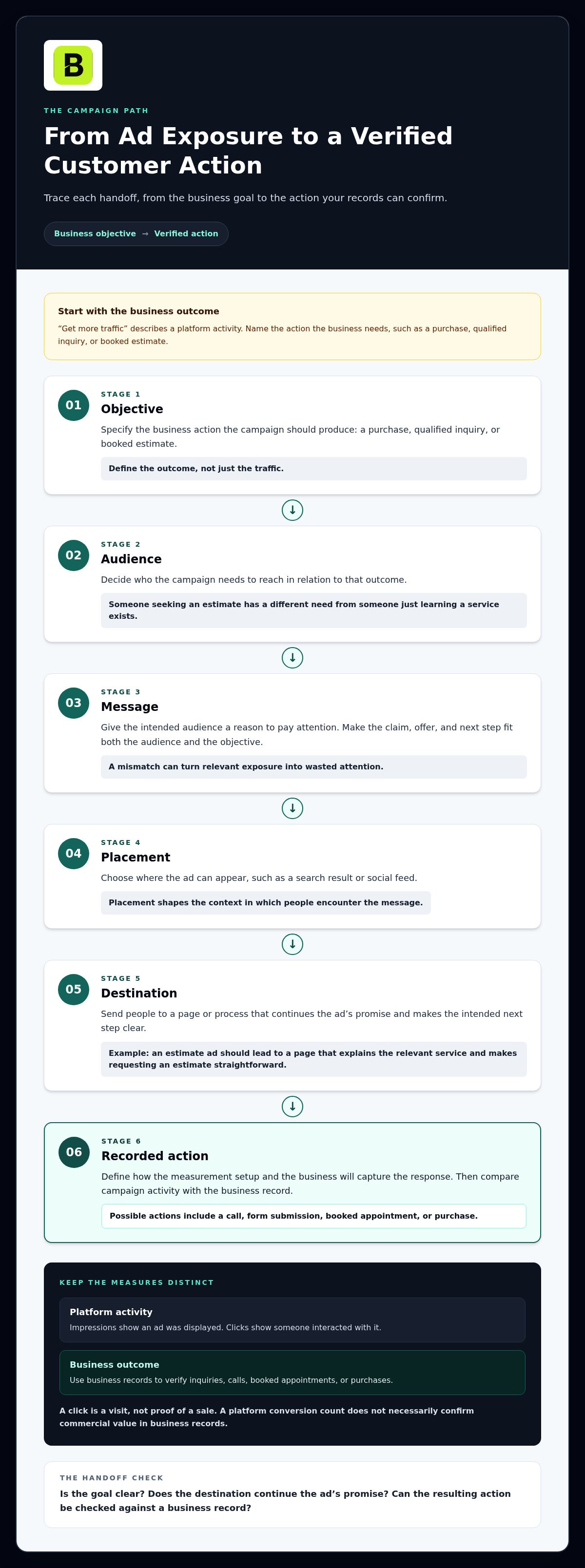
An ad is only the first handoff. To understand what it contributes, trace the campaign from the business goal through to an action you can verify. Each decision sets conditions for the next one. If the goal is vague or the destination fails to make the next step clear, more delivery won’t repair the break.
The campaign sequence from objective to destination
Use this sequence to map what the campaign needs to do and where it could fail:
- Objective: Name the business action you want, such as a purchase, qualified inquiry, or booked estimate. “Get more traffic” describes a platform activity, not the business outcome.
- Audience: Define who the campaign should reach in relation to that action. A person seeking an estimate has a different need from someone learning that a service exists.
- Message: Give that audience a reason to pay attention. The ad’s claim, offer, and next step need to make sense for the audience and the objective.
- Placement: Choose where the ad can appear, such as a search result or social feed. The placement affects the context in which people encounter the message.
- Destination: Send people to a page or process that continues the ad’s promise and makes the intended next step clear.
- Recorded action: Define how the business and measurement setup will capture the response, then compare the record with the campaign’s reported activity.
These steps are connected. If a contractor advertises estimate appointments, the landing page should explain the relevant service and make requesting an estimate straightforward. A broad homepage that hides the offer adds friction, even if the ad reaches people likely to need the work. Relevant traffic can still be wasted by a weak destination.
What happens after someone clicks
An ad click is a visit, not proof of a sale. After arriving, a visitor might call, submit a form, book an appointment, purchase, or leave without acting. The website or lead process needs to capture the action that matters, while the business should retain a record it can use to confirm what happened.
A conversion event is a defined action that measurement tools are set to record, such as a form submission or purchase. Platforms can report events they receive through configured tracking, but a platform’s conversion count doesn’t necessarily represent every customer action. A call completed outside the website, for example, may need a separate tracking process to appear in business records.
Inconsistent event setup creates false comparisons. If one campaign counts form views and another counts submitted forms, their reported conversion totals don’t mean the same thing. We connect campaign activity to paid campaign tracking and measurement so the event definition can be checked against the action the business actually needs to verify.
Why Paid Digital Marketing Does Not Guarantee Sales
Paying for ad delivery doesn’t guarantee demand, sales, or profitable growth. Paid digital marketing can control parts of the campaign, but it can’t force a customer to want the offer, make an unavailable product available, or ensure a sales team follows up effectively.
Separate campaign inputs from business conditions. The campaign team can adjust the audience, message, placement, budget, and destination. The business still controls the offer, pricing, inventory, service capacity, and response process. If those conditions fail, more impressions or clicks may increase activity without improving the outcome.
Measured activity shows what a platform recorded; verified business impact shows what the company can confirm in its own sales or lead records. The difference matters before you decide to increase, cut, or reallocate spend.
Why clicks and conversions can tell different stories
An ad platform attributes a conversion according to its tracking setup and attribution rules. A business record may instead show completed orders, qualified inquiries, or booked estimates. The two views can differ because they define, observe, or assign credit to actions differently. Neither dashboard automatically provides a complete account of what happened.
Tracking faults can widen the gap. A duplicated event may count one action more than once. A missing tag may fail to record an action. Consent settings can limit what tracking captures. Attribution can also assign credit to an ad even when the business’s transaction record doesn’t show a corresponding sale. These are reasons to investigate discrepancies, not to assume the platform count is the verified result.
Compare like with like. Confirm what each reported conversion represents, check whether one action can be counted twice, and reconcile campaign reports with orders or lead records. For local businesses, call and lead tracking can help connect advertising activity with calls and inquiries that the business can review.
What advertising cannot repair by itself
An ad can send attention to an offer. It can’t make an unclear offer persuasive. If a landing page omits key service details or makes the next step difficult to find, interested visitors can leave without acting. If a request comes in but follow-up is delayed or inconsistent, the campaign may have created an opportunity that the business failed to handle.
Audience targeting has limits, too. It can help direct a message toward people who may be relevant, but it can’t create a fit between a customer’s need and an unsuitable product, offer, or service. Inventory shortages, limited capacity, and weak sales follow-up sit beyond the ad placement itself.
- Check the offer: Is it clear, available, and relevant to the intended buyer?
- Check the destination: Does the page support the promise in the ad and make the next step usable?
- Check the response: Can the business identify, qualify, and follow up on incoming actions?
Advertising is one part of the sales system. Judge it by verified actions and the conditions that turn those actions into business outcomes, not by delivery metrics alone.
How to Prepare a Paid Digital Marketing Campaign Without Guesswork
A campaign should not go live just because the ads are built. Readiness means the offer, destination, response process, and measurement are prepared to handle the traffic and show what happened. Use this checklist before activation. It focuses on operational setup, not how much to spend or which channel to choose.
- Choose one primary business action. Define the result the campaign is meant to support, such as a completed purchase, qualified inquiry, or booked estimate. Keep secondary actions separate so a page view doesn’t get mistaken for the outcome that matters.
- Confirm the offer is ready. Make sure the advertised product or service is available, the terms are clear, and the business can handle the responses the campaign may generate. An ad can’t resolve an inventory gap or a service team’s lack of capacity.
- Match the message to the destination. The landing page should continue the ad’s promise, explain the offer, and make the next step clear. Check it on a phone and desktop. Test forms, booking paths, and purchase steps instead of assuming they work.
- Prepare the response process. Decide who reviews new inquiries, how they are recorded, and how the business identifies a qualified lead or completed appointment. A form submission without a reliable follow-up process is not a finished customer journey.
- Define and test measurement. Specify which events represent meaningful actions, then test that they record correctly before traffic arrives. Our ecommerce tracking and measurement work connects campaign reporting with the actions a business needs to assess.
- Set a comparison point. Identify which business records will be checked against platform reports after launch, such as orders, qualified inquiries, or booked estimates. Use consistent definitions so campaign reports and internal records are measuring comparable actions.
Define the action and prepare the destination
One primary action makes campaign setup easier to evaluate. For an online store, that could be a completed purchase rather than a product-page view. For a contractor, it could be a booked estimate rather than a click on the phone number. Keep the ad promise, page content, and requested action aligned. If the ad promotes an offer the destination barely explains, the handoff is broken before measurement begins.
Set up measurement before launch
Testing matters because a conversion event can be missing, duplicated, or attached to the wrong step. Confirm what should trigger each event and perform a test action through the same path a customer would use. After launch, compare the platform’s reported events with the business records that verify purchases, qualified inquiries, or bookings. A difference is a reason to investigate the setup and definitions, not to accept either total without review.
Keep a record of the test action, the event it should trigger, and where the corresponding business record appears. That gives the team a practical reference when reviewing early campaign data or diagnosing a reporting gap. It also makes changes easier to evaluate because the expected action and its measurement are documented before the campaign is active.
What a Sound Paid Digital Marketing System Needs to Scale
Increasing campaign activity magnifies the system already in place. If the message, destination, or measurement is weak, more delivery can magnify waste instead of producing clearer business evidence. Scaling calls for connected execution: campaigns aligned to a defined business action, relevant creative, a usable destination, and tracking that can be checked against business records.
That connection matters during day-to-day decisions. If an ad earns attention but the landing page doesn’t support its promise, changing audience settings won’t fix the broken handoff. If reported conversions rise but the business can’t verify matching purchases or qualified leads, raising the budget may amplify a measurement error. Each adjustment should respond to evidence from the whole path, not one isolated platform metric.
Connect campaign management, creative, and measurement
Campaign management should account for what the ad says, what happens after the click, and how the resulting action is recorded. A change to the offer may require new copy or creative, a matching page update, and a review of the event used to measure response. Treat these as connected operating inputs, not separate tasks that can be optimized in isolation.
Creative production supports that system by giving the campaign clear, relevant ways to present its offer. Direct-response ad creative can communicate the message and next step, but no creative format guarantees a business outcome. The work is to make the offer understandable, keep it consistent with the destination, and assess response using reliable measurement.
For an ecommerce business, a product ad, product page, checkout path, and purchase event should tell a coherent story. If the ad promotes one item but sends visitors to a generic page, or the purchase event records inconsistently, reports won’t provide a sound basis for the next decision. The same operating logic applies to service businesses: connect the promise to a relevant page, a usable inquiry path, and a record of what the inquiry became.
Make ownership and accountability visible
Scaling also requires clear responsibility for decisions and their consequences. At Barlo Digital, every account is director-led. The work is handled at senior level, with no account-manager layer and nothing handed to a junior. That structure keeps campaign choices, creative direction, and measurement connected to the people responsible for execution.
Our founder, Carlos Benavides, has fifteen years in direct-response marketing and more than $50M in lifetime ad spend. That experience informs our operating approach, but it is not a promise of a particular result. Performance still depends on the offer, market conditions, customer response, and accurate measurement.
Set the Standard for Your Next Campaign Decision
Before committing more budget, decide what evidence would justify the next move. Set that rule in advance, while the numbers are still neutral. It could mean confirming that customer actions match your records, that the offer can be fulfilled, or that the next step in the buying process is working. The point is to make expansion a business decision, not a reaction to a dashboard that looks busy.
That discipline gives paid digital marketing a clear role in your plans. Spend should follow evidence and operating capacity, not pressure to keep increasing activity. If the evidence is incomplete, the next move may be to fix measurement or the customer path rather than increase exposure.
For ecommerce businesses ready to connect campaign execution with their store’s customer journey, explore Barlo Digital’s ecommerce ad management. Make the next decision with a clear standard, and give your business a sounder basis for moving forward.
Frequently Asked Questions
Is paid digital marketing the same as paid media?
People often use the terms interchangeably, but paid digital marketing specifically refers to buying advertising placements online. Paid media is broader: it can include paid placements outside digital channels, depending on how a business uses the term. For planning, separate the cost of media delivery from other campaign work, such as creative production or measurement. That distinction makes it easier to see what the ad budget itself covers.
Can paid digital marketing work for a small business?
Yes, if the business can serve the customers it seeks and has a way to judge whether the campaign supports a worthwhile outcome. Start with a focused offer and a defined customer action. A specialty retailer, for example, might assess whether promoted products generate purchases that fit its margins and stock levels. The business should also account for who handles incoming inquiries or order issues as demand changes.
How long does paid digital marketing take to work?
There’s no fixed timeline. The time needed to assess a campaign depends on factors such as the sales cycle, the number of meaningful actions, and how long customers take to decide. Early delivery data can reveal whether ads are being shown or links are working, but it may not establish commercial value. Set review points around the business’s decision cycle, then use enough verified outcomes to guide changes.
Does paid digital marketing replace SEO or organic marketing?
No. Paid placements and organic visibility serve different roles. A business might use ads to promote a seasonal offer while building useful pages that can attract search traffic over time. The two can support the same customer journey, but their costs and results should be evaluated separately. Keep channel-specific records so a purchase or inquiry isn’t casually credited to paid advertising simply because both paid and organic activity occurred.
Why do ad platforms report different conversion numbers?
Platforms can assign credit to the same customer action differently. For example, separate platforms may each attribute one purchase to their ads under their own reporting rules, while the store records a single order. Reporting periods, event settings, duplicate events, and limited tracking signals can also change totals. Compare records using a shared identifier, such as an order number, where available, and inspect how each platform defines and attributes a conversion.
Do paid digital marketing ads guarantee customers or sales?
No. Buying advertising secures placement, not a customer’s decision to buy. A campaign may reach the intended audience and still produce no sales if the offer doesn’t meet demand, the product is unavailable, or the buying process creates friction. Judge performance against confirmed orders or qualified business inquiries, then account for fulfillment and sales costs before calling a campaign profitable. Delivery volume alone cannot establish that customers were gained.

Article by
Carlos Benavides
Carlos Benavides founded Barlo Digital and is its Director of Paid Media and Performance. He has fifteen years in direct-response marketing, more than $50M in lifetime ad spend, and a B.S. in Computer Science, which is why tracking at Barlo Digital is built by hand. Barlo Digital is a director-led paid media and search agency serving US ecommerce brands, home-service companies and practices.


