

Creative should be part of a paid social program when the agency’s scope includes it. An agency can plan and produce ads, test creative against audience and campaign goals, and measure which assets drive useful results. But creative, targeting, account ownership, and reporting need clear owners from the start.
It’s reasonable to expect more than campaign setup. Ads can lose effectiveness when the message misses the audience or measurement can’t show which campaigns contribute to sales. Adding platforms won’t automatically solve either problem.
This article explains what paid social agencies can handle, how creative testing and measurement fit into the work, and what to clarify about account access and ownership. It also compares paid social with paid search and programmatic advertising, so you can see where each channel fits and avoid spreading budget without a clear reason.
Key Takeaways
- Set clear expectations for who develops ad creative, what gets tested, and how results guide the next iteration.
- Separate platform-reported conversions from evidence that advertising is contributing to incremental business.
- Keep account access and ownership transparent so your business retains control of its advertising assets.
- Build audience targeting around customer signals and campaign goals, then refine it based on performance.
- Choose paid media channels for their distinct roles instead of spreading budget without a clear plan.
Do you handle creative within your paid media programs?
Creative belongs in campaign planning when ad production is part of the service. A strong process connects each asset to an audience, a message, and a measurable goal.
Creative Testing and Campaign Optimization
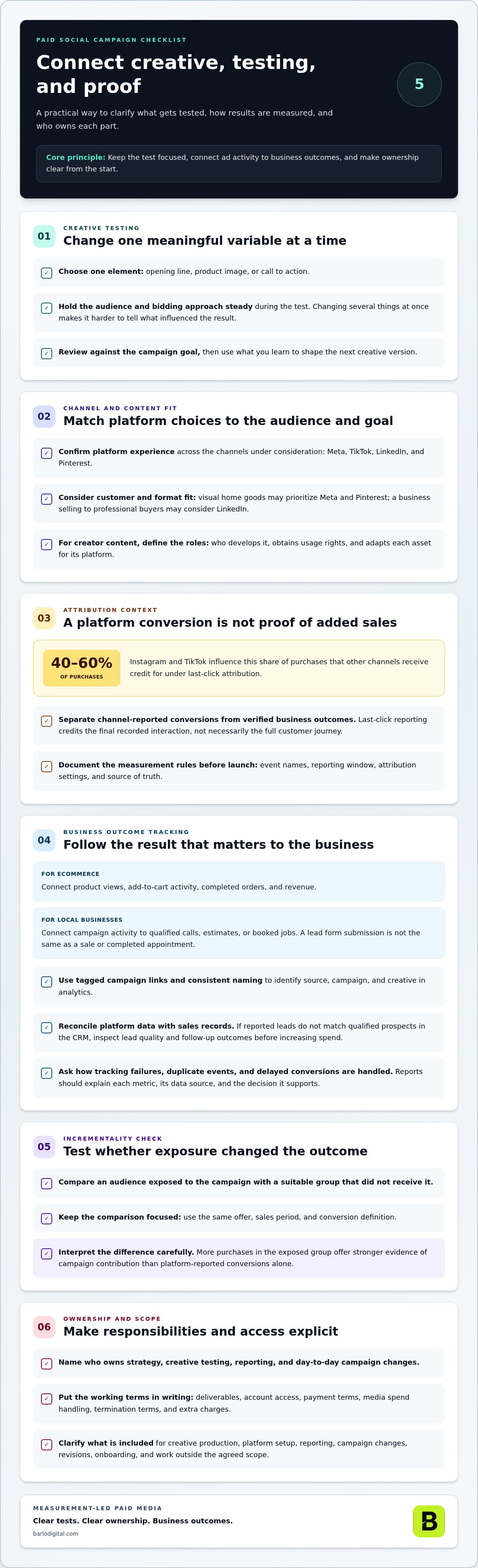
Test one meaningful variable at a time, such as the opening line, product image, or call to action. Keep the audience and bidding approach stable during the test. Changing the audience, creative, and bidding in the same week makes it harder to identify what influenced the result. Review performance against the campaign goal, then use what you learn to shape the next creative version.
Ask which platforms the team manages, such as Meta, TikTok, LinkedIn, and Pinterest. A paid social advertising agency should explain how its platform experience fits your customers, creative formats, and campaign objective. A retailer selling visual home goods may prioritize Meta and Pinterest, while a business selling to professional buyers may consider LinkedIn.
Social commerce and influencer campaigns need clear roles. For example, a beauty brand could use creator content to demonstrate product use, then run paid ads to reach relevant audiences. Clarify who develops the content, obtains usage rights, and adapts each asset for its platform. These details determine whether creator material can be reused beyond its original placement.
Case studies are most useful when they explain the approach, not just claim an outcome. Look for the brand’s objective, channels, creative approach, test structure, and measurement method. A case study about a subscription brand acquiring first-time customers may offer little guidance to a local business seeking booked appointments. Compare the business challenge, not just the industry label.
Paid social agencies commonly charge a flat management fee, a percentage of ad spend, or a hybrid fee. Ask what each model covers and whether creative production, platform setup, reporting, and campaign changes are included. The pricing structure matters less than a written scope that connects each charge to defined work.
Agency, In-House, and Freelancer Comparisons
An in-house team offers direct access to product knowledge and internal decision-makers. A freelancer can provide focused execution, while an agency may combine strategy, creative, and channel management across a broader team. Compare the people doing the work, their responsibilities, and how quickly decisions move. Don’t assume an agency’s size tells you who will manage your campaign.
Before hiring, ask who owns strategy, creative testing, reporting, and day-to-day campaign changes. Your contract should name deliverables, account access, payment terms, media spend handling, termination terms, and extra charges. To avoid surprises, request a written explanation of charges for creative revisions, onboarding, platform fees, and work outside the agreed scope.
Measurement, attribution, and incrementality
A platform can report conversions without proving its ads caused them. Separate what the channel records from what your business can verify in sales, orders, or booked appointments.
Attribution and Incrementality
Attribution assigns credit to interactions along a customer’s path. Incrementality asks a different question: would the purchase have happened without the advertising? Last-click attribution gives credit to the final recorded channel, which can hide earlier influence. Instagram and TikTok influence 40-60% of purchases that other channels receive credit for under last-click attribution.
Consider a customer who sees a product on Instagram, later searches the brand, then buys through a paid search ad. Last-click reporting may assign the sale to search alone. That report describes the final recorded interaction, not the full sequence or the effect of social exposure.
To assess incremental impact, compare outcomes for an audience exposed to the campaign with those for a suitable group that did not receive it. Keep the comparison focused: use the same offer, sales period, and conversion definition. If the exposed group makes more purchases, that difference offers stronger evidence of campaign contribution than platform-reported conversions alone.
Social Advertising Attribution
Build a measurement chain that connects ad exposure to business outcomes. For an ecommerce brand, track product views, add-to-cart activity, completed orders, and revenue. For a local company, connect campaign activity to qualified calls, estimates, or booked jobs. A lead form submission is not the same as a sale or completed appointment.
Before launch, document event names, the reporting window, attribution settings, and the source of truth. For example, compare Meta’s reported purchases with completed orders in the ecommerce platform. Systems may record interactions differently, which can create discrepancies. The goal is not to force every report to match, but to understand what each number represents.
Use tagged campaign links and consistent naming to identify the source, campaign, and creative in analytics. Then regularly reconcile platform data with sales records. If Meta reports leads but the CRM shows few qualified prospects, inspect lead quality and follow-up outcomes before increasing spend.
Ask an agency how it handles tracking failures, duplicate events, and delayed conversions. A useful report explains each metric, its data source, and the decision it supports. It should distinguish platform-reported results from verified business outcomes, then say whether the evidence supports continuing, adjusting, or stopping a campaign.
Measurement breaks when teams treat every platform conversion as additional revenue. Review attribution alongside customer records and channel activity, then test whether exposure changes outcomes. This discipline helps brands make budget decisions based on evidence rather than a dashboard’s credit assignment.
Account ownership and onboarding
Give the agency access, but keep the business in control of its advertising assets. That distinction matters if the working relationship ends or your internal team changes. Before onboarding, identify who owns each account, who can administer it, and how access will be removed when needed.
For Meta, TikTok, and other platforms, map the assets before campaigns launch. These may include the ad account, business portfolio, pixel or dataset, product catalog, payment method, and connected social profiles. A retailer, for example, should know whether its catalog and tracking assets sit under its own business profile or an agency’s.
Use an onboarding checklist to catch gaps before spend begins:
- Confirm the business controls the primary platform account and billing method.
- Grant the agency only the access needed to manage campaigns and reporting.
- Record which pixels, datasets, catalogs, and social profiles connect to each account.
- Document campaign goals, conversion events, naming conventions, and approval contacts.
- Agree on who can approve new creative, budget changes, and landing page edits.
These steps prevent a common handoff problem: the ad account exists, but the business can’t access its history or connected assets. A clear ownership map also helps distinguish agency fees from platform charges. The contract and account setup should specify who pays the platform directly and who approves spend changes.
Onboarding should establish a baseline, not just collect passwords. Share recent campaign structure, available creative, product or service priorities, and known tracking issues. For a TikTok campaign, clarify whether the business has usable video assets, who approves creator content, and where campaign traffic should go. Each answer affects setup and the initial testing plan.
Set a clear approval route. Name the person who signs off on claims, offers, creative, and landing pages, then specify how feedback is delivered. If a campaign depends on a seasonal promotion, document its end date and replacement offer before launch. This prevents ads from running with outdated messaging.
Finally, agree on the exit process before work starts. The business should know how it receives campaign records, creative files, tracking documentation, and administrator access. A paid social advertising agency should explain how it hands back those assets and clarify which account permissions it needs and why. Clear exit terms help your team continue operating without rebuilding its foundation.
Audience development and targeting
Targeting should start with who can buy, not every available platform filter. For a local roofer, that means matching campaign geography to service areas and distinguishing homeowners seeking repairs from people researching replacement projects.
Build audience groups around meaningful differences in need, readiness, and prior contact. A dental practice could separate people who visited a service page from existing patients, while a home improvement company could distinguish estimate requests from general site visits. Each group needs a relevant message and a clear reason for inclusion.
Use customer and campaign data to shape those groups. Review past inquiries, completed purchases, service categories, and locations to identify useful patterns. For example, a landscaping company might find that its strongest inquiries involve seasonal yard projects, then develop messaging around those services rather than broad homeownership interests.
- Define the ideal customer by service, location, and buying need.
- Separate prospects from current customers where the campaign goal differs.
- Exclude areas the business cannot serve and audiences that cannot take the next step.
- Compare audience quality through qualified leads, sales, or booked appointments.
Platform targeting is only one input. Meta can use location, interests, and customer signals, but a long list of filters doesn’t automatically make an audience more valuable. Start with a clear customer profile, then test whether tighter criteria improve lead quality or simply limit delivery.
Retargeting can reach people who have already interacted with a business. A contractor might show a project example to visitors who viewed a remodeling page, while excluding people who already submitted an estimate request. This makes follow-up advertising more relevant and reduces wasted impressions on completed actions.
For prospecting, compare audience approaches against the same business outcome. A local retailer might test a customer-informed audience against broader geographic targeting. Keep the offer and landing page consistent during the comparison, then assess qualified orders rather than platform engagement alone.
Ask how targeting decisions change after launch. A useful agency explains which audience signals informed the setup, what defines a quality outcome, and what evidence would trigger a revision. If a campaign produces many inquiries but few booked estimates, investigate location fit, service intent, and lead qualification before expanding reach.
Audience development is an ongoing process. Update customer exclusions when records change, revisit geography when service coverage shifts, and separate new-customer acquisition from repeat-customer campaigns. These controls help keep paid social focused on reachable prospects and business outcomes.
Paid search, paid social, and programmatic advertising
These channels reach consumers at different moments and use different buying signals. Decide what role each will play before dividing the budget.
Paid Media Channel Mix
Paid search reaches people expressing intent through queries, such as someone searching for emergency plumbing. Paid social can introduce an offer before a consumer actively searches. Programmatic advertising buys digital placements across websites and apps, often using audience and context signals.
The channels can support one another, but their reported conversions may overlap. A consumer might see a social ad, search for the business later, then convert through paid search. Judge each channel by its role and contribution, not just its last recorded click.
Focus matters. Brands often perform better by concentrating paid social budgets on two or three platforms rather than spreading them across six. That doesn’t make a fixed platform mix right for every business. Match channels to customer behavior, creative capacity, and measurable business goals.
For example, a local service company could use paid search to capture urgent demand and paid social to build awareness around seasonal work. Programmatic may have a role when broader reach matters, but adding it without a distinct purpose creates complexity. Define the outcome each channel owns before expanding the mix.
Choosing a Paid Social Agency
Choose an agency that can explain each channel’s role in your plan. Ask who manages strategy, creative, measurement, and account access. Request a sample report that distinguishes platform-reported results from verified sales, qualified leads, or booked appointments. The answer should connect campaign activity to decisions, not just impressions and clicks.
How do you choose the best paid social advertising agency for your business? Compare its proposed channel mix, testing method, reporting, and the seniority of the people doing the work. Choose a team that ties those responsibilities to your specific business outcome.
How much do paid social advertising agencies charge in the United States? Pricing depends on scope, channel count, creative work, and account complexity, with a quote provided after a request. Compare the defined deliverables and any extra charges, not just the fee structure.
Risks include unclear scope, weak account controls, reporting that overcredits a channel, and budget spread across platforms without a defined role. A contract should specify deliverables, approval rights, account access, media spend handling, and termination terms. These controls make responsibilities clear before a campaign launches.
For a local business comparing search and social execution, review local ad management across Google Search, Local Services Ads, and Meta. The key decision is not whether to use every channel. It is whether each channel has a clear job and a measurement method tied to business results.
Barlo Digital: Ecommerce tracking and measurement audit
Barlo Digital’s Ecommerce tracking and measurement audit helps ecommerce businesses identify gaps between ad platform reports and recorded sales. Use it when campaign decisions depend on tracking that may be incomplete, duplicated, or difficult to reconcile. The audit examines how measurement supports decisions across paid channels, helping teams see which reported outcomes they can use with confidence.
When tracking needs correction, Measurement Rescue addresses tracking fixes. For a broader review of campaign performance, an ecommerce ads audit can help identify where campaign setup or measurement needs attention. These services focus on the mechanics behind advertising decisions.
If your ecommerce reports need a closer examination, explore our ecommerce tracking and measurement audit.
Make the next decision with clear evidence
Define the business outcome your advertising must support, then choose the next step based on the gap you need to address. Barlo Digital offers ecommerce ad management across Meta, Google, and TikTok, ecommerce tracking and measurement audits, and local SEO and AI search. A director reviews every audit and runs every account. Nothing gets handed to a junior.
If ecommerce campaign management is the priority, contact Barlo Digital about ecommerce ad management. Start with the business goal and move forward with a clearer basis for your decision.
Frequently Asked Questions
Do you produce the ad creative, and how much of it?
Yes. Barlo Digital offers ad creative and UGC, including direct-response creative and video assets for paid social campaigns. The scope depends on the campaign’s channel, objective, and available materials. Start by identifying the assets needed, such as new concepts, edits, or creator content, then agree on deliverables and approval steps before production begins.
Do you run paid social for B2B, or is this mostly for consumer brands?
Paid social can support both B2B and consumer marketing. Business campaigns can focus on decision-makers and relevant professional audiences, while consumer campaigns may promote products or services directly. Barlo Digital’s paid advertising management covers ecommerce and local campaigns across its relevant channels. For B2B companies, Barlo Digital also provides appointment setting for sectors such as MSPs, manufacturing, and staffing.
How do you decide how much budget goes to prospecting versus retargeting?
Set the allocation using audience size, available first-party signals, and the campaign’s primary objective. A new store with limited site traffic may need more investment in reaching potential customers. A store with substantial product interest may have more opportunity to re-engage visitors. Review audience overlap and purchase patterns, then adjust based on the business outcomes each group produces.
What does your testing process look like, and how often do you test?
Testing starts with a written hypothesis, such as whether a product demonstration explains its value better than a static image. Define the success measure and the decision each result will inform before launch. Review performance when there’s enough relevant activity for a useful comparison. Testing frequency depends on campaign volume, new creative availability, and signs that existing assets are losing effectiveness.
What exactly do you offer as a paid media agency?
Barlo Digital manages paid advertising across Google Search, Meta, TikTok, Local Services Ads, and Amazon PPC. Ecommerce campaigns cover Meta, Google, and TikTok, while local ad management includes Google Search, Local Services Ads, and Meta. Related services include ad creative and UGC, ecommerce ads audits, competitor ad teardowns, and tracking and measurement work. The right service depends on your business and campaign objective.
What services does a paid social advertising agency provide?
A provider may handle campaign strategy, platform setup, audience planning, creative production, ad management, and performance reporting. The scope varies by provider and agreement. Before work begins, assign each task to an owner. For example, establish who supplies product details, approves claims, creates landing pages, and acts on lead feedback. This prevents important campaign work from falling between teams.
How do paid social agencies measure campaign performance and ROI?
They compare campaign costs with business outcomes, using metrics suited to the sales model. An ecommerce store can assess completed orders and revenue alongside advertising costs. A service business can track qualified inquiries through to booked work. For a fuller financial view, account for returns, cancellations, and repeat purchases when records are available. Agree on data sources and reporting definitions before interpreting ROI.
What results can businesses expect from a paid social campaign partner?
A paid social advertising agency should provide a defined scope of work, documented campaign decisions, and reporting against agreed business measures. Revenue, lead quality, or customer acquisition also depends on factors such as the offer, sales process, audience, and landing page. Set a baseline before launch and review whether campaign activity supports the intended business outcome. Clear deliverables and transparent measurement matter more than promises of specific sales results.

Article by
Carlos Benavides
Carlos Benavides founded Barlo Digital and is its Director of Paid Media and Performance. He has fifteen years in direct-response marketing, more than $50M in lifetime ad spend, and a B.S. in Computer Science, which is why tracking at Barlo Digital is built by hand. Barlo Digital is a director-led paid media and search agency serving US ecommerce brands, home-service companies and practices.


