

What if your PPC agency reports more conversions than your analytics platform can verify? That gap can make a campaign look profitable or hide wasted spend behind a polished dashboard. Agency promises often sound alike, but the work behind them differs. Scope, tracking, and clear ownership of problems determine whether paid campaigns connect to real business results.
It’s reasonable to compare fees and channel expertise, but those details only tell part of the story. A percentage-of-spend model, fixed retainer, or project-based engagement can each suit a different need. None automatically includes creative, landing pages, or lead tracking.
This guide explains what PPC management involves and how to compare agency models by scope, measurement, and operating process. You’ll learn what to look for when platforms disagree, which responsibilities to define, and how to match support to your acquisition goals. Barlo Digital manages campaigns across Google Search, Meta, TikTok, Local Services Ads, and Amazon PPC, with related capabilities in measurement, creative, websites, and lead tracking. The goal is to help you make a clear decision based on how the work gets done.
Key Takeaways
- Map campaign responsibilities before comparing proposals. Ad management can mean different things depending on channels, creative, tracking, and landing-page scope.
- Assess a PPC agency by how it connects campaign activity to qualified leads or revenue, not just clicks and platform-reported conversions.
- Choose between an agency, freelancer, in-house team, or channel specialist based on the expertise, capacity, control, and coordination your business needs.
- Before launch, define the goal, confirm account access, validate tracking, and assign ownership for creative approvals and lead follow-up.
- Connect paid media with measurement audits, tracking fixes, and lead tracking so campaign decisions rely on a clearer view of performance.
What a PPC Agency Does Beyond Launching Ads
A PPC agency manages paid campaigns and the work required to plan, run, and improve them. Pay-per-click describes an advertising model where advertisers pay for clicks or other defined interactions; What is Pay-Per-Click (PPC)? provides a broader overview. Managing PPC is more than buying traffic, though. Campaign decisions need to support a business goal, and results should be assessed against what the business can sell profitably.
The scope depends on the engagement. One agreement may cover campaign execution on a single channel. Another may include multiple platforms and related work such as ad creative, landing pages, or measurement. These are separate responsibilities, not automatic parts of every management fee. If the scope is vague, ads can run while the assets or tracking needed to assess them remain untouched.
Which work typically sits inside PPC management?
Core management typically means translating a campaign objective into an account structure and settings, then monitoring results and making adjustments. Before work begins, document the channels and tasks included, who has platform access, and who owns related work outside the ad account.
- Planning: Set campaign objectives, audience or search intent, budget allocation, and the role each campaign serves.
- Account structure: Organize campaigns and ad groups so targeting, budgets, and results can be interpreted clearly.
- Bidding and targeting: Configure how campaigns compete for placements and which audiences or searches they reach.
- Ongoing optimization: Review performance, test changes, and adjust campaign settings against the agreed goal.
- Scope boundaries: Specify whether audits, new creative, landing-page changes, and tracking fixes are included, billed separately, or handled by the client.
Platform permissions matter, too. Access should let the agency do its assigned work while keeping account ownership, billing, analytics, and conversion setup clear. A responsibility map helps prevent a common failure: each party assumes someone else is maintaining a key part of the system.
Why a PPC agency needs business context
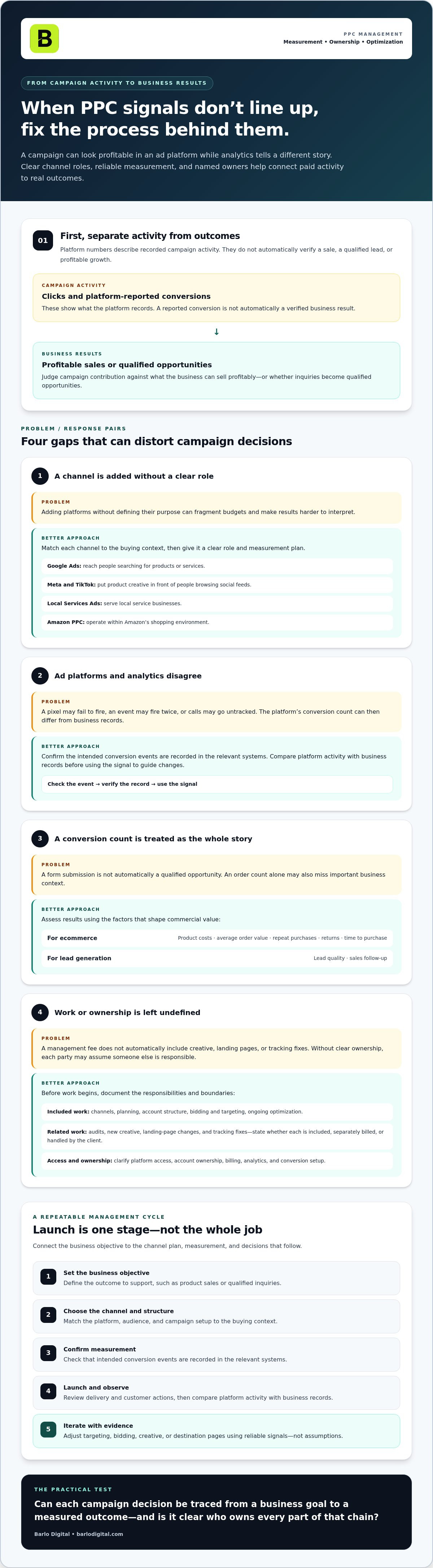
Campaign settings can be technically correct and commercially wrong. A store with thin margins cannot judge performance by order count alone. Product costs, average order value, repeat purchases, returns, and the time it takes a customer to buy all affect how results should be assessed. For lead-generation businesses, lead quality and sales follow-up matter. A form submission is not automatically a qualified opportunity.
Channel strategy should fit the buying process. Search advertising can capture people actively looking for a product, while social platforms can introduce products to audiences who weren’t searching. Amazon PPC operates within a marketplace, where product listings and marketplace sales shape the context. No channel is right for every business, and adding platforms without a clear role can complicate management and measurement.
PPC activity is the paid traffic a campaign generates; business results are the profitable sales or qualified opportunities that traffic helps produce. The distinction matters. Clicks and platform-reported conversions describe activity. On their own, they don’t prove profitable growth.
How PPC Agency Delivery Connects Channels, Tracking, and Optimization
Campaign management works as a cycle, not a launch-day task. A PPC agency should connect the business objective to the channel plan, campaign setup, measurement, and ongoing decisions. If the objective is profitable ecommerce growth, for example, the setup needs to measure more than traffic volume. It should help assess whether paid visits lead to valuable orders.
- Set the business objective. Define the outcome the campaign should support, such as product sales or qualified inquiries.
- Choose the channel and structure. Match the platform, audience, and campaign setup to the buying context.
- Confirm measurement. Check that the intended conversion events are recorded in the relevant systems.
- Launch and observe. Review delivery and customer actions, then compare platform activity with business records.
- Iterate with evidence. Adjust targeting, bidding, creative, or destination pages based on reliable signals rather than assumptions.
Channels aren’t interchangeable. Google Ads can reach people searching for products or services. Meta and TikTok can put product creative in front of audiences as they browse social feeds. Local Services Ads serve local service businesses, while Amazon PPC operates within Amazon’s shopping environment. A business may use one or several channels, but each needs a clear role and measurement plan. Adding a platform without defining those can fragment budgets and make results harder to interpret.
How measurement changes campaign decisions
A platform-reported conversion is an event recorded under that platform’s settings. It isn’t automatically a verified sale, qualified lead, or profitable outcome. If a pixel fails to fire, genuine activity can disappear from campaign feedback. If an event fires twice, the system may count one action twice. If calls go untracked, campaigns that generate phone inquiries can appear weaker than they are.
Those errors affect more than reporting. Bidding and campaign optimization may rely on conversion signals, so inaccurate inputs can push decisions toward the wrong audience or action. Compare platform records with order or lead data, and investigate material gaps before treating a trend as evidence.
Reliable conversion data doesn’t guarantee better results, but it gives optimization decisions a sounder basis. Measurement audits and tracking fixes can uncover broken pixels, duplicate events, attribution gaps, or missing call data. Detailed reporting metrics belong in a separate reporting guide. Here, the priority is whether the underlying signals can be trusted.
When creative and landing pages belong in the conversation
An ad makes a promise, and the destination page needs to carry that promise forward. If a social ad highlights a product benefit but leads to a broad category page, the message and buying experience can lose continuity. Even well-targeted traffic may struggle to convert when the page doesn’t match the ad’s offer or intent.
Creative production and website changes aren’t automatically part of media management. Define who creates and approves ads, who updates landing pages, and who tests changes. Barlo Digital provides ad creative, UGC, website design, and redesign to connect these parts of campaign delivery. For businesses reviewing how those pieces fit together, Barlo Digital’s paid advertising and measurement capabilities offer a useful starting point.
PPC Agency, Freelancer, Specialist, or In-House Team: Compare the Models
There’s no universally best way to run paid campaigns. The right setup depends on the number of channels, the work required, and the expertise already on your team. Compare the operating trade-offs, not just the job titles.
Agency
Expertise: Can combine campaign, channel, and related skills across a team.
Channel coverage: May cover multiple platforms, depending on its scope.
Capacity: Can suit ongoing or cross-channel workloads.
Control: The business sets goals and access, while the agency executes the agreed work.
Coordination: Responsibilities across media, creative, and measurement need clear ownership.
Independent freelancer
Expertise: Often centered on the person’s specific experience.
Channel coverage: May focus on a few platforms or a broader set.
Capacity: Can fit a defined workload that matches their availability.
Control: The business works directly with the practitioner.
Coordination: Additional skills or coverage may need separate arrangements.
Channel specialist
Expertise: Concentrated in a particular platform or channel.
Channel coverage: Deep focus in that area, with other channels managed elsewhere or internally.
Capacity: Fits a business whose main need is specific and bounded.
Control: Internal teams retain direction and coordinate other work.
Coordination: Someone must connect specialist activity to the wider acquisition plan.
In-house team
Expertise: Builds knowledge around the company’s products, customers, and processes.
Channel coverage: Depends on the team’s combined skills.
Capacity: Must cover campaign work alongside other responsibilities.
Control: Offers direct day-to-day oversight.
Coordination: The business owns internal handoffs, continuity, and training.
When an agency model can make operational sense
An agency can make sense when campaign work spans several channels and the business lacks the internal time or specialist coverage to coordinate them. Broader access doesn’t automatically mean broader accountability, however. Assign an owner for each part of the work, including campaigns, creative, tracking, and website changes. Otherwise, important tasks can fall between teams.
Barlo Digital manages paid advertising across Google Search, Meta, TikTok, Local Services Ads, and Amazon PPC. That is available channel coverage, not a recommendation that every business use every platform. The useful question is whether the proposed mix fits the company’s products, customers, and capacity to manage the work.
When a narrower or internal model may be enough
A freelancer or channel specialist may fit a business with one main campaign need, a contained workload, or a capable internal lead. In-house management can also make sense when the company already has paid-media expertise and can dedicate time to execution, review, and coordination. Direct control is valuable, but it still requires operating capacity.
Choose the model that matches the work you can define and support. A PPC agency can provide wider coordination, while a focused specialist or internal owner may better fit narrower needs. In every case, establish who owns decisions, access, and handoffs before work begins.
What to Define Before a PPC Agency Engagement Begins
Many campaign problems start before the first ad runs, with an undefined goal, untested tracking, or work both sides assume the other will handle. Set the operating terms before launch. A clear agreement gives the team a usable baseline and makes responsibilities visible when something breaks.
- Define the business goal. State what the campaign should support, such as ecommerce revenue, sales of a specific product category, or qualified leads. Clarify how the business will judge whether those outcomes are valuable.
- Map the scope. Name the channels, campaign tasks, and related services included. Separate media management from creative production, landing-page changes, and tracking work. State exclusions plainly.
- Confirm access and ownership. Assign access to ad accounts and analytics. Identify who owns each account, billing, data, and approvals.
- Validate measurement. Review the conversion actions and check whether available tracking reflects real customer activity.
- Agree on launch conditions. Set who approves ads and destination pages, what needs to be ready, and who can authorize changes once campaigns are live.
Set scope, access, and responsibilities
A PPC agency can’t be accountable for work outside its agreed scope. List the channels and campaign tasks, then specify whether creative, UGC, website updates, or landing-page work are included or handled separately. Fees depend on the scope, so define the work before comparing proposals. Also name the internal owner for approvals, product or sales feedback, and lead response. The agency may generate demand, but the business needs to define what happens when a prospect or order arrives.
Account and analytics access should support the agreed work without blurring ownership. Record which accounts the agency can manage, which systems remain under the business’s control, and who can make changes. Clear permissions help prevent a handoff where campaign history or measurement access is lost when responsibilities shift.
Establish a credible measurement baseline
Before interpreting new campaign activity, review existing conversion actions, tracking integrity, attribution limits, and campaign history. Check whether key events fire correctly, whether duplicate events inflate counts, and whether relevant customer actions are missing. For ecommerce, compare ad-platform signals with order data where possible. Document known gaps rather than treating incomplete tracking as a clean starting point.
Barlo Digital’s tracking and measurement audits assess analytics, pixels, and attribution issues, while Measurement Rescue addresses tracking fixes. This work can clarify which signals are usable before they guide campaign decisions. A baseline won’t remove every attribution limitation, but it makes assumptions and known gaps easier to identify.
Define these conditions before launch, not after conflicting numbers create a dispute. Explore Barlo Digital's paid advertising services to see how campaign management connects with measurement support.
How Barlo Digital Connects PPC Management to Growth Operations
Paid media can create demand, but it can’t fix broken measurement, unclear sales follow-up, or a website that fails to support the ad’s promise. Barlo Digital connects campaign management with the operational work around it, so channel activity can be assessed in context. This is an operating approach, not a promise of a particular outcome.
A measurement-first starting point
Campaign changes rely on signals. If an ecommerce pixel misses purchases, analytics records duplicate events, or lead sources aren’t tracked consistently, those signals can misdirect decisions. Reviewing measurement before making major changes helps separate campaign performance issues from data problems.
Barlo Digital’s ecommerce tracking and measurement audits examine analytics, pixels, and attribution. Measurement Rescue addresses tracking fixes, while call and lead tracking helps connect paid activity with inquiries that may not appear as online form submissions. The work can be tailored to the business’s existing setup and campaign needs.
For broader context on how advertising work and evaluation fit together, see Paid Advertising Services: What They Include and How to Evaluate Them. A useful assessment starts with the actual operating gap, not an assumption that every business needs the same package of services.
Choose the scope that matches the business
Ecommerce campaigns and lead-generation campaigns have different operating demands. Ecommerce work may center on Google, Meta, TikTok, or Amazon PPC, with the goal of connecting advertising to product sales. Local lead generation may depend on Google Search, Local Services Ads, or Meta, alongside call tracking and a process for responding to inquiries. Choose channels to fit the buyer’s path, not simply because they appear on a broad platform list.
B2B campaigns bring another set of considerations. A lead may need qualification and follow-up before it becomes a sales opportunity. For relevant B2B or in-home service contexts, appointment setting can support the handoff from inquiry to scheduled conversation or estimate. This is a related operational service, distinct from managing ad campaigns.
Creative and website work can also support campaign execution when the message or destination needs attention. Barlo Digital provides ad creative, UGC, website design, and redesign. Define their role against a specific campaign need, such as aligning an ad’s product claim with the page a shopper reaches, rather than assuming they’re part of every media engagement.
PPC Management Services: What They Include and How to Assess Them can help frame responsibilities and evaluation criteria. Then examine your current measurement setup, campaign channels, and follow-up gaps. Assess a ppc agency against those real operating needs, not a generic promise of growth.
Discuss your PPC operation with Barlo Digital and identify which parts of campaign management and measurement need attention.
Make the Next Decision Measurable
The next step isn’t necessarily adding another campaign. First identify the operational constraint limiting your acquisition work. Is the goal unclear? Are conversion signals unreliable? Does no one own the handoff from ad response to sales follow-up? Name the constraint, then decide whether it calls for a change in scope, process, or support.
A useful conversation with a PPC agency should start with that diagnosis, not a prewritten promise. Barlo Digital emphasizes founder-led, director-level delivery, keeping senior oversight close to campaign work. Bring your current priorities and unresolved questions so the discussion can focus on what needs attention and what a practical next step should address.
Discuss your PPC operation with Barlo Digital and take a clearer view of what should happen next. You don’t need every answer before you begin. You do need a specific problem to solve and a way to judge whether the work is addressing it.
Frequently Asked Questions
What does a PPC agency do?
A PPC agency plans and manages paid advertising campaigns, then uses campaign and business data to guide changes. Depending on the agreement, the work may include account setup, audience or keyword targeting, bidding, creative, or conversion tracking. For example, an online store might need help organizing product campaigns, while a service business may need calls tracked alongside form submissions. The written scope determines who handles each task.
Is a PPC agency worth hiring for a small business?
It can be, if the business has a clear acquisition goal and enough capacity to act on the results. A small company with one campaign and an experienced employee may be better served internally. Outside management may make more sense if campaign work is taking time away from core operations or specialist knowledge is missing. Compare the cost of support with the workload it removes and the value of the opportunities it helps manage.
How much does a PPC agency charge?
There’s no single standard fee. Agencies may charge a fixed management fee, a base fee combined with a share of ad spend, hourly rates, or project fees for audits and setup. Compare the work covered, not just the fee format. One proposal may include campaign management but exclude new creative and tracking repairs. Get the scope and billing basis in writing so the total commitment is clear.
Which advertising platforms can a PPC agency manage?
Platform coverage varies by agency and business need. Barlo Digital manages paid campaigns across Google Search, Meta, TikTok, Local Services Ads, and Amazon PPC. These channels serve different buying contexts: Amazon is tied to marketplace shopping, while Google Search can reach people actively looking for a product or service. The relevant mix depends on where customers make decisions and whether the business can support the campaigns and follow-up.
How long does it take for a PPC agency to improve campaign performance?
There’s no reliable fixed timeline. The pace depends on the account’s condition, conversion volume, buying cycle, and how quickly the business can approve and implement changes. A campaign with broken tracking may need measurement fixes before performance can be judged. A business with a longer sales cycle may also need more time to connect ad activity to completed sales. Set an initial review period around the work and data available, not a promised result date.
Can a PPC agency work with a company's existing ad accounts?
Yes. An agency can often manage campaigns inside existing accounts when the business provides the access needed for the agreed work. Keeping account ownership with the company can preserve campaign history and continuity if responsibilities change. Before access is granted, clarify permissions, billing ownership, and who can approve changes. Also confirm whether analytics and conversion tools are accessible, since ad account access alone may not provide enough context to evaluate campaign activity.

Article by
Carlos Benavides
Carlos Benavides founded Barlo Digital and is its Director of Paid Media and Performance. He has fifteen years in direct-response marketing, more than $50M in lifetime ad spend, and a B.S. in Computer Science, which is why tracking at Barlo Digital is built by hand. Barlo Digital is a director-led paid media and search agency serving US ecommerce brands, home-service companies and practices.


