

An active ad account can still waste budget. Clicks, impressions, and platform-reported conversions may rise while qualified leads and revenue remain unclear. That’s the gap effective ppc management services are meant to close, not disguise with more activity or a fuller dashboard.
If you’re struggling to tell ongoing optimization from basic account maintenance, it’s reasonable to question what an agency is actually doing. Campaign changes matter when they’re tied to reliable tracking and business outcomes. Without that connection, reports can look busy while decisions remain guesswork.
This article explains what PPC management should cover, from campaign strategy and channel selection to creative, measurement, and ongoing optimization. You’ll see how those pieces work together, what to look for when comparing agency scopes, and how to assess whether proposed work fits your goals, budget, and capacity to act on incoming leads.
Key Takeaways
- Effective PPC management services involve ongoing planning, execution, measurement, and improvement, not just launching ads or adjusting bids.
- Use a clear workflow to connect business goals, trustworthy conversion tracking, campaign tests, and optimization decisions.
- Choose channels based on the goal: Google Search, Meta, TikTok, Local Services Ads, and Amazon serve different campaign needs.
- Assess an agency’s work by its data access, reasoning behind changes, and connection to qualified leads or revenue.
- Align campaign management with tracking, creative, and website needs, then set the starting scope according to account condition and measurement reliability.
PPC Management Services: What the Work Actually Covers
PPC management is the ongoing planning, execution, measurement, and improvement of paid campaigns. Pay-per-click (PPC) advertising charges advertisers when someone clicks an ad, but effective management looks beyond the click to what happens next. For an ecommerce business, that means assessing whether ads attract shoppers who browse, add products to their carts, and complete purchases.
Launching ads is a setup task. Changing bids is an account action. Neither is a management strategy on its own. Strong ppc management services connect campaign decisions to business goals, then use reliable evidence to determine what to adjust, test, or stop. Without that connection, an account can accumulate activity without showing whether the spend supports growth.
What PPC management includes beyond launching campaigns
Management starts with planning: defining the objective, audience, budget approach, channel, and measurement plan. It continues through account implementation, creative testing, performance review, and optimization. Routine maintenance keeps campaigns running; strategic management determines whether they’re aimed at the right outcome and what evidence should trigger a change.
Ad performance depends on more than platform settings. The offer, images or video, copy, product page, and checkout experience all influence the value of a click. If a campaign attracts relevant shoppers but the landing page obscures product details or makes the next step difficult, changing bids won’t fix the underlying problem. The right scope may therefore include creative, tracking, or website improvements alongside media management.
- Planning: Connect the campaign objective to the audience, channel, and intended conversion.
- Implementation: Build the account structure, targeting, ads, and measurement setup around that plan.
- Testing: Compare creative, messaging, or campaign approaches to identify meaningful differences.
- Review and optimization: Interpret results, make reasoned adjustments, and assess whether they support the business goal.
Why measurement belongs inside the service
Ad platforms optimize toward the events they receive. If a purchase event is missing, the system may not register completed orders. If the same event fires more than once, results can look inflated. Either problem can steer decisions toward misleading signals instead of actual customer actions.
Measurement integrity means the data accurately records the actions that matter to the business.
That requires checking how analytics, platform pixels, and event tracking capture important steps, such as product views, add-to-cart actions, and purchases. For businesses that generate inquiries by phone, call and lead tracking can help connect campaign activity to those outcomes. The goal isn’t to collect more numbers. It’s to make sure each number reflects a real, relevant action.
Set the business objective before interpreting platform performance. A low-cost click isn’t automatically valuable, and a reported conversion isn’t proof of a sale. Review the path from ad interaction to the business result, confirm that tracking behaves as intended, and use that evidence to guide the next test. Media, creative, measurement, and the conversion experience are connected parts of the work, not separate boxes to tick.
How PPC Management Turns Campaign Data Into Decisions
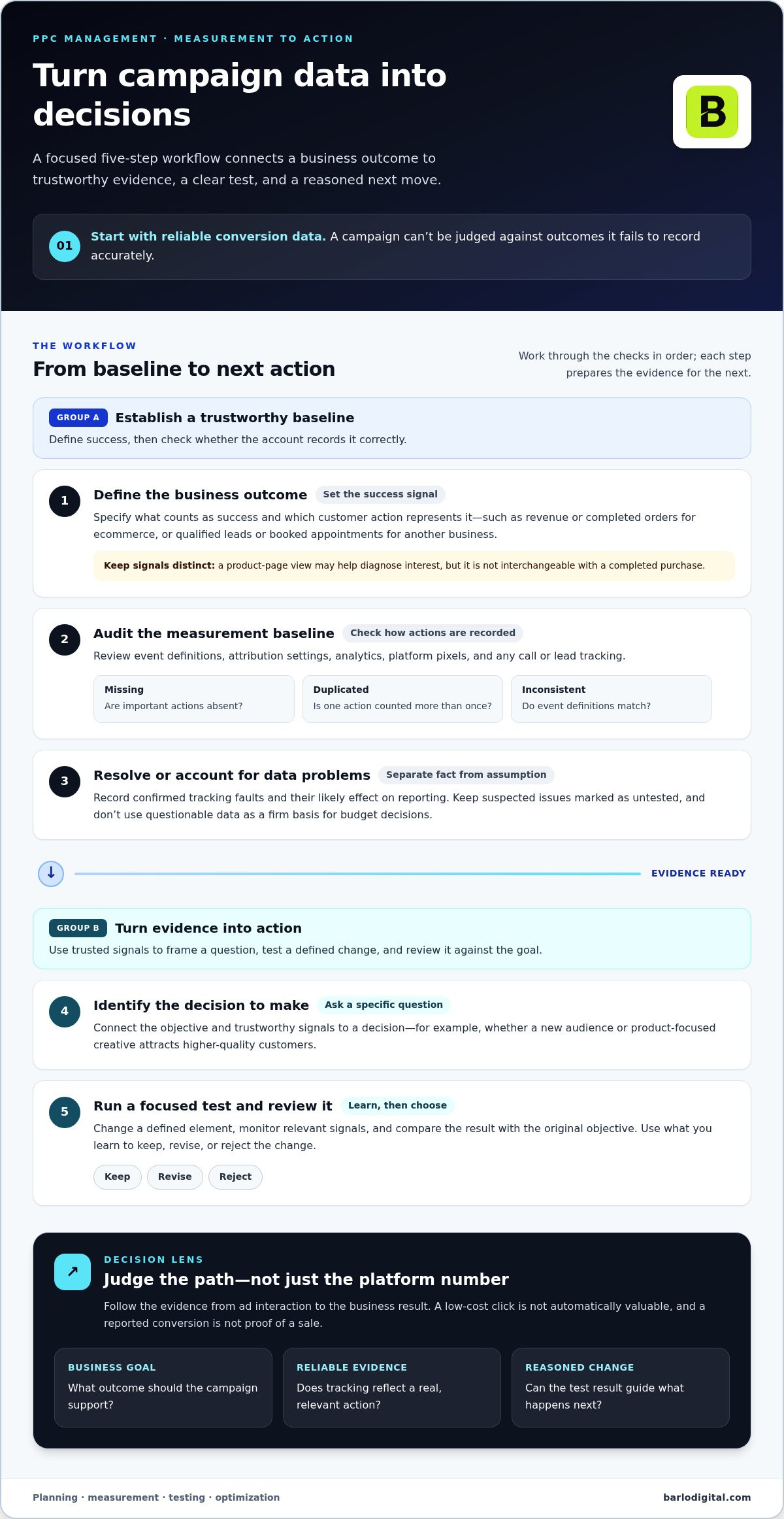
Campaign data becomes useful when it changes a decision for a defined business reason. A management process should start with the outcome you need, identify the evidence you trust, and then run a test whose result can guide the next action. More edits and more reports don’t prove progress.
Reliable conversion data is the starting point for optimization, because a campaign can’t be judged against outcomes it fails to record accurately.
Start with the outcome and the tracking baseline
Set the target before reviewing channel metrics. For an ecommerce business, that may be revenue or completed orders; for another business, it could be qualified leads or booked appointments. Then inspect how the account records those outcomes. Separate confirmed tracking faults from untested assumptions, and note which decisions each issue could distort.
- Define the business outcome. Specify what counts as success and which customer action represents it. A product-page view may help diagnose interest, but it isn’t interchangeable with a completed purchase.
- Audit the measurement baseline. Review event definitions, attribution settings, analytics, pixels, and any call or lead tracking. Check whether important actions are missing, duplicated, or recorded under inconsistent definitions.
- Resolve or account for data problems. Record confirmed faults and their likely effect on reporting. Don’t treat a suspected tracking issue as proven, but don’t use questionable data as a firm basis for budget decisions either.
- Identify the decision to make. Turn the objective and trustworthy signals into a specific question, such as whether a new audience or product-focused creative attracts higher-quality customers.
- Run a focused test and review it. Change a defined element, monitor relevant signals, and compare the result with the original objective. Use what you learn to keep, revise, or reject the change.
Test, learn, and adjust without mistaking noise for progress
Testing targeting, bids, creative, or landing pages can show what influences response, but changing several elements at once makes the result harder to interpret. Keep the question narrow. Platform recommendations can inform a test, but they don’t replace judgment about the offer, margin, inventory, or quality of customers acquired.
Separate leading indicators from commercial outcomes. Click-through rate or add-to-cart activity may signal a change in shopper response; revenue, qualified leads, and sales quality show whether that response supports the business. A temporary movement in an early signal isn’t proof that the change worked. Assess results in context, including the customer’s path to purchase and the time needed to evaluate the outcome.
Essential PPC Best Practices can be a useful reference for goal setting, budget management, and optimization. Apply those practices through a decision trail: what changed, why it changed, what evidence followed, and what action comes next. That’s the standard to expect from ppc management services. For ecommerce campaigns, ecommerce ad management can connect campaign decisions with measurement and creative work.
Which PPC Channels and Service Scope Fit Your Goal?
More channels don’t automatically mean better coverage. Each reaches people in a different context and produces signals that need to be judged against the buying journey. The right channel mix depends on the customer path and the business goal. A campaign built to capture existing demand needs a different plan from one designed to introduce a product to new shoppers.
Match the channel to the buying journey
Start with how customers discover and buy. Search can capture active demand; paid social can introduce products and test creative. Amazon PPC is for businesses selling through Amazon, where campaign evaluation should account for the marketplace purchase path. Local Services Ads serve a different purpose and generally fit local service businesses, not a standard ecommerce store.
| Channel | Potential fit | Signals to evaluate |
|---|---|---|
| Google Search | Capture shoppers actively searching for products or solutions. | Relevant search traffic, purchase actions, and revenue attributed with care. |
| Meta | Build product discovery and test visual or offer-led creative. | Engagement and site actions, then qualified purchases and revenue. |
| TikTok | Test short-form creative for discovery and product interest. | Creative response, meaningful site visits, and resulting purchases. |
| Local Services Ads | Reach customers seeking eligible local services, rather than serve as a default ecommerce channel. | Relevant inquiries and lead quality, where the business model fits. |
| Amazon PPC | Promote products sold through Amazon’s marketplace. | Marketplace ad activity alongside product sales and commercial value. |
This comparison is a starting point, not a reason to advertise everywhere. Choose channels based on audience, buying journey, conversion type, and the evidence available to judge results. If a channel’s role can’t be connected to a meaningful business outcome, adding it may only spread budget and attention thinner.
Decide whether the engagement needs more than media buying
Before increasing spend, establish that tracking records the actions used to judge performance. A measurement audit or repair may be needed if analytics, pixels, or purchase events are missing or unreliable. Scaling on faulty signals can amplify poor decisions. Fix the evidence first, then assess whether the campaign merits expansion.
Media execution also depends on the assets and destination behind an ad. Creative and user-generated content (UGC) can support tests of different messages or product presentations. Website design can address gaps between the ad click and purchase. These are distinct work areas, but each can affect whether campaign traffic turns into a valuable customer action.
Define the scope around the actual constraint: channel strategy, measurement, creative, or the website experience. The right ppc management services engagement shouldn’t expand into every channel by default. Keep account-level ecommerce tactics, such as detailed campaign structures or product-feed decisions, in a dedicated ecommerce guide. Here, focus on whether the scope fits the business model and produces evidence you can use.
How to Judge PPC Management Without Chasing Vanity Metrics
A dashboard can show movement without showing business impact. Clicks and impressions describe activity. Platform-attributed conversions show what the platform claims credit for. Neither proves on its own that advertising produced profitable sales or valuable customers.
Use a simple test when assessing ppc management services: can you access the underlying data, understand why decisions were made, and connect reported results to commercial outcomes? If any answer is unclear, performance claims need more context before they can guide budget decisions.
Check whether the evidence supports the decisions
Start by clarifying what counts as a conversion. Does the event represent an actual purchase, a qualified lead, or a meaningful appointment, or is it an earlier action such as a form start? For phone inquiries, check whether call and lead tracking connect the campaign source to what happened afterward. A low reported cost per lead means little if the inquiries don’t fit the business.
Then check whether the numbers can be interpreted. Reports need a defined time period, attribution context, and a clear outcome definition. A platform’s credit for a conversion may differ from another system’s view because the systems may use different attribution rules. Treat that difference as a reason to examine the method, not to assume one number is automatically correct.
Don’t accept a single ROAS or lead-cost target as universal. What counts as commercially sound depends on factors such as product economics, sales quality, and the path from first interaction to purchase. Look for a clear explanation of how a target relates to the company’s own goals and constraints, rather than a benchmark presented without context.
Look for clear ownership and useful communication
Find out who owns campaign decisions and whether that person can explain the reasoning behind them. The accountable lead should connect a change to evidence, identify what it is meant to test, and explain how the result will shape the next decision. A list of edits isn’t the same as a rationale.
Useful communication makes the decision trail visible: what changed, what signal informed the change, and what the team plans to learn next. You don’t need an elaborate report format to assess that. You need enough access to the advertising account and measurement data to understand the conclusions, plus a clear explanation when platform data and business records don’t align.
- Data access: You can see the account and the information used to support performance claims.
- Decision logic: Campaign changes have a stated reason and a result the team intends to evaluate.
- Commercial relevance: Reporting distinguishes activity from purchases, qualified leads, or other defined business outcomes.
If a report says only “performance improved” without explaining the period, attribution method, or outcome, it doesn’t give you enough to judge the work. Look for accountability instead: clear definitions, decisions tied to evidence, and results interpreted in your business context. As Barlo Digital produces ad creative and user-generated content (UGC) alongside campaign management, you can Explore Barlo Digital’s measurement and paid advertising work to see how those parts connect.
What Barlo Digital’s PPC Management Connects: And What Happens Next
Paid campaigns don’t operate in isolation. Their value depends on whether tracking captures meaningful actions, creative earns attention from the right audience, and the website supports the next step. Barlo Digital manages campaigns across Google, Meta, TikTok, and Amazon, and provides related measurement, creative, and website services to address those parts of the campaign.
The point isn’t to bundle every capability into every engagement. It’s to identify what currently limits sound campaign decisions. If purchase tracking is unreliable, increasing spend won’t solve the measurement gap. If tracking is dependable but shoppers aren’t responding to the ads, creative may deserve attention. If clicks arrive but the purchase path creates friction, the website may be part of the problem.
Connect campaign execution to measurement and conversion
Barlo Digital provides ecommerce tracking and measurement audits, Measurement Rescue tracking fixes, and call or lead tracking alongside paid advertising management. These services address different points of failure: analytics or pixel issues can distort campaign signals, while call and lead tracking can connect advertising activity to inquiries and their outcomes.
Creative and conversion experience matter too. Barlo produces ad creative and user-generated content (UGC) to support campaign testing, and provides website design and redesign to address issues on the destination side. The right scope depends on what the evidence shows. A campaign that needs focused media management shouldn’t automatically expand into creative production or website work, and a clear tracking problem shouldn’t be treated as a bidding issue.
Set a practical starting point for the engagement
Before defining scope, make the business need explicit. Identify the outcome you want advertising to support, the channels currently in use, and the most consequential uncertainty. For example, you may need to know whether campaign reporting reflects real purchases, whether current creative reaches the right shoppers, or whether the site converts traffic into orders.
An account and measurement review gives those questions structure. It can distinguish an account execution issue from a tracking fault or a conversion-path concern, helping shape work around the actual constraint instead of a generic list of activities. The starting point should reflect your goals, account condition, and confidence in the data used to judge performance.
Barlo Digital describes its delivery as founder-led and director-level. For a company assessing ppc management services, that means looking for clear ownership and decisions grounded in the account and its evidence, not just platform activity.
- Define the objective: State the commercial result the campaigns should support.
- Surface the uncertainty: Identify the tracking, creative, channel, or website question that blocks a confident decision.
- Set the scope: Match the work to the account’s condition and the evidence required to evaluate progress.
Bring your campaign goals and measurement questions into the conversation. Discuss PPC management with Barlo Digital and identify a practical starting scope for your paid advertising.
Make the Next Campaign Decision Deliberate
The next step isn’t automatically more spend, another channel, or a longer list of optimizations. It’s choosing the decision that would most improve your understanding of campaign performance, then making sure the evidence can support it. That focus keeps ppc management services accountable to business priorities rather than activity for its own sake.
Barlo Digital connects paid campaign management with tracking audits, Measurement Rescue, and call and lead tracking when measurement needs attention. Campaign execution can also draw on creative, UGC, or website design where those areas are relevant. Work is founder-led and director-level, with campaigns managed across Google, Meta, TikTok, Local Services Ads, and Amazon. The right starting scope depends on what your account and goals require, not a preset commitment to every channel or capability.
Bring a clear outcome and the biggest unanswered question about your advertising. That gives the work a practical starting point and makes the next decision easier to evaluate. Explore PPC management with Barlo Digital and move forward with a clearer basis for action.
Frequently Asked Questions
What do PPC management services include?
PPC management services commonly cover campaign planning, account setup or oversight, ad testing, performance review, and ongoing adjustments. The scope can also include creative development, tracking work, or website improvements when they’re relevant to the campaign. For example, a store launching a new product may need campaign execution and fresh ad creative, while an established account with inconsistent purchase records may need measurement work before its results are useful.
How much do PPC management services cost?
The cost depends on the work involved, such as the number of channels, account complexity, creative needs, and whether tracking or website work is included. There isn’t one fee that fits every business. Compare proposals by checking what work is included, what is billed separately, who is responsible for each task, and how the scope relates to your goals. A lower fee may reflect a narrower scope, not equivalent work.
Does PPC management include the advertising budget?
Usually, the advertising budget is separate from the management fee. The budget is the amount allocated to buy media on platforms such as Google or Meta; the management fee pays for campaign planning and execution. Treat them as distinct parts of the total investment. A clear budget plan should state how much is intended for media, which platforms receive it, and how changes to that allocation are handled.
How long does PPC management take to show results?
There’s no fixed timeline for meaningful results. Early signs, such as ad engagement or product-page activity, may appear before enough purchase data exists to judge commercial impact. The evaluation period depends on factors such as sales volume, buying cycle, campaign changes, and tracking quality. Set a review window around the decision being tested, and avoid treating a brief fluctuation as proof that a campaign has succeeded or failed.
Can PPC management services take over an existing ad account?
Yes. An existing account can be reviewed and managed, with its current structure, campaign history, access, and measurement setup informing the transition. An account with useful historical data may support a different starting plan than one with unclear event definitions or inconsistent naming. Barlo Digital provides ecommerce ad audits and paid campaign management, so existing account condition can shape the work rather than forcing a rebuild by default.
Are PPC management services worthwhile for a small business?
They can be worthwhile if the business has a clear advertising objective, a budget it can sustain, and a way to evaluate the customers or sales generated. A small business should consider management costs alongside media spend and its ability to fulfil new orders. If the available budget is too limited to support meaningful testing, an audit or measurement repair may be a more practical first step than expanding campaigns.
Do PPC management services include landing page design?
Not always. Some engagements focus on campaign management, while others include website or landing page work as a separate part of the scope. A landing page can be relevant if ad traffic reaches the site but the purchase journey is confusing or incomplete. Barlo Digital offers website design and redesign alongside paid advertising work, with the scope based on the campaign need rather than an assumption that every account requires a redesign.

Article by
Carlos Benavides
Carlos Benavides founded Barlo Digital and is its Director of Paid Media and Performance. He has fifteen years in direct-response marketing, more than $50M in lifetime ad spend, and a B.S. in Computer Science, which is why tracking at Barlo Digital is built by hand. Barlo Digital is a director-led paid media and search agency serving US ecommerce brands, home-service companies and practices.


